For decades, one of Pokémon’s most unusual promises has been continuity. A creature caught in an old cartridge could, with the correct hardware, software, subscriptions, cables, and an occasional ritual sacrifice to the gods of account linking, keep moving forward. The route has never been simple, but it has made individual Pokémon feel less like save-file data and more like tiny digital heirlooms.
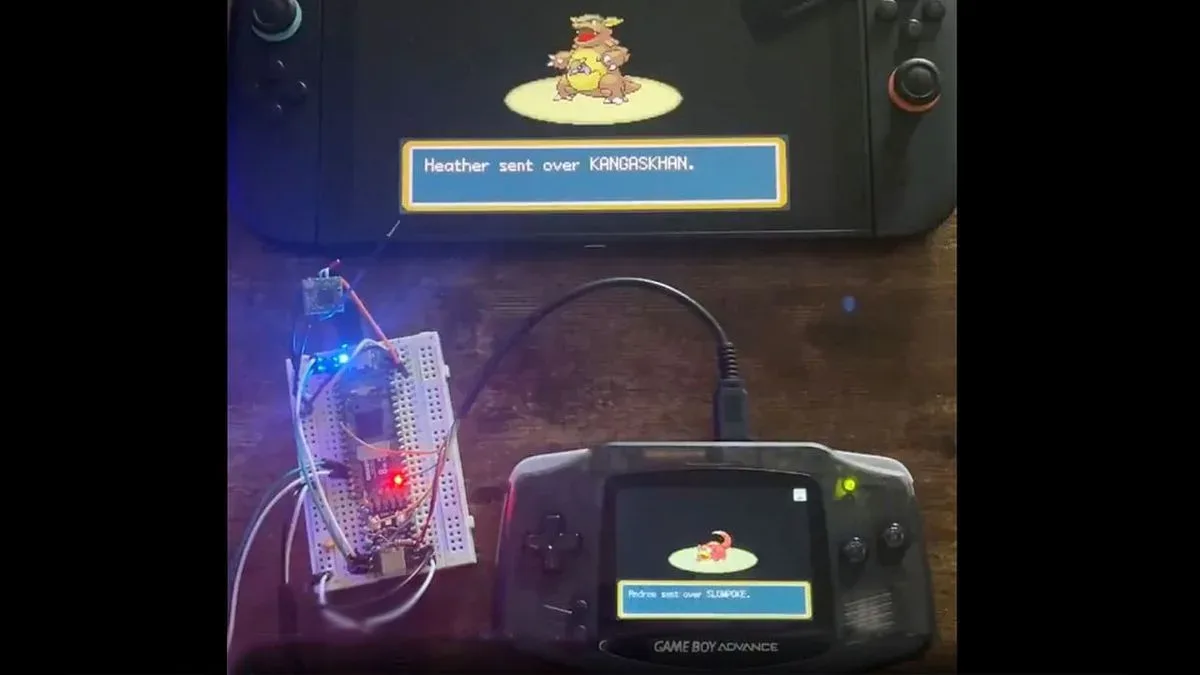
That continuity is about to face another major pressure point. Pokémon Bank is scheduled to end service on February 26, 2027, closing a key official bridge for Pokémon stored across the Nintendo 3DS era. In the shadow of that deadline, a modder and game developer known as Drewworks has shown an intriguing work-in-progress alternative: a homebrew adapter capable of making a real Game Boy Advance communicate and trade with a Switch 2.
It is not a plug-and-play replacement for the established official transfer chain, and it should not be treated as one. The project still has work ahead. But the demonstration is a fascinating reminder that preservation-minded communities do not merely collect old games; sometimes they build new paths through the gaps left behind when official services retire.
A trade across generations of Nintendo hardware
The footage shared by Drewworks shows what the project is intended to accomplish at its most basic and most astonishing: a physical GBA participating in a Pokémon trade with a modern Nintendo console. Seeing systems from such distant generations exchange creature data has the charming absurdity of watching a link cable negotiate a visa with the future.
That visual matters because Pokémon transfers are often discussed as menus, cloud boxes, and compatibility charts. At the center of those systems, though, is the personal history attached to a given Pokémon. A player may remember the cartridge it came from, the route where it was caught, the friend who traded it, or the team that carried them through a long-ago Elite Four run. When a service shutdown threatens a transfer route, players are not simply losing a feature. They may be losing confidence that those stories can continue.
Drewworks’ adapter is especially notable because it involves a real Game Boy Advance rather than only emulated software or save-file editing. That is a meaningful distinction for players who value original hardware, original cartridges, and the odd little restrictions that accompanied Pokémon’s historical transfer ecosystem. A functioning bridge from the GBA generation to a Switch-family system is the sort of engineering challenge that immediately catches the eye of both retro-game tinkerers and long-term Pokémon keepers.
Why Pokémon Bank’s end date matters
Pokémon Bank has been one of the crucial pieces of infrastructure connecting Nintendo 3DS Pokémon games to newer storage and transfer options. Its closure on February 26, 2027 will narrow the officially supported routes available to players with collections living on that hardware.
The consequences are broader than simply leaving some boxed monsters in a discontinued application. The shutdown is expected to leave five Pokémon completely unobtainable, while other Pokémon with years of player history could become effectively stranded on Nintendo 3DS systems if owners have not moved them before the service ends. Exact outcomes can depend on the Pokémon, game, prior transfer status, and compatibility rules, so players should avoid assuming that every creature follows the same path.
Related coverage includes Modder Demonstrates GBA-to-Switch Pokémon Trading Adapter Ahead of Pokémon Bank Closure.
That uncertainty is part of what makes archival planning so stressful. Pokémon’s portability has always been conditional: a creature may need to be in the right game, meet rules imposed by later generations, and pass through a sequence of services that were built years apart. When one link in that sequence disappears, a collection can go from mobile to marooned with remarkable speed.
The situation is also a useful caution for anyone who depends on legacy tools in retro gaming. Keeping the right hardware powered, maintaining data backups where appropriate, and understanding the systems one relies upon can be far more practical than assuming a cloud-connected bridge will exist forever. That same mindset applies across classic gaming setups, whether the concern is Pokémon storage or choosing between RetroArch and standalone emulators for a configuration that remains manageable over time.
An encouraging prototype, not an instant migration plan
It is tempting to look at a video of a successful cross-generation trade and declare the preservation crisis solved. That would be getting ahead of the hardware cart. The adapter shown by Drewworks remains in development, and a public demonstration does not establish a finished consumer product, broad game support, simple setup, or a risk-free method for moving a treasured collection.
There are practical barriers, too. A DIY hardware project is likely to require technical confidence, components, and patience that many players do not have. Even hobbyists comfortable with soldering, firmware, custom boards, or cartridge interfaces will want to know much more about compatibility and safeguards before using any emerging tool with irreplaceable save data.
- Compatibility: A successful demonstration does not automatically mean every GBA Pokémon title, Switch title, regional version, save state, or special case will work.
- Data integrity: A Pokémon collection can contain years of sentimental value. Players should be wary of any process that has not been thoroughly documented and independently understood.
- Legitimacy rules: Modern Pokémon software may apply validation checks to transferred data. A device communicating successfully is not by itself proof of universal acceptance throughout every current or future service.
- Availability: No general release, price, production plan, or timetable was established by the demonstration.
Those limitations do not diminish the accomplishment. They explain why it is best seen as a promising technical milestone rather than an instruction to rush out and rewire a childhood cartridge collection. Homebrew preservation thrives on experimentation, but experimentation and archival best practice are not always the same activity.
Official routes are changing, too
There is another relevant piece of the Pokémon transfer picture. The Switch versions of Pokémon FireRed and LeafGreen are set to gain Pokémon HOME compatibility in 2027. That planned support could give those particular releases an official relationship with the current cloud-storage ecosystem, though it does not erase the looming Pokémon Bank deadline or automatically provide a path for every older Pokémon held on 3DS hardware.
The distinction is important. Compatibility for Switch ports concerns those Switch releases; it is not necessarily the same thing as a complete rescue route for original Game Boy Advance cartridges or every Pokémon already parked in Bank. Players weighing their options should keep the individual platforms and services separate rather than treating any one announcement as a universal fix.
Pokémon’s history is full of these overlapping systems: old cartridges, remakes, handheld generations, online storage applications, and new console releases that arrive with their own technical assumptions. Each addition can create another opportunity for continuity, but it can also create another dependency with an expiration date. The GBA-to-Switch adapter speaks directly to the desire to make that continuity less fragile.
Preservation is personal in Pokémon
Retro preservation is sometimes framed as a battle over whether old games can still be played. Pokémon adds a more personal wrinkle: whether the things players caught in those games can still travel. A cartridge may be preserved on a shelf, a ROM may be archived, and a console may be repaired, yet a particular trained Pokémon can still be trapped behind a retired service.
That helps explain the interest around Drewworks’ prototype. It is not merely an impressive cable trick. It represents a possible future in which enthusiast-made tools help players maintain access to histories that official platforms no longer support. There is a long road between a working demo and a dependable community solution, but the idea has obvious appeal.
For now, Pokémon owners with important 3DS-era collections should treat the February 26, 2027 Bank closure as a real deadline, investigate the official options available to their specific games, and avoid putting irreplaceable data at risk on unproven methods. Meanwhile, the adapter demonstration offers a welcome glimpse of the ingenuity that tends to appear whenever old hardware is told its journey is over. In Pokémon, someone usually finds another route through the tall grass.