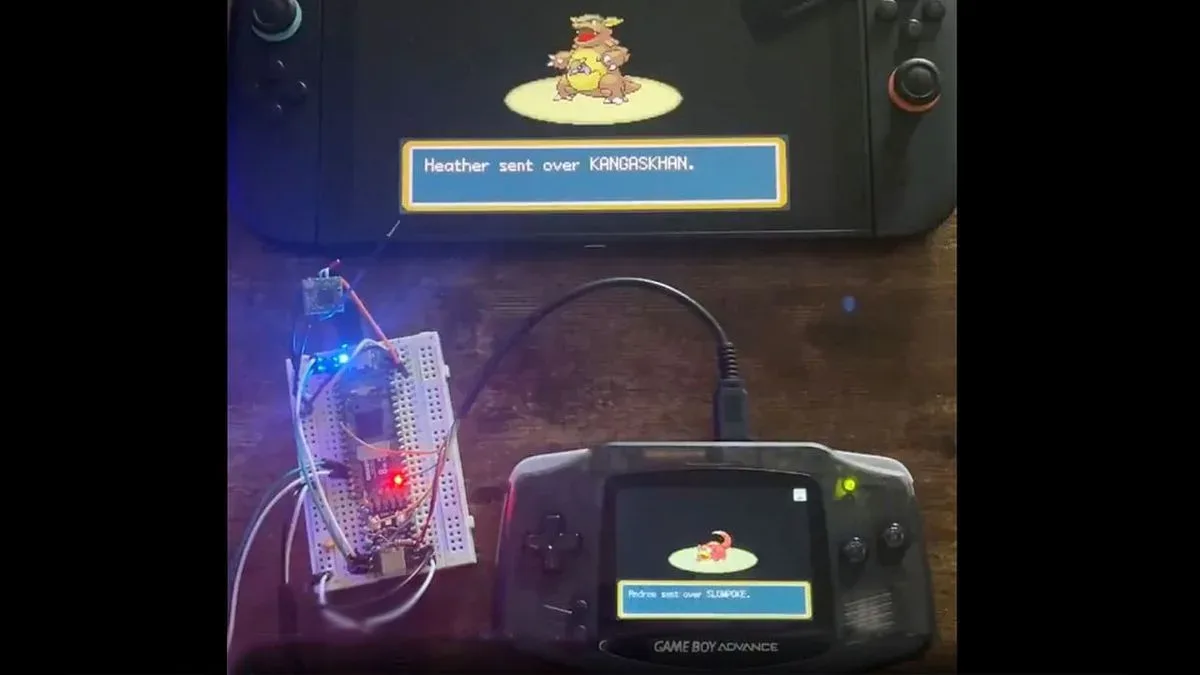
A Game Boy Advance launched in 2001. Nintendo’s newer hybrid hardware belongs to a very different era. Yet a work-in-progress adapter credited to Drewworks is demonstrating a remarkably odd, delightful connection between those generations: Pokémon caught in Game Boy Advance titles can be traded onward toward Pokémon Home through the newer Switch-era setup.
The project is not a consumer-ready cable, not a polished retail accessory, and not something owners should expect to plug in and use without further work. That distinction matters. Still, the early result is exciting precisely because it bridges a gap that normally feels permanent. A cartridge-era handheld and a modern Nintendo platform are being made to communicate for a purpose that has always sat at the center of the series: moving beloved Pokémon forward.
For collectors, preservation-minded players, and anyone with a save file full of creatures caught two decades ago, the appeal is obvious. The hardware may be old, the connectors may be inconvenient, and the current device may look more like an exposed prototype than an accessory destined for a display shelf. But it points at a future in which a Game Boy Advance cartridge is not merely an artifact to admire. It can remain part of an active Pokémon journey.
What Drewworks’ adapter is shown to do
Drewworks has shared work on an adapter intended to link Game Boy Advance Pokémon games to the modern Pokémon ecosystem. The demonstrated goal is to trade Pokémon from Game Boy Advance releases including Pokémon Ruby, Sapphire, and Emerald toward Pokémon Home. Pokémon FireRed and LeafGreen may also be supported, though that part remains uncertain rather than confirmed.
That wording is important because the project is still developing. It should be treated as a promising prototype, not as a finished migration method with a guaranteed compatibility list. There is no basis yet to assume that every cartridge revision, save condition, creature, regional format, or transfer scenario will behave identically. Nor is there any reason to presume an eventual public release, a price, or a particular final form.
Even with those caveats, the core demonstration is substantial. Pokémon on a Game Boy Advance save were built around the link-cable world: two handhelds, physical proximity, and a process that could feel both magical and temperamental. Seeing that lineage reach a current platform makes the old hardware seem less isolated.
Why the timing matters for long-term Pokémon saves
The effort arrives as Pokémon players look more closely at the paths that connect older games to newer storage and services. Pokémon Bank is stated to be shutting down next year, placing additional attention on what options remain for players who want to preserve or migrate creatures from earlier generations. A project like this does not erase the practical questions around official services, compatibility, or the eventual destination of transferred Pokémon. It does, however, show that enthusiasts are still exploring alternatives where official bridges are limited, aging, or nearing a deadline.
That is especially meaningful for Game Boy Advance-era games. Ruby, Sapphire, Emerald, FireRed, and LeafGreen are not simply old entries in a long-running RPG series. For many people, they hold original teams, event memories, childhood catches, breeding projects, and creatures carried across several machines. In Pokémon terms, a save file can become a tiny time capsule with a surprisingly large emotional payload.
The technical challenge is only one part of the appeal. The bigger idea is continuity. If a Pokémon caught on a 2000s cartridge can still participate in a contemporary storage ecosystem, the cartridge gains a role beyond nostalgia. It becomes a living beginning point rather than a closed chapter.
A prototype is a proof of concept, not a shopping recommendation
It is tempting to see a video of a successful trade and jump straight to the useful question: where can I get one? At this stage, that is the wrong question. The device is visibly unfinished, and its creator acknowledges that more development is needed. Its current appearance is closer to exposed computer hardware than a tidy, molded link cable. That is not a criticism; prototypes are supposed to prioritize making the impossible work before making it look effortless.
Anyone interested in the project should also resist filling in blanks. The available information supports a demonstration involving Game Boy Advance Pokémon games and Pokémon Home, plus possible FireRed/LeafGreen compatibility. It does not establish universal support across the Game Boy, Game Boy Color, Nintendo DS, 3DS, or every Switch and Switch 2 configuration. It also does not establish what setup steps, additional hardware, software, account requirements, or save restrictions might apply.
That cautious approach is valuable across retro hardware. Before trying any modern connection solution, it pays to identify exactly which console, port, cable standard, display, or software path is involved. The same basic principle appears in this guide to mapping a retro console connection before buying an HDMI adapter: determine the actual chain before treating an accessory as a universal answer. A Game Boy Advance-to-modern-Pokémon link is considerably more specialized than video output, but the discipline is the same.
The link-cable spirit survives
There is a fitting historical symmetry here. Pokémon trading helped turn the Game Boy link cable into more than a peripheral. It was an invitation to meet up, negotiate, make a risky trade, fill a Pokédex entry, or briefly panic when the transfer appeared to stall. The equipment could be finicky, but the social ritual was part of its charm.
Modern players may remember those moments fondly while also remembering the troubleshooting: uncertain cable seating, mismatched game progress, battery worries, and the universal belief that moving the handheld slightly would somehow ruin everything. A modern bridge may be much more technically ambitious, but it preserves the same essential premise. One device reaches toward another so that a Pokémon can keep moving.
It also fits neatly with the broader culture of couch multiplayer and shared hardware rituals. The fun was never solely in the data transfer; it was in the ceremony around it, from deciding who went first to loudly blaming the cable when something failed. For a humorous refresher on that familiar territory, see the unwritten rules of couch multiplayer.
Part of a growing retro-hardware conversation
Drewworks’ work follows another notable connector experiment from earlier in the year: Robert Dale Smith’s controller link cable project. The two efforts are not the same, but together they underline the creative momentum around retro Nintendo hardware. Each experiment answers one question while encouraging ten more. Can older machines communicate with newer ones? Can original controls work in new contexts? Can legacy formats be preserved without pretending their limitations never existed?
Projects like these are often most valuable before they become products. A successful prototype establishes that an idea is feasible. It gives other tinkerers a reference point, sparks discussion around methods and limitations, and may inspire different approaches to a problem. In the retro gaming space, that sort of visible experimentation can matter as much as a finished box on a store shelf.
There is also a healthy tension in keeping expectations grounded. The original Game Boy Advance experience should not be reduced to a pipeline for modern storage, and a prototype should not be treated as an official replacement for established transfer methods. But players should be allowed to appreciate the technical and historical novelty of the bridge. It connects systems separated by more than two decades without pretending that their differences do not exist.
A fascinating route, with more work ahead
For now, the clearest takeaway is simple: the Game Boy Advance and newer Switch-era hardware have been made to communicate in a way that can move Pokémon from Ruby, Sapphire, and Emerald toward Pokémon Home. Possible support for FireRed and LeafGreen remains a possibility rather than a settled promise. The adapter is unfinished, its design is still rough, and its wider availability and final capabilities are unknown.
That is plenty to be excited about anyway. Retro gaming thrives on the moment someone looks at two pieces of hardware separated by generations and refuses to accept that they must stay strangers. This adapter does not merely connect ports. It reconnects an old cartridge library with the possibility of an ongoing Pokémon story—one trade at a time.