Sony has published a patent describing a frame-generation technique that could give a future PlayStation system its own approach to creating extra images between traditionally rendered frames. The filing, titled Generation Super Sampling and identified as US-20260320740-A1, outlines a familiar broad idea with an important possible addition: using controller-input data as part of the prediction process.
That distinction matters because frame generation is not simply a free performance switch. It can make motion appear smoother, but it also raises difficult questions about responsiveness, image artifacts and whether players can choose when it is active. A model that knows what a player is asking the game to do could, in theory, make a generated image better anticipate imminent movement than one working from rendered images and engine-provided motion information alone.
There is one major caveat before putting a “PlayStation 6 feature” label on the technology: this is a patent, not a product announcement or a specification sheet. Patent filings can describe experiments, alternatives and long-term ideas that never appear in a retail console. Sony’s work nevertheless provides a useful look at one possible direction for its next-generation graphics strategy.
What frame generation actually does
A game normally renders each displayed frame itself. If it renders 30 frames per second, the screen receives 30 game-rendered images every second. Frame generation adds synthetic, or interpolated, images between those rendered frames. Rather than asking the game to fully draw every additional image, a model studies available visual and motion data and estimates what an in-between moment should look like.
The appeal is clear. Rendering a game scene is costly: lighting, geometry, effects and other visual work all need processing resources. Generating an intermediate image can increase apparent smoothness without requiring the game to render every displayed frame conventionally. But it is an estimate, not a complete replacement for rendering. The quality of that estimate depends on the input data, the scene and the model’s ability to understand what is moving and how it should move.
That is why frame generation is often discussed alongside two separate measures of performance:
- Rendered frame rate: how many frames the game itself produces.
- Displayed frame rate: how many frames reach the display after generated frames are inserted.
Those figures can differ substantially. A higher displayed rate may improve the perceived flow of motion, while the underlying rendered frame rate remains important for the game’s base responsiveness and for the amount of reliable visual information available to the generation system.
The patent’s distinctive idea: incorporate controller input
The filing describes generating an interpolated frame using information from a conventionally rendered frame. In that basic respect, it belongs to the same general family as frame-generation methods already established in games. Its notable proposal is to feed controller data into the prediction process as well.
Related coverage includes Sony Patent Describes Controller-Aware Frame Generation for a Future PlayStation System.
Conventional frame generation can use rendered images and motion vectors supplied by a game engine. A motion vector is data that indicates how a point or object is expected to move from one frame to another. It gives a reconstruction or generation system a more direct clue than pixels alone. If a character, camera or object is moving, those vectors can help estimate where visual details should appear in an inserted frame.
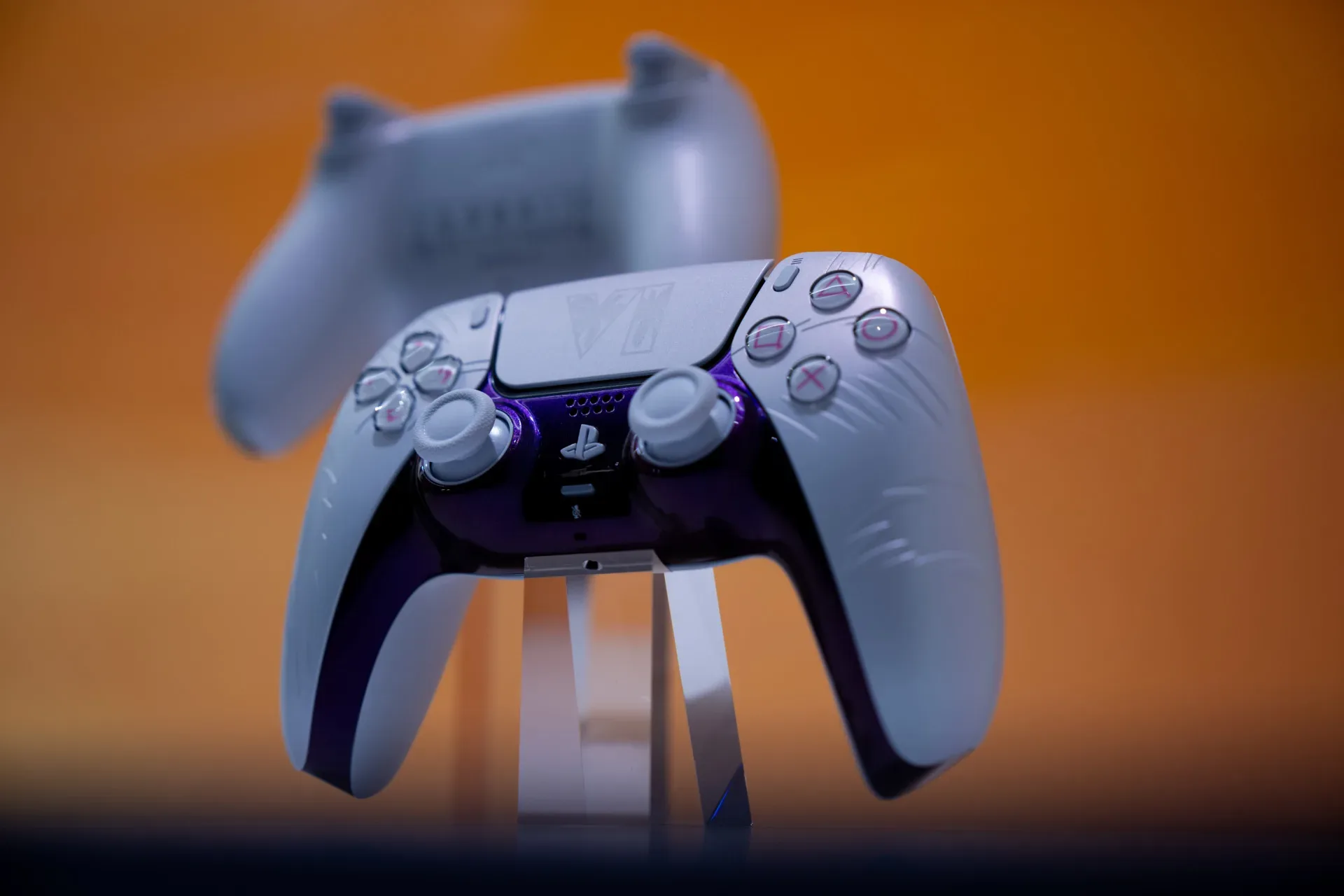
Controller input could supply another kind of clue: player intent. A stick movement, button press or other input can precede a visible change in the game world. By incorporating that information, the proposed system could potentially make a more informed prediction of camera or character movement during the interval between rendered frames.
The filing’s stated aim is to reduce latency or frame-to-frame hitching. Latency is the delay between a player action and its visible result. Hitching refers to uneven or disrupted frame delivery that makes motion feel less consistent. They are related to a player’s experience but are not identical problems: a game can feel delayed without severe stutter, and it can stutter despite relatively direct input response.
In practical terms, controller-aware generation is interesting because it acknowledges a core limitation of purely visual prediction. An image model can infer where something has been heading, but it cannot necessarily know that a player is about to sharply alter direction. Input data might make that prediction more timely. Whether it can do so well enough to produce a tangible advantage would depend on an eventual implementation, game integration and the kind of action taking place on screen.
Why responsiveness is the central question
Frame generation can make output look smoother while still introducing trade-offs. Generated frames require time to analyze available information and produce a prediction. If the base game is already running at a very low frame rate, inserting synthetic images does not automatically solve the fundamental delay before a newly rendered frame arrives.
That distinction is especially important on a console, where players may expect a straightforward experience rather than a collection of technical toggles and compromises. A frame-generation mode may be useful when it builds on a solid rendered performance level. It is more concerning if it is used to present a higher headline frame rate while the game’s conventional performance is too low to deliver responsive control.
The patent does not establish how Sony would expose the technology to players, whether developers could require it, or whether it would be optional on a game-by-game basis. Those policy and interface decisions could prove as meaningful as the algorithm itself. A clear toggle, sensible defaults and honest presentation of performance modes would give players more control over the balance between image fluidity and response.
Players who favour fast reactions may prioritize native rendering performance. Others may value the smoother appearance produced by inserted frames, particularly in slower-paced games. The point is not that one preference is universally correct; it is that a feature built around prediction should ideally be presented as a choice with understandable consequences.
Multi-frame generation is mentioned, but its use on TVs is less obvious
The patent also leaves room for predicting more than the immediate next image. Its language says a decoder system may be trained to predict any number of images before or after an input image. That opens the possibility of multi-frame generation, in which more than one generated image is inserted between conventionally rendered frames.
Multi-frame generation reached PC gaming with the RTX 5090 in 2025. Its usefulness is easiest to understand in environments with very high-refresh-rate displays, such as gaming monitors operating at 144Hz or above. More generated images can help fill those rapid refresh cycles, assuming the overall pipeline has enough performance and the visual compromises remain acceptable.
The case is less immediately compelling for a living-room console connected to a television. TVs that support higher refresh rates are limited to 120Hz, which places a practical ceiling on how much additional display output can be used. That does not make multi-frame capability meaningless; a future system could support a range of displays and output scenarios. Still, the patent’s inclusion of the concept should not be read as evidence that it would be a defining console feature.
More broadly, patent language commonly covers multiple possible embodiments. Mentioning an option means it is under consideration in the intellectual-property design, not that every version would ship or that a consumer device would expose every mode.
Artifacts remain part of the equation
The other recurring challenge with generated images is the possibility of visual artifacts. Because an interpolated frame is predicted rather than fully rendered by the game, difficult motion can produce errors: details may look unstable, objects may appear distorted, or fast changes may not be represented cleanly. A model may have more trouble where the visual information is ambiguous or where movement changes suddenly.
Controller-aware input is potentially relevant here as well. If player intent gives the model advance warning of a camera turn or directional change, it may help the system choose a more plausible in-between image. That is an inference from the proposed design, not proof of a finished result. The patent describes an approach; it does not provide consumer-facing demonstrations or evidence of how it would perform across different games.
It also would not eliminate the need for a game’s own rendering pipeline to be well optimized. Generated frames can complement rendering work, but they cannot guarantee that every scene, input pattern or visual effect will behave perfectly. The strongest outcome would be a system that developers use to enhance a healthy baseline rather than conceal an unhealthy one.
What this says—and does not say—about PlayStation’s future
The filing joins other recent Sony patent activity that has described an AI agent intended to monitor a system and deploy fixes before the user notices a problem, as well as an NFC reader in a PlayStation controller for tap-to-pay functionality. Together, those documents suggest the company is examining a broad collection of ideas around future hardware, system software and controllers.
They do not confirm a release window, final features or even the existence of a particular shipping configuration. The safest reading is narrower: Sony has documented a controller-aware frame-generation concept that could be relevant to a future PlayStation platform.
For players, the most meaningful questions would come later. Can the feature be disabled? What rendered performance does a game need before it is enabled? How clearly will games communicate the trade-off between response and smoothness? And how consistent will results be across genres and displays?
Those questions fit into a larger conversation about what consoles should promise when they offer increasingly sophisticated rendering techniques. As debates over player choice and platform expectations continue, digital game ownership needs more than a storefront promise—and similarly, a performance feature needs more than an impressive technical label. It needs transparent implementation that respects how people actually play.
For now, Generation Super Sampling is an intriguing patent rather than a PlayStation 6 confirmation. Its controller-input angle is the key detail to watch: it proposes that the system should not only study what the game has shown, but also consider what the player has just asked it to do.