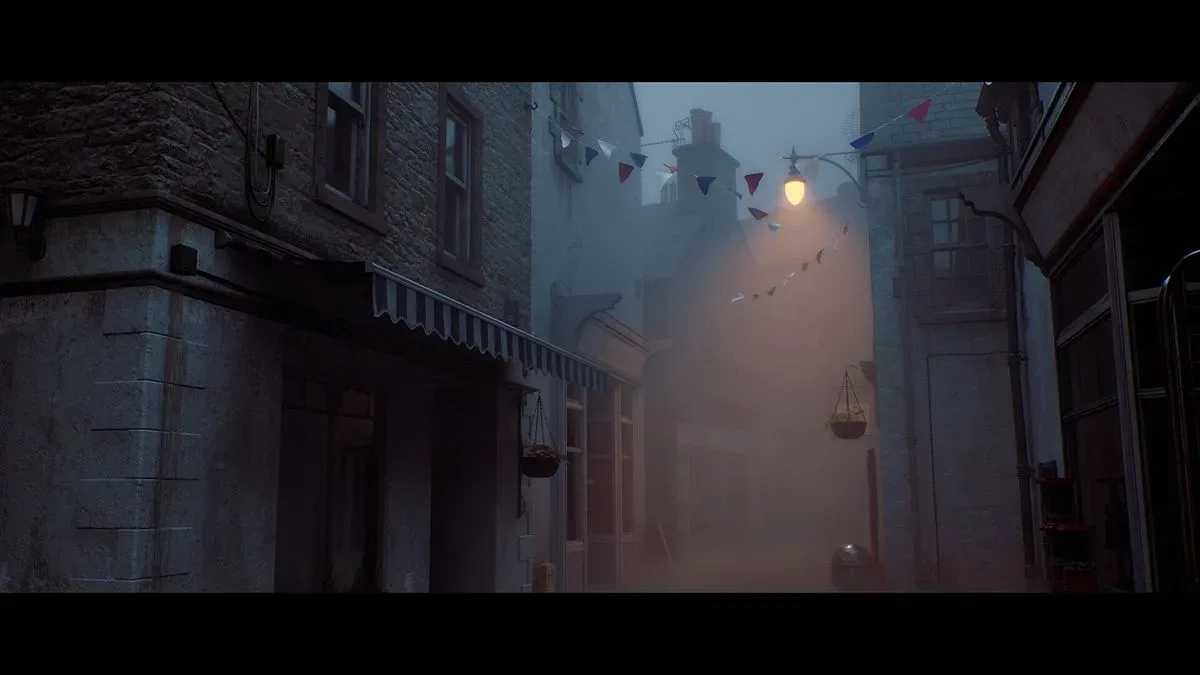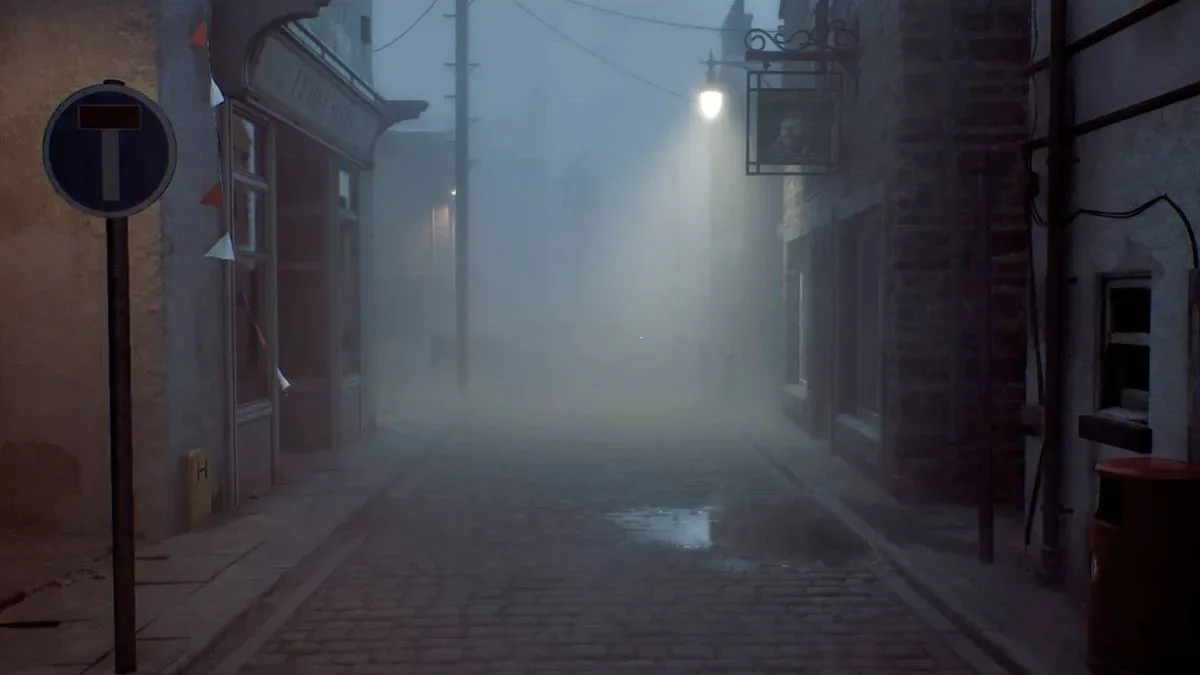
Silent Hill: Townfall appears to understand a fundamental truth of the series: the most alarming room is often the one that looks completely ordinary, until you realize it has been waiting for you to notice what is wrong. Its setting, St Amelia, is built around that uneasy recognition. The island town is steeped in grey fog, cramped cobbled streets, dim apartment lights, soggy boardwalks and the kind of coastal chill that makes every telephone box look like it contains either a lifesaving clue or a terrible decision.
The town’s visual language is strongly British and seemingly informed by Scotland, even if the game does not explicitly label St Amelia as Scottish. That ambiguity serves the premise. It is not a postcard version of a real place; it is a distorted, isolated town that feels credible enough to make its emptiness unsettling. The streets look as though everyone disappeared in the middle of a routine evening. Lights remain on. Buildings stand intact. Fog fills the gaps between structures. Yet no one is there to explain why.
Screen Burn Interactive’s game is scheduled for September 24, 2026, on PlayStation 5, PC and Xbox Series X/S. Its Gamescom 2026 demo suggests a project with an impressively committed atmosphere and a potentially intriguing set of analog-era puzzle tools. It also suggests that Townfall’s deliberately patient horror could be difficult to communicate in a tightly controlled preview slice, especially when its first stretch keeps the player at a considerable distance from danger.
St Amelia is doing the heavy lifting, and doing it well
Townfall places players in a first-person perspective, a notable choice for this branch of Silent Hill. The franchise has experimented with viewpoints across its history, and the more recent Silent Hill: The Short Message also used first-person play on PS5. Here, that camera angle seems designed to make St Amelia feel immediate and claustrophobic. There is no detached view over a character’s shoulder to soften the sense of inhabiting an abandoned street. You are simply in it, looking at fog, locked routes and decaying traces of other lives.
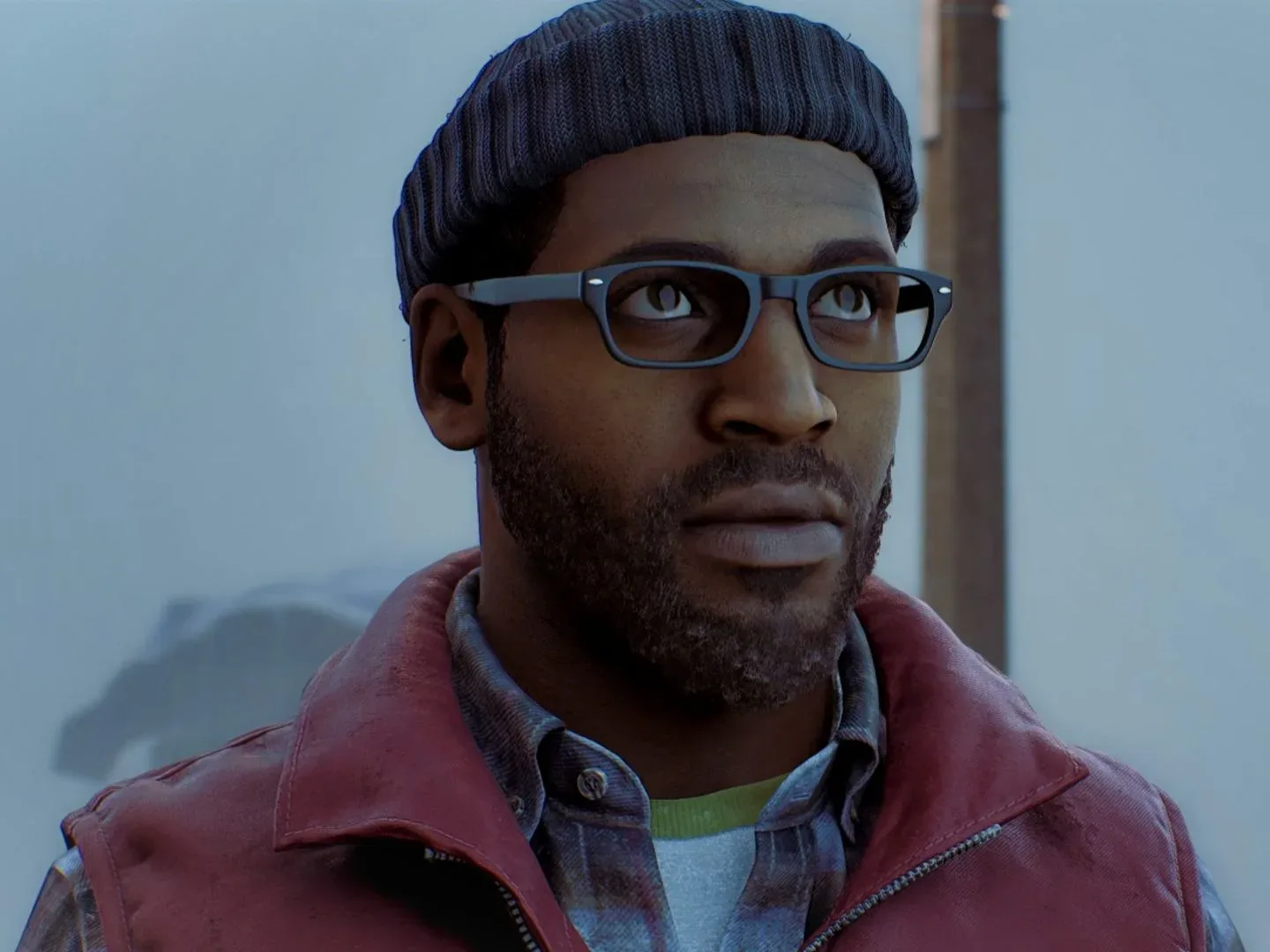
The protagonist begins with amnesia and a hospital bracelet, an introduction that places familiar Silent Hill ideas on the table without immediately spelling out their purpose. Memory, guilt, identity and unreliable perception have long been central ingredients in the series’ particular brand of dread. A hospital bracelet is not subtle, but Silent Hill has never been embarrassed by an ominous prop. Put one on an amnesiac in an empty town and the audience is entitled to start mentally pinning red string across a corkboard.
The environment reportedly rewards close observation more than forward momentum during the demo’s early section. Leaflets, notes in a doctor’s window and information boards overlooking the water all contribute small pieces of local texture. That approach has obvious appeal for players who enjoy the series’ environmental storytelling: the sense that a place can disclose its history through discarded paperwork, public notices and details that may not become meaningful until much later.
There is a difference, though, between making a player feel like an investigator and making them feel stranded in a museum after closing time. Townfall’s early presentation seems to press against that boundary. St Amelia has the look of a richly haunted place, but the demo apparently offers limited opportunities to engage with it beyond reading and walking. Its oppressive mood lands; the question is whether the full game supplies enough agency, discovery and escalation to turn that mood into sustained tension.
A slow burn needs something to catch fire
The most significant concern raised by the showing is pace. Roughly 70 minutes of the demo reportedly consisted largely of traversal and cinematics, with no enemy encounter visible during that time. Holding monsters back can be smart horror design. An unseen threat is often more powerful than a creature placed directly in front of the player, and Silent Hill’s best scares have never depended solely on combat. Sound, implication and the suspicion that reality has developed a personal grudge are all part of its toolkit.
But delayed confrontation has to create anticipation rather than impatience. If players repeatedly explore the apparent edges of an area and find little response, the atmosphere risks becoming static. The fog stops being a hiding place for possibilities and becomes an excuse for another five minutes of heading down a street that does not lead anywhere useful. A vertical slice faces an especially hard version of this problem: it has to preserve the game’s intended rhythm while still providing enough material to show why that rhythm will pay off.
A telephone box sequence illustrates the tension between Townfall’s ideas and its onboarding. The phone rings, but initially there is nobody on the other end. A short directory includes the phrase save yourself, which points toward a number that must be entered to save progress and trigger a cinematic. It is a wonderfully appropriate Silent Hill concept: an old public telephone converted into a strange ritualistic interface, with saving itself becoming part of the fiction rather than a menu interruption.
Yet the clue is easy to miss. That can produce a period of retracing steps through an area where there may be nothing new to find. Obscure puzzle logic is another old Silent Hill tradition, of course, but there is a fine line between cryptic and invisible. The full release may provide clearer contextual nudges or make the search more rewarding. In the demo, however, the sequence reportedly could make forward progress feel less like a discovery and more like an accidental code-entry exam.
Preview environments are uniquely hostile to games built around isolation. A crowded convention floor is not an ideal setting for a title whose terror depends on quiet, abandonment and slow immersion. That does not erase concerns about the demo’s long opening, but it is important context. A home session with headphones, no time limit and fewer nearby distractions may allow St Amelia’s details to settle in differently. Horror pacing is fragile; it is notoriously hard to judge when the real world is full of queues, chatter and somebody loudly explaining a controller layout two stations away.
Questions about how game settings create immersion extend well beyond traditional horror. Recent discussion around immersive storytelling and shared spaces underscores how much a player’s physical context can affect an experience intended to make a world feel present.
The radio is Townfall’s most promising signal
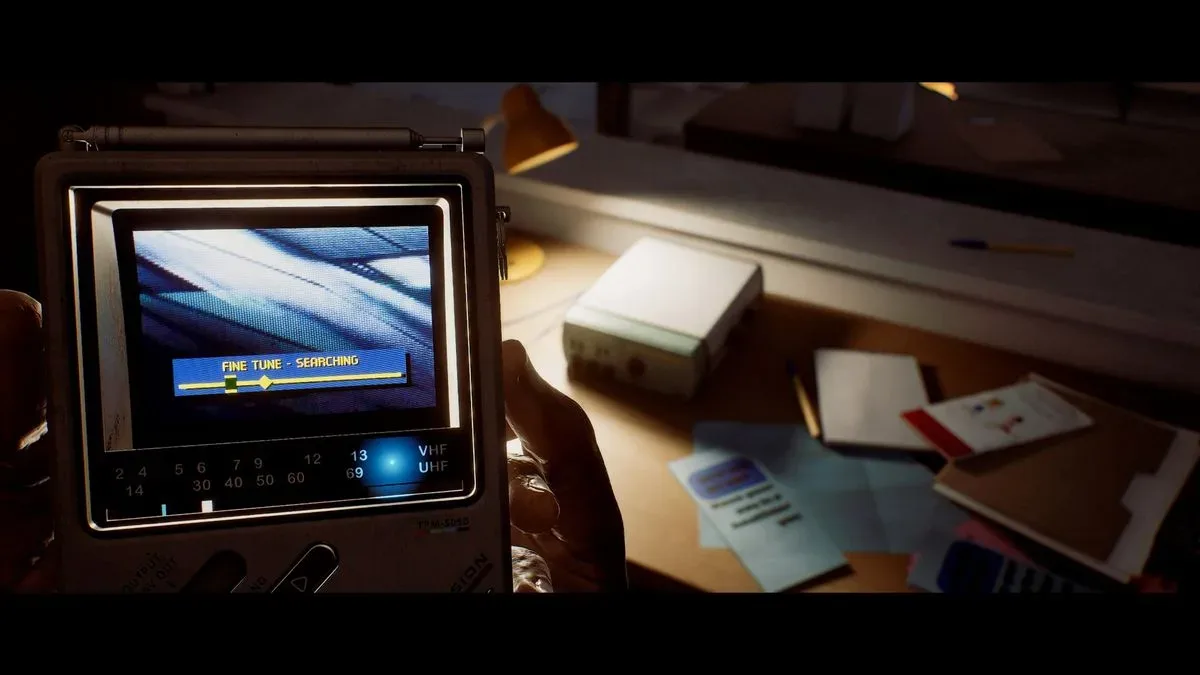
Townfall’s strongest mechanical idea in the demo is its use of a portable radio-like device. The story takes place in the mid-1990s, and Screen Burn is leaning into analog technology rather than treating that period as decorative wallpaper. Players tune the device to individual frequencies, potentially receiving audio fragments that hint at puzzle solutions. The signals may represent the past, the present or something less easily categorized, which is exactly the kind of uncertainty Silent Hill can use to make an ordinary tool feel spiritually unsafe.
The same device can apparently reveal static-filled impressions of nearby enemies on its small display. That is a great fit for the franchise’s traditions. Rather than granting clean supernatural vision, it provides incomplete information: outlines, interference and a warning that does not necessarily tell you what is actually coming. It also makes the act of looking at the screen a choice. A player can seek reassurance from the device, only to receive a more disturbing confirmation that something is near.
The complication is that the demo did not seem to let this enemy-detection feature fully demonstrate its value. The device may show signs of threats, but if the threats themselves remain distant or absent for the length of a preview, players are left waiting for the mechanics to graduate from promise to pressure. The radio has the ingredients for an excellent loop: tune, interpret, doubt, advance, and regret advancing. Townfall simply needs to give that loop enough opportunities to matter.
What Townfall still has to prove
Nothing about the reported slow opening rules out a strong final game. Some of the most memorable horror games start quietly, and Silent Hill is not supposed to play like a sprint through a haunted obstacle course. Its worlds are often mournful before they are openly hostile. St Amelia already seems to have the visual identity needed to support that tone, and the first-person viewpoint plus period-specific radio mechanics could distinguish Townfall from other entries in the broader franchise.
Still, players will need more than beautifully arranged decay. The release will have to show that its puzzles can feel satisfyingly strange instead of merely opaque, that its exploration has meaningful returns, and that its withheld monsters become a source of mounting terror rather than an item on a checklist. The game’s initial demo has established a town worth worrying about. Its next task is making players feel that the town is worrying about them.
That measured design goal is almost the inverse of the immediate chaos valued in local competitive games, where every rule must be understandable before someone claims the good controller. For a reminder of that entirely different social contract, see the unwritten rules of couch multiplayer. St Amelia, mercifully, looks like a place where nobody will ask you to pass the second controller.
For now, Silent Hill: Townfall looks encouraging in its setting, art direction and use of analog unease. Whether its slow-build approach becomes elegantly unbearable or simply too restrained will be clearer when players can spend more than a single demo session inside its fog.