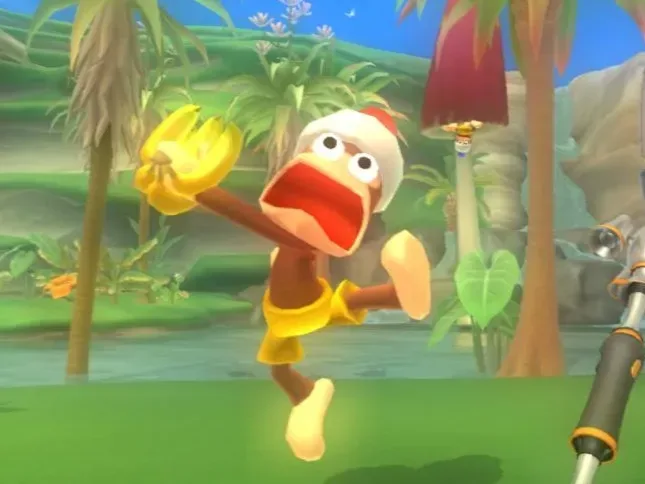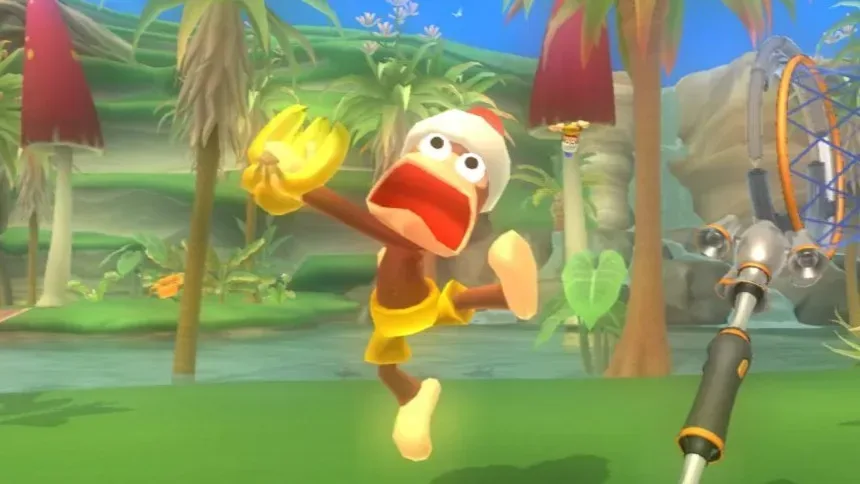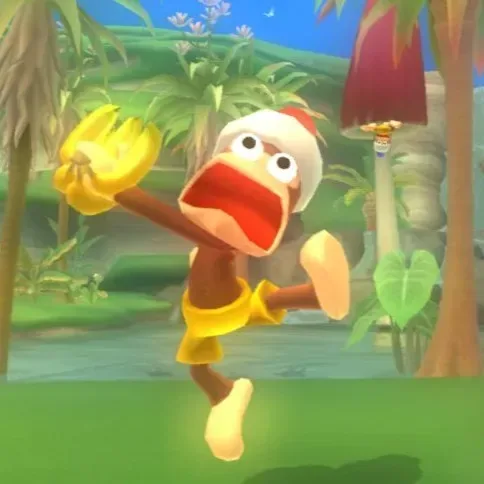
Ape Escape may finally be preparing to break out of its long cage. A new report indicates that an entry in Sony’s dormant monkey-chasing series is in development, with Evening Star—the studio associated with Sonic Mania and Penny’s Big Breakaway—reportedly attached.
There is one giant banana peel of a caveat: this is not an official announcement. Sony has not confirmed an Ape Escape project, a developer, platforms, a release window, or even the basic shape of a potential game. The information is still best understood as a report about an early project rather than evidence of a game ready to be shown.
That distinction matters especially here. The reporting suggests the game was only barely approved and getting started when the information was initially heard. It was also characterized as not especially close to release. In other words, Ape Escape fans have a plausible reason to pay attention, but not a reason to start practicing their net-swinging reflexes for a launch date.
What the report says
The current claim centers on two connected ideas: that a new Ape Escape is being made, and that Evening Star is the external studio working on it. The suggestion has received some corroboration, but the account also openly notes that it is not the most extensively multi-sourced report. That degree of uncertainty should remain attached to every detail, including Evening Star’s involvement.
The project is reportedly not being handled by Team Asobi, despite immediate speculation connecting the series to the studio behind Astro Bot. Instead, the understanding is that Sony has assigned the work to an outside team. Evening Star is the name linked to that role because of its work on Penny’s Big Breakaway and, notably, Sonic Mania.
External studio means a developer outside the platform holder’s own internal studio group. That is different from a first-party team: a studio directly owned by the company publishing or licensing the game. Under this reported arrangement, Sony would retain the Ape Escape property while another developer builds a new installment under license or partnership. It is a familiar structural possibility for a company with a large back catalogue, though Sony has not publicly confirmed such a strategy in this case.
Why Evening Star is a notable name
Evening Star’s connection makes the rumor more interesting than a bare mention of an unnamed contractor. Sonic Mania was widely praised as a successful return for a long-running platforming franchise. That history naturally creates a compelling comparison point: a studio that has worked on a celebrated revival of one beloved mascot series could be a logical candidate for another.
Still, that comparison should not become a promise. Ape Escape and Sonic are distinct series, and the report does not identify any mechanics, visual style, scope, creative leads, or design goals for a new Ape Escape. Evening Star also developed Penny’s Big Breakaway, which received a more mixed response than Sonic Mania. The available record therefore supports recognition of the studio’s experience, not a prediction about how a hypothetical Ape Escape game would play or be received.
Related coverage includes Ape Escape Revival Reportedly in Development at Evening Star.
For fans, the most sensible takeaway is that Evening Star has a resume relevant to the challenge of revisiting an established character-driven game. A revival needs to recognize why the original was remembered while still giving a contemporary audience a reason to care. But whether this alleged project is a faithful continuation, a reset, or something else entirely remains unknown.
A series with a long gap behind it
The reported revival would be a major return for Ape Escape. The last release in the series was PlayStation Move Ape Escape for PlayStation 3 in 2010. The last mainline entry was Ape Escape 3, released for PlayStation 2 five years before that.
That makes the rumored project notable not only as a potential new game, but as a possible effort to reintroduce a series that has been absent for years. Long-running properties can retain recognition even when they have not had a recent mainline release, but the length of the hiatus also means Sony and any development partner would face basic unanswered questions: Who is the new game for? How closely should it follow the older entries? And what is the role of a classic PlayStation series in a current catalogue?
The report does not answer those questions. It does, however, frame Ape Escape as part of a wider possibility: Sony may be exploring the use of third-party developers to bring dormant franchises back across its portfolio. “Dormant” in this context simply means a property that has not received a new major installment for a substantial period. Licensing such a series to an external team could allow a platform holder to revisit more of its archive without requiring every project to come from an internal studio.
What a third-party revival strategy could mean
The notion of outside teams working with older PlayStation properties is still unconfirmed, but it is worth separating the potential business model from the specific Ape Escape rumor. A third-party licensing strategy would not necessarily mean every revival is outsourced, nor would it mean the original owners have stepped away from creative oversight. It would mean outside developers could potentially take on selected projects tied to Sony-owned franchises.
That approach can be particularly relevant for series that have a devoted audience but have not been an active priority for years. An external developer with a fitting specialty could provide focus without assuming that the game needs the scale of a flagship internal production. The practical appeal is straightforward: more dormant brands could potentially be explored, while internal studios remain committed to their own projects.
At the same time, nothing in the reporting establishes which franchises might be considered, how far such a plan has progressed, or whether every rumored project is related to one unified initiative. Killzone has also recently been the subject of revival rumors, although its historical association with Guerrilla Games makes it a different case from an alleged external Ape Escape production.
Anyone watching the broader business side of games can also see how projects are often described through their technical or production ambitions, as with Assetto Corsa EVO’s reported 1:1 free-roam recreation plans. The Ape Escape report is much less specific: there are no claimed features, no stated technical targets, and no confirmed platform plan. Its significance rests on the potential return of the franchise and the reported choice of developer, not on an announced design pitch.
What has not been confirmed
It is easy for an early rumor to acquire extra details as it travels. For now, the list of unknowns is much longer than the list of reported facts:
- No official confirmation from Sony has been provided.
- No title, release date, window, platforms, trailer, or screenshots have been announced.
- No gameplay details or story information have been reported.
- Evening Star’s role has not been publicly confirmed.
- There is no confirmation that Team Asobi is involved.
- There is no confirmed public roadmap for a wider Sony dormant-franchise revival effort.
That uncertainty should temper both enthusiasm and concern. A project at the very beginning of development can change substantially, and a report about early approval is not the same thing as a guaranteed release. Until Sony or Evening Star speaks publicly, it is not possible to say whether the project will be announced, when it might appear, or whether the reported arrangement will remain intact.
Why the rumor still matters
Despite all of those limits, the report has genuine interest for PlayStation history and for fans who have waited since the PlayStation 3 era for a new Ape Escape release. The series’ last mainline game belongs to the PlayStation 2 generation, while its most recent release arrived in 2010. A credible suggestion that Sony may be revisiting it is therefore more meaningful than ordinary background chatter.
The Evening Star angle adds a second point of interest. The studio’s work on Sonic Mania provides a clear example of a developer contributing to a well-regarded return for an established platforming property. It does not tell us what a new Ape Escape would be, but it gives the rumor a tangible creative hook.
For now, the appropriate status is simple: possible, early, and unannounced. Ape Escape may be on its way back, and Evening Star may be the team opening the cage door. Until either party confirms it, though, the story remains a report rather than a finished catch.