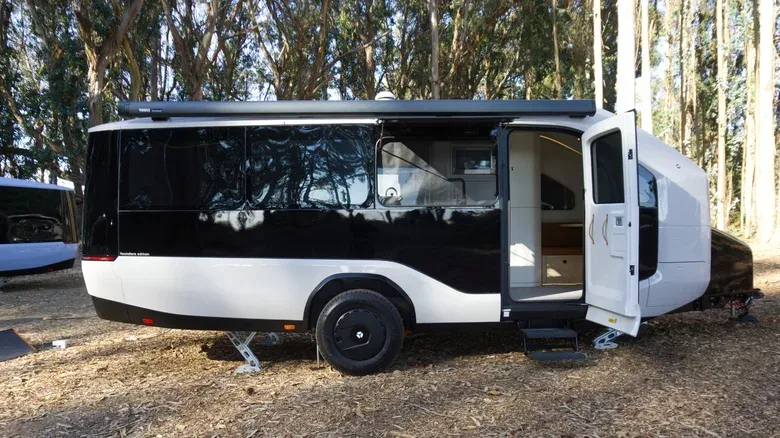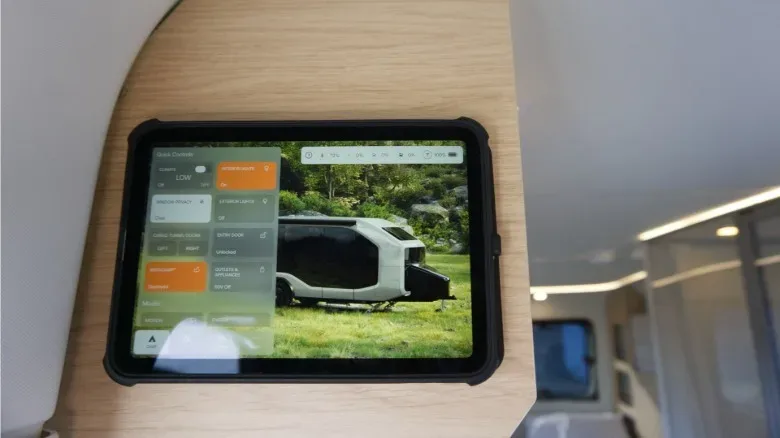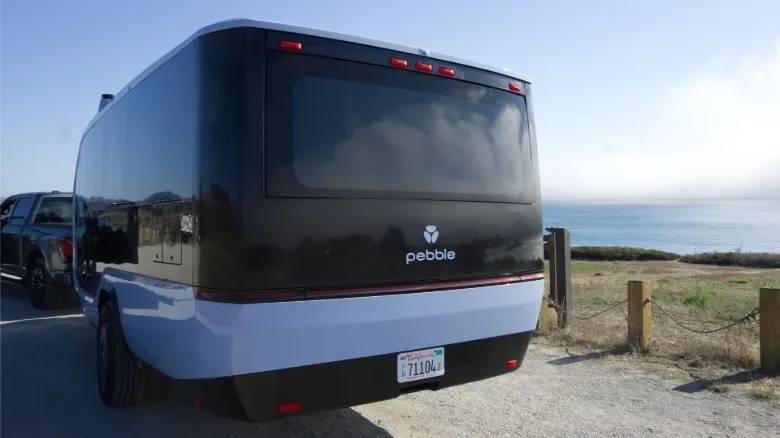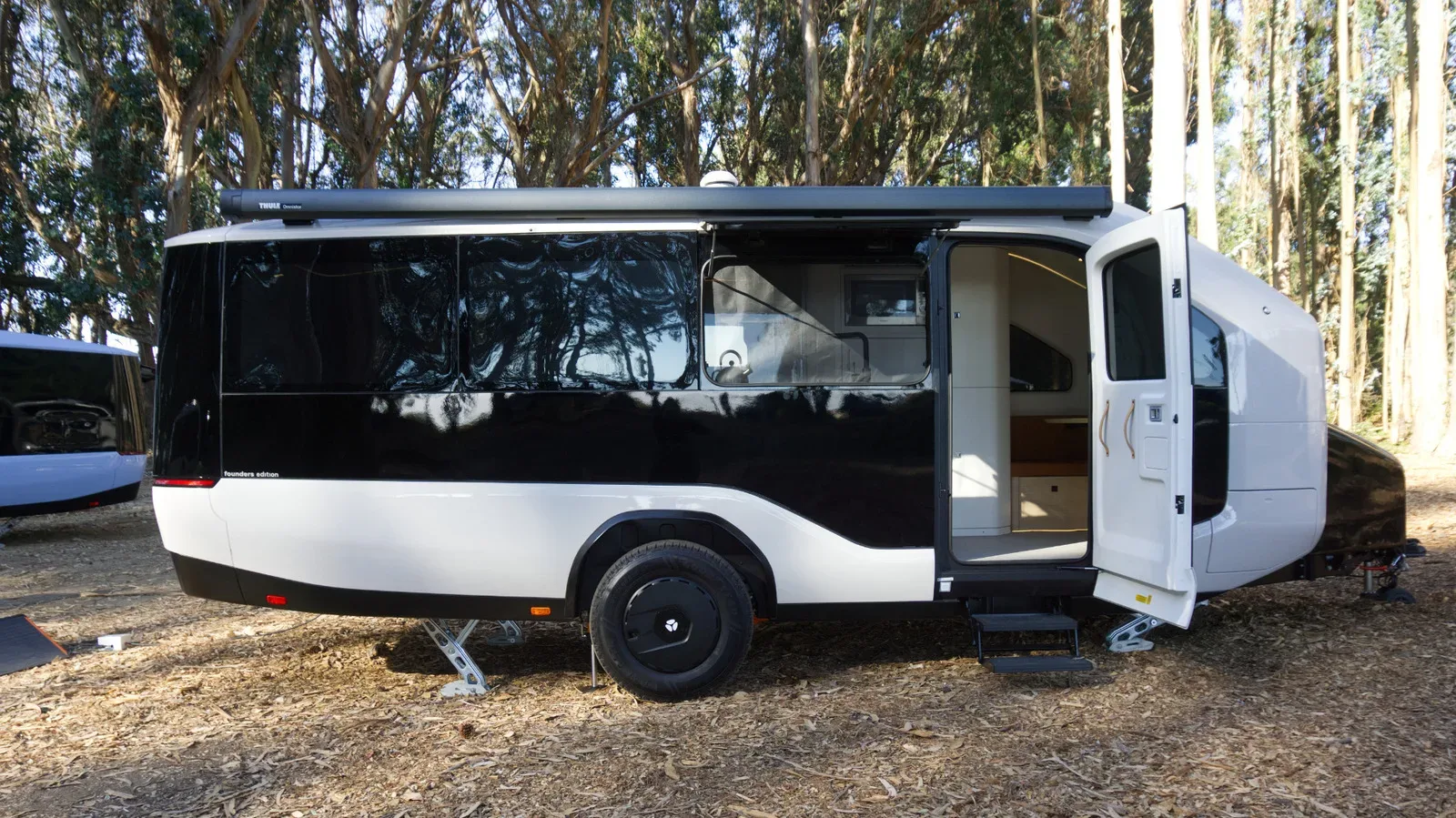
Camping trailers are usually sold on escape: get away from the screens, leave the complicated gear behind, and perhaps rediscover the special sound of somebody asking where the leveling blocks went. Pebble’s Flow takes a markedly different route. This is an electric RV built around a supplied iPad Mini, automation and a decidedly modern interior. It treats the trailer less like a rugged box that needs a sequence of manual rituals and more like a compact, software-directed living space.
An overnight stay in the Pebble Flow suggests that approach has real appeal, particularly for people intimidated by the mechanics of towing and setting up a traditional RV. The trailer pairs an enclosed, work-friendly interior with automated hitching, remote maneuvering, hydraulic leveling, integrated solar equipment and in-wheel motors intended to assist while towing. It is an ambitious package, although its starting price of $159,000 makes clear that this is a premium solution to camping’s fiddlier jobs, not a casual entry point.
A compact cabin designed for work as well as sleep
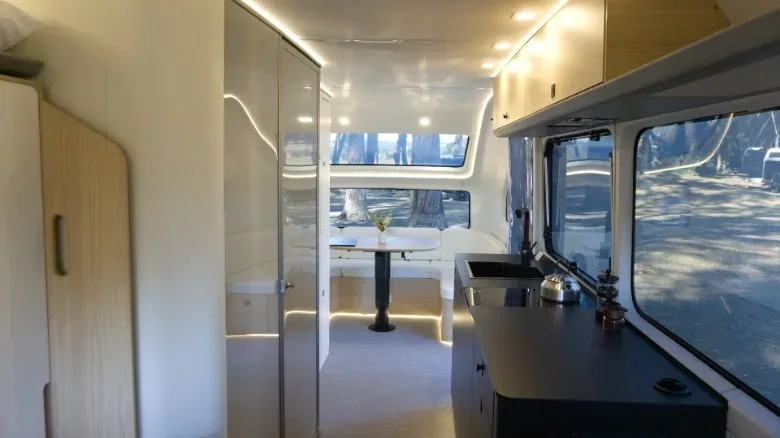
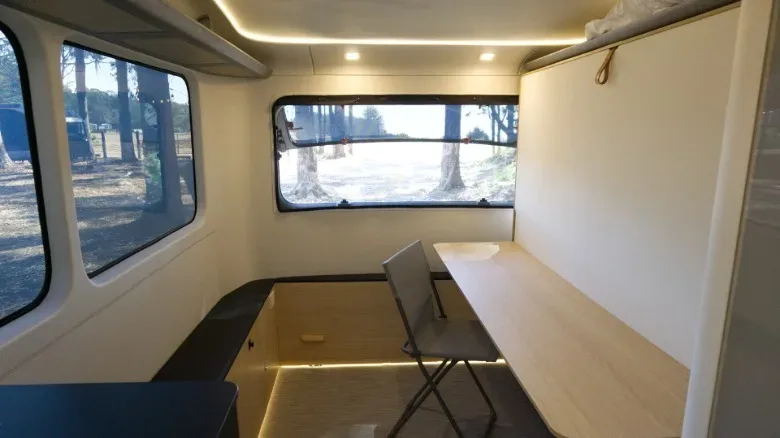
The Flow’s interior configuration makes the strongest case for the “micro-hotel suite” comparison. The layout includes a front dinette that converts into a bed and a queen-size Murphy bed at the rear. When stowed, that Murphy bed reveals a dedicated desk. Two people were able to work in the space without it feeling overly cramped, with the dinette and desk both serving as usable laptop stations.
There are trade-offs. The dinette’s cushioned bench seating was more comfortable, but its table had enough wobble to distract during computer work. The rear desk is functional rather than expansive: it accommodated a laptop, phones, a camera and chargers, but may not comfortably fit an external monitor setup. Its location beside a rear window that opens fully does provide ventilation and a view, which matters in a small trailer where a workday can otherwise become very enclosed.
That workstation angle is worth emphasizing. The Flow is not simply presenting a way to sleep away from home; it is also designed for someone who expects to bring their connected routine along. The desk, nearby outlets at the bed and central tablet control reinforce that idea. Anyone planning a true mobile office will still need to think through their own computers, displays and charging needs. For broader context on how component costs can affect conventional PC setups, see our coverage of DDR4 and PC-build decisions.
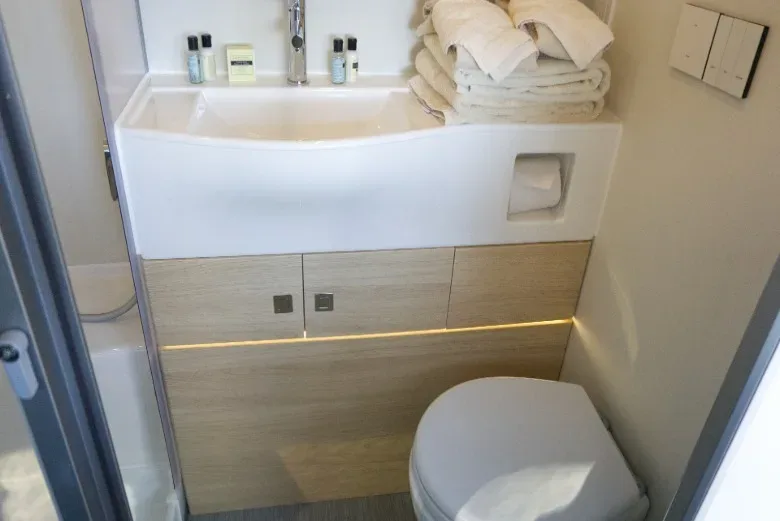
The bathroom also separates the Flow from the rougher end of camping. It has a flushing toilet and a distinct shower stall rather than a combined wet-bath arrangement. The shower was reported to heat quickly and deliver good water pressure, despite its compact dimensions. The caveat is acoustics: the water pump is conspicuously loud when the sink or shower is running. In a one-room-ish living space, that repetitive pump noise is not a small inconvenience if another person is asleep.
Sleep itself appears to be a happier story. The Murphy bed was considered unexpectedly comfortable, and easily reached outlets on each side make a meaningful practical difference. Little details such as having a place to charge a phone without rearranging the cabin are the difference between a futuristic trailer concept and a place people can plausibly inhabit overnight.
Smart glass gives privacy, with a spaceship side effect
Every exterior window uses electrochromic smart glass. Electrochromic glass changes its opacity when electrically controlled; here, the occupants can switch windows from clear to frosted at the press of a button. In a shared campsite, that is a practical privacy feature. It avoids a manual curtain routine and lets users quickly obscure the interior.
Related coverage includes Pebble Flow Turns EV RV Camping Into a Tablet-Controlled Stay.
It also contributes to the Flow’s distinctive atmosphere. With the windows frosted and the interior LEDs on, it can be difficult to judge the time of day. That effect was described as slightly disorienting rather than unpleasant, helping create the sense of being in a brightly lit spaceship. Potential owners should read that as an honest experiential consideration, not merely a design flourish: maximum privacy and light-blocking can make the living space feel more detached from the outdoors that camping is ordinarily meant to foreground.
Fortunately, the opening rear window offers a counterweight. The Flow’s central promise is control, but its best layout choices still leave room for fresh air and a view.
The iPad is the command center
The supplied iPad Mini is more than a convenient remote. It is the Flow’s primary control hub for climate, lights and other trailer functions, while also handling the automated hitching and remote movement systems. Using one familiar touchscreen for these tasks lowers the apparent barrier to operating the trailer, especially for newcomers who may find conventional RV procedures daunting.
The headline feature is a camera-equipped hitch that detects the tow vehicle’s hitch ball. If the tow vehicle is within four feet of the trailer’s front, the Flow can enter a self-hitching process even when the two are not perfectly aligned. In observed use, the trailer was guided onto a Rivian’s hitch through a small number of tablet inputs, and the process took roughly 45 seconds.
That is a useful example of automation tackling a precise frustration rather than being added solely for spectacle. Hitching normally demands careful alignment between a tow vehicle and trailer. Pebble’s system is designed to reduce the precision required of the driver by letting the trailer identify and move toward the hitch position. It does not change the importance of normal towing safety and owner familiarity, but it could make one of the most stressful setup moments feel considerably less forbidding.
The same tablet can move the unhitched trailer around a parking space. The firsthand use was cautious, limited to movements of around a foot at a time, while company representatives demonstrated larger maneuvers including parallel parking and moving across mulch-covered campsite ground. Remote movement is compelling for fitting a trailer into a tight space, but it is also the feature most likely to make first-time users feel as though they are directing a very expensive, very real robot. Caution seems appropriate.
“Instacamp” focuses on setup friction
Pebble calls its automatic leveling and stabilization function “instacamp.” Once at a destination, hydraulic lifts deploy to level and steady the trailer. Leveling matters for comfort and for ordinary tasks inside an RV; the appeal is not mysterious. The point of the feature is to move that work from a manual site-by-site chore to a command issued through the Flow’s control system.
This illustrates the product’s larger philosophy. Rather than claiming that camping should be technologically invisible, the Flow makes technology very visible but tries to make it remove manual hassle. For buyers, the question is less whether an iPad-controlled trailer is novel—it indisputably is—and more whether the automation solves the tasks that keep them from using an RV frequently. On the evidence here, hitching, parking and leveling are the clearest answers.
In-wheel motors aim to ease the towing burden
The Flow’s in-wheel motors provide additional power while the trailer is being towed. Pebble’s stated goal is to help preserve a tow vehicle’s fuel economy or EV range. The distinction is important: the reported driving was not a long road trip or range test, so there is no independently observed mileage or efficiency result to attach to the claim.
There was, however, a chance to tow the trailer around campground roads and onto Highway 1. The tablet remained inside the tow vehicle while moving, as Pebble advises, and another person toggled the trailer motors. The difference was subtle, with the setup feeling stable throughout the drive. That is a useful early impression of behavior, but not a substitute for extended towing data across varying speeds, grades, weather and battery conditions.
For an EV trailer, that restraint matters. “Range” is a technical term describing how far an electric vehicle can travel before it requires recharging. A trailer’s effect on that distance can be central to an electric tow vehicle owner’s trip planning. Assistance from the trailer’s motors may help, but prospective buyers should not treat a brief, stable towing experience as proof of a specific range benefit.
2027 models add a twin-bed layout and more solar potential
Pebble also showed 2027 Flow models with a new floorplan. Instead of the queen Murphy bed that converts into the rear desk arrangement, the new configuration uses two fixed twin beds. The mattresses can be pushed together to create a king-size bed, while the stationary layout opens up added under-bed storage. That gives buyers a genuine choice between a flexible convertible rear area and a more traditional sleeping arrangement with extra storage.
The other notable change is a solar expansion developed with Jackery. Current models have 1.1 kW of rooftop solar capacity. With the optional self-powered add-on, 2027 models can support up to four external 500-watt panels, increasing total solar input capacity to 3.1 kW.
kW, or kilowatts, measures power—the rate at which electricity can be generated or used. The Flow’s 45 kWh battery uses a different unit: kWh, or kilowatt-hours, measures stored energy. Pebble says the expanded 3.1 kW solar capability can cover a typical day’s energy needs and help recharge that battery. The exact outcome will necessarily depend on conditions and use, but the practical implication is straightforward: additional panels could make the trailer more viable farther from fixed power connections.
That option may be less essential for owners who primarily visit campgrounds with power access. For off-grid users, though, it is a meaningful addition because it expands the ability to replenish the onboard battery rather than relying only on an external source.
A luxurious answer to RV complexity—at a luxury price
The standard Pebble Flow starts at $159,000. A Founder’s Edition with the self-powered upgrade is listed at $193,000. Those figures put the trailer well beyond an impulse purchase, and the Flow will not suit every garage, driveway, travel style or budget.
Still, the overnight experience makes a persuasive case that Pebble’s unusual interface is more than a show-floor gimmick. The interior is comfortable enough for work and sleep, the bathroom has the feel of a major upgrade over basic camping arrangements, and the systems aimed at hitching, maneuvering and leveling address practical RV pain points. Its few noted limitations—wobbly dinette table, narrow desk for a larger monitor setup, loud water pump and a potentially time-blurring smart-glass interior—are tangible, but they do not erase the clarity of the product’s pitch.
The Pebble Flow is not trying to make RV ownership feel old-fashioned. It is trying to turn the trailer into a controlled, electrified, software-forward space that happens to follow a tow vehicle. For campers who want less setup labor and more button-press certainty, it may feel a little like living in a spaceship. Crucially, it appears to be a surprisingly comfortable spaceship.