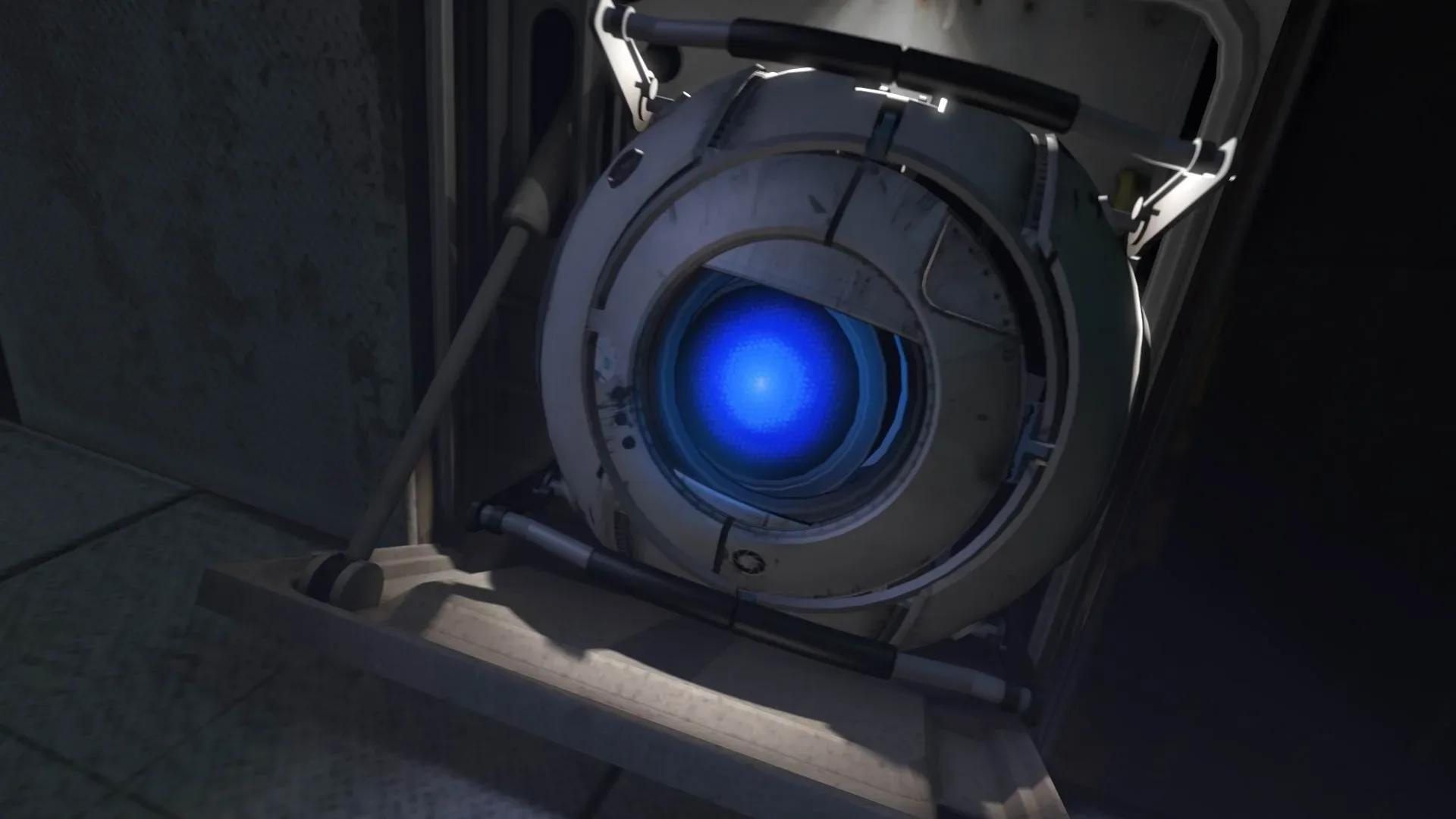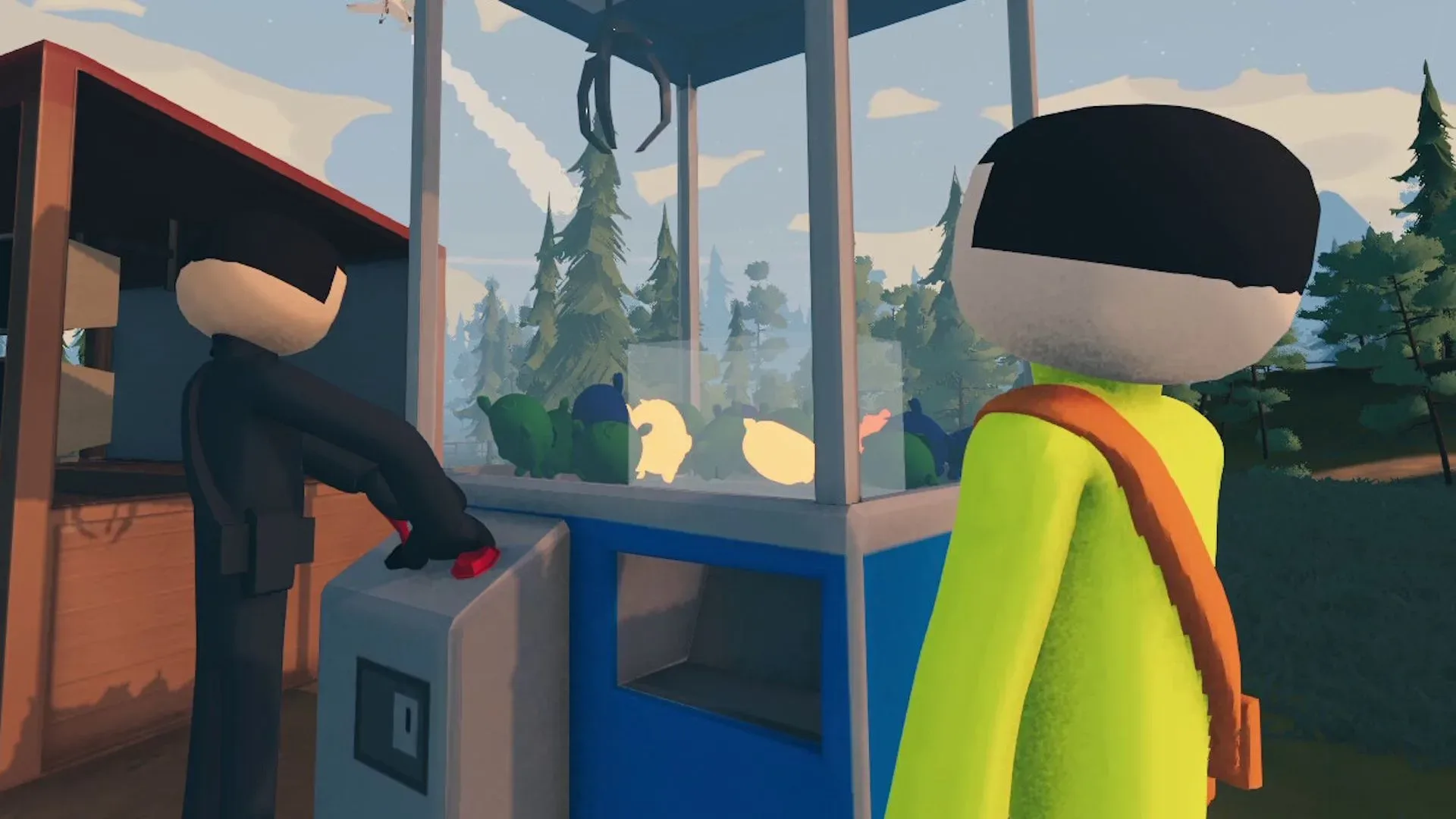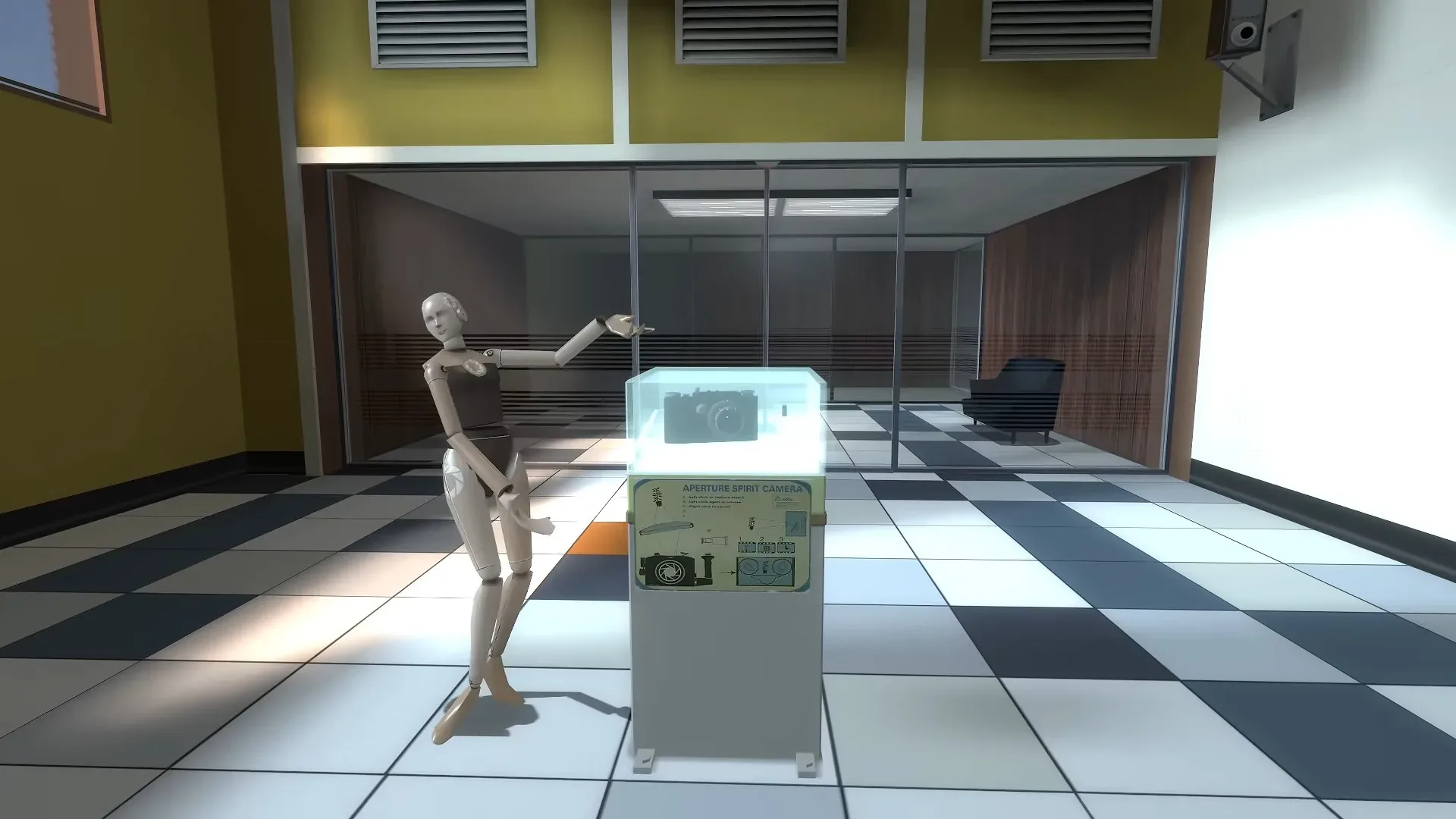
One of Valve’s most intriguing unreleased experiments is no longer confined to old descriptions, scattered assets, and persistent fan curiosity. F-Stop, the cancelled project conceived as a prequel to Portal, has reportedly been reconstructed into a playable build after material from three separate leaks was brought together by the Valve Cut Content community.
The reported result is not being presented as a pristine, official release. People who have played the reconstructed version have noted missing assets and occasional absent dialogue. Still, the build is described as essentially 99% complete—an extraordinary change for a game that, until very recently, existed publicly more as a tantalising design footnote than something players could meaningfully examine.
That distinction matters. Unreleased games are often discussed through concepts, screenshots, or second-hand accounts. A playable build offers something much more concrete: a chance to see how its spaces, rules, puzzles, and pacing worked together. In F-Stop’s case, that could finally make it possible to assess a strange early branch of the Portal family on its own terms, rather than solely through the ideas that apparently survived into Portal 2.
What F-Stop was meant to be
F-Stop originated during Valve’s 2007 Directed Design Experiments, a three-month period in which the company split into five teams. Each team was tasked with designing and partially building a game experiment; F-Stop was the fifth project.
For more context, explore Three iPads Could Arrive in Early 2027, With OLED Air and Cooler Pro Rumored.
Its premise positioned it as a prequel to Portal, set around an experimental Aperture Science camera. Rather than using portals as the primary way to alter the player’s relationship with rooms and objects, F-Stop’s central mechanic involved manipulating perspective through photography and camera-based interactions.
Perspective, in this context, is more than a visual trick. It means treating the player’s viewpoint as part of the puzzle system. A familiar example of perspective-based design would be an object that appears to change scale or location depending on how it is framed. The supplied details do not establish every rule F-Stop used, so it would be premature to reduce the game to any one specific effect. What is clear is that its camera was designed to let players disrupt ordinary spatial assumptions and solve puzzles in a way that differed from Portal’s portal-gun logic.
That makes F-Stop particularly interesting as a design experiment. Portal makes players learn a compact set of spatial rules and then tests how cleverly they can apply them. F-Stop seems to have asked a related but distinct question: what happens when the camera itself becomes the tool that changes how a puzzle space can be understood?
Related coverage includes Valve's Cancelled Portal Prequel F-Stop Reportedly Reconstructed Into a Playable Build.
Why Valve cancelled it
Gabe Newell was reportedly very enthusiastic about the project, but playtesters were less impressed. F-Stop was ultimately scrapped.
That does not necessarily mean every part of the project failed. Playtesting is a development process in which people use an unfinished game so its creators can identify confusion, frustration, pacing issues, or concepts that do not communicate as well in practice as they did on paper. A mechanic can be novel, technically impressive, and even exciting to its designers while still proving difficult for players to read or enjoy.
For a perspective-driven puzzle game, clarity would have been especially important. Players need to understand not just that the world can be changed, but why a particular action changed it and how that result can be used intentionally. If the relationship between a camera action and its consequence is unclear, experimentation can turn from satisfying discovery into guesswork. The available account does not identify the precise playtesting objections, so any diagnosis beyond that would be speculation. But the divide between internal enthusiasm and player response helps explain why F-Stop never became a finished commercial game.
Its cancellation was not the end of its influence. Some of F-Stop’s dialogue, characters, and mechanics were reworked for Portal 2. That gives the recovered build added historical value. It may provide a rare opportunity to see ideas closer to their experimental form, before elements were revised and repurposed for a released sequel.
Three missing pieces reportedly came together
The playable reconstruction is tied to a sequence of leaks rather than one complete package appearing all at once. In late August, a roughly 13-terabyte leak known as Steam2 reportedly surfaced online. It was said to include nearly every Steam depot from 2003 through 2013, along with a significant amount of F-Stop material.
A Steam depot is, broadly, a package of game data used within Steam’s distribution infrastructure. For preservation and reconstruction purposes, asset data can be important, but it is not automatically enough to make a project function. Art, audio, models, and other files may reveal an enormous amount about a game while still leaving out the instructions and level-building information required to assemble a playable version.
That was reportedly the initial obstacle with F-Stop. The Steam2 material included most of the game’s assets, but lacked both its source code and its mapsrc data. “Mapsrc” was Valve’s folder name for map source-code data: the underlying editable level information rather than simply a finalised playable map. In practical terms, these materials can be crucial because they preserve how a level was constructed and how its components were intended to interact.
Over the following 48 hours, the missing source code and mapsrc data reportedly appeared through the Valve Cut Content project’s Discord server. The group’s moderators said the person who initially provided the mapsrc had sought $1,000, but ultimately released the files for free. The Valve Cut Content team then verified the authenticity of the map files, and community members combined the three sets of material into the playable result now being discussed.
Why “playable” does not mean “official”
The reported reconstruction changes what can be known about F-Stop, but it does not turn it into an official Valve product or establish that Valve considers the build final. It is important to keep those lines clear.
A project can be nearly complete in a functional sense while still lacking the polish expected from a commercial release. Missing dialogue, incomplete assets, rough presentation, and unresolved bugs can substantially affect how a game feels. The 99% figure is itself a community-reported assessment, not a formal completion metric from Valve. It should be understood as shorthand for “remarkably close to functional and substantial,” rather than a guarantee that every intended detail is present or finished.
There is also a key historical difference between a cancelled build and a game that merely launched in an imperfect state. A released title reflects a publisher’s decision to put that version in front of the public. A cancelled project may contain abandoned directions, temporary material, or systems that were still being reconsidered when work stopped. That does not make it unworthy of attention; it makes the context essential.
For players and game-design enthusiasts, the most responsible way to approach F-Stop is as a recovered development artifact. Its value lies partly in what it reveals about experimentation: a prominent studio testing another way to make first-person puzzle spaces feel surprising, then apparently deciding that the concept did not meet the needs of its audience in that form.
A rare window into Portal’s road not taken
F-Stop’s recovery is compelling because it is not simply a lost level pack or a small discarded prototype. It was a distinct attempt to build a Portal-adjacent game around a different central verb: using a camera to manipulate perception and solve problems. The project also sits within a defined period of Valve experimentation, connecting its internal development process to material that later found a home in Portal 2.
That means the reconstructed build could help separate two questions that are often mashed together when cancelled games are discussed. The first is whether an idea was interesting. By all appearances, F-Stop’s perspective-puzzle premise was certainly distinctive. The second is whether the idea worked well enough for a broad audience as a finished game. The reported negative response from playtesters suggests Valve believed the answer was not yet yes.
Those are not contradictory outcomes. In fact, they are often how influential design work happens: an ambitious premise is explored, its limitations become visible, and the strongest elements are carried forward in a revised form. F-Stop’s reported links to Portal 2 make that process unusually visible.
For now, the most significant development is simple: material once thought of as inaccessible has reportedly been assembled into something people can play and study. Even with missing pieces and the caveats that come with any reconstructed cancelled game, F-Stop has gone from a largely abstract “what if?” to a far more tangible part of Valve’s history.