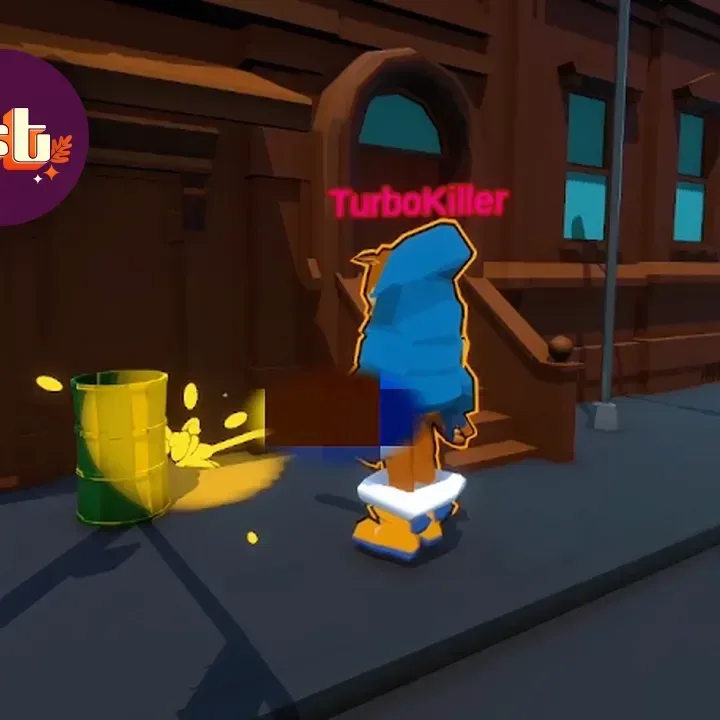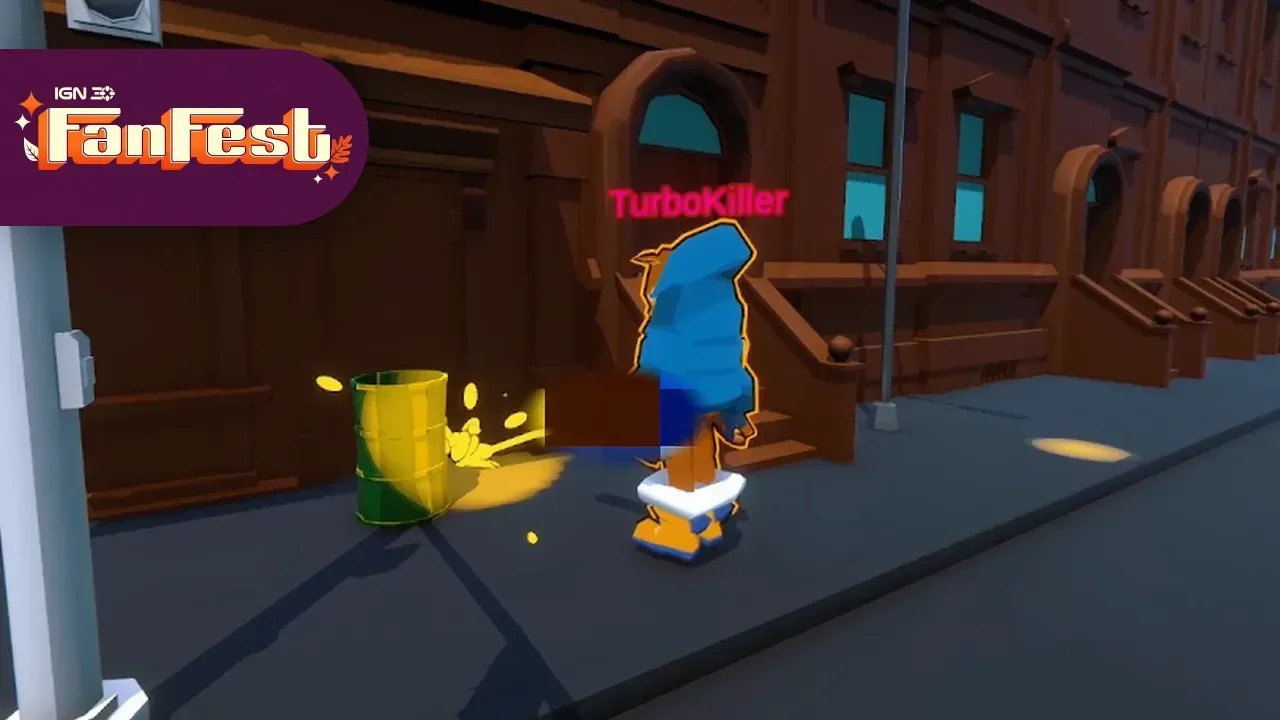
Urine Trouble: PEE V PEE has made its intentions unusually clear: its central objective is to pee on things before somebody else does. A newly shown trailer frames the Steam game as a chaotic territorial multiplayer contest in which players race around a map and claim objects—including buildings, cars, and fountains—by spraying them.
Its player characters are called Pissers, a name that leaves little room for confusion about the tone. The premise is proudly crude, but the underlying competitive idea is immediately recognizable: get to valuable spaces or objects first, mark them, and deny control to opponents. The game’s twist is that all of that familiar map-claiming logic is expressed through a deliberately ridiculous bodily-function gag.
For players who would rather not join the mayhem, the trailer’s setup also includes a different side: police characters hunting the Pissers. That suggests a conflict structured around opposing objectives rather than a single group simply accumulating territory without resistance. Exactly how the police stop players, how claims are counted, and what constitutes victory have not been detailed.
The game is currently available to wishlist on Steam. No release date, price, platform plans beyond Steam, or fuller explanation of its systems was provided.
A gross-out premise with a readable competitive hook
At face value, Urine Trouble is a joke game, and it does not appear interested in hiding that fact. Its language, character label, and imagery are calibrated for the sort of reaction that alternates between a laugh and a deeply concerned stare at one’s screen. But a silly theme does not automatically mean a directionless design.
The important word in the pitch is claim. In multiplayer games, claiming an area or item generally means establishing control over it in a way opponents can contest, erase, steal, defend against, or otherwise influence. Here, the stated action is spraying objects. That makes the territory mechanic highly visual and intuitively legible: players should be able to understand what is at stake by looking at the things being marked.
There is a natural difference, however, between the broad premise and the details needed to judge the game’s depth. The available footage description establishes that players will race around a map and try to claim objects. It does not establish whether every object has the same value, whether claims change hands, whether teams exist, whether the action is score-based, or whether a round ends on a timer. Those unanswered questions matter because they determine whether the game plays as a short-form party distraction, a more tactical territory contest, or something between the two.
For now, its strongest confirmed feature is clarity of purpose. It is not coy about what players do, why they do it, or the kind of chaotic comic energy it wants to create.
What the police role could mean
The police option is more than a throwaway alternative in the premise. It introduces what game designers often call asymmetry: opposing sides operate toward different goals and may have different tools. Rather than every participant using the same actions to pursue the same score, one group creates the disorder while the other attempts to contain it.
That kind of setup can make a match more dynamic because success is not defined only by being the fastest player on the map. A Pisser may need to choose between a prominent object that is risky to claim and a less visible target that is safer. A police player, meanwhile, may need to predict where the chaos will happen next rather than merely react after objects have already been claimed.
Those are potential implications of the two-role premise, not confirmed mechanics. The trailer description does not say whether police can arrest, remove claims, block access, or use any particular equipment. It also does not say whether players select sides freely, rotate through them, or enter a dedicated mode. Still, the inclusion of police creates a useful counterweight to the game’s most obvious gag: there is a built-in pursuer-and-disruptor relationship, rather than only an unopposed mess-making simulator.
Territory control, translated into toilet humor
Territory control is a simple term for competitive play built around owning spaces, objectives, or items on a shared map. The format can reward movement, route planning, awareness of opponents, timing, and defense. Urine Trouble’s stated version appears to transfer that idea from abstract zones to recognizable environmental objects.
Buildings, vehicles, and fountains are useful targets from a presentation standpoint because they are easy to spot and sound inherently public. Marking them turns the act of claiming into the punchline. The game is not merely asking a player to capture “Point A”; it is asking them to perform an obviously inappropriate act on something everyone can identify.
That could give the game a strong spectator quality. A match built around recognizable targets is easier to parse than one filled with unnamed icons, especially when its presentation depends on exaggerated chaos. The available information does not specify whether the game will support streaming tools, online matchmaking, local play, or any audience-facing features, so none of that should be assumed. But the concept itself is plainly fashioned for instant comprehension.
Its off-color framing also distinguishes it from games where territory control is presented as military domination, athletic competition, or abstract sci-fi conflict. The action is intentionally undignified. That tone can be an advantage when a game wants to make failure funny rather than frustrating: being beaten to a fountain by a rival is an easier situation to laugh about when the contest is this shameless from the outset.
What has—and has not—been confirmed
There is enough information to identify the game’s basic fantasy: move through a map, spray objects to claim them, compete with other Pissers, or play police pursuing them. There is not enough to responsibly fill in the rest.
- Confirmed: Urine Trouble: PEE V PEE is coming to Steam and can be wishlisted.
- Confirmed: Players can race around a map to claim objects by peeing on them.
- Confirmed: Named examples of claimable objects include buildings, cars, and fountains.
- Confirmed: A police role is available to hunt the Pissers.
- Not detailed: release date, price, additional platforms, match size, online features, progression, modes, or exact scoring rules.
That distinction is particularly useful for a concept-first reveal. A punchy trailer can communicate a mood and a core verb quickly, while leaving a lot of practical questions unanswered. Wishlist interest will likely depend on whether later details show that the funny premise has enough structure beneath it to sustain repeat matches.
The value of committing to the bit
There is a certain honesty in a title like Urine Trouble: PEE V PEE. It does not dress up its subject with a euphemism or promise solemn drama. Even its “Pissers” label signals that the game is treating bad taste as an intentional part of its identity, not an accidental side effect.
That commitment matters because comedy games can lose their footing when their mechanics and presentation seem to be pulling in different directions. Here, the theme, objective, targets, and opposing role all point at the same comic scenario: a public-space mess that has become a competitive event, with police chasing the people responsible.
The early reveal is also part of a broader appetite for compact concepts that can be explained in a sentence. In this case: claim the map by peeing on it, or stop the people doing that. It is an absurd elevator pitch, but it is a very clear one.
Water-related game oddities have a long way to go before they reach this particular level of immaturity. For a considerably less biological example of liquid-fueled chaos, see the recently shared Majora’s Mask water glitch.
Why the reveal leaves room for curiosity
The trailer establishes the joke; the next question is whether Urine Trouble can make the joke strategically interesting. Map layout, target placement, player mobility, the police side’s capabilities, and the rules around a claimed object will all shape the answer. A single fountain is funny to mark. Choosing whether to risk it while police close in and rivals compete for it is where a multiplayer game can begin to find a rhythm.
Nothing presented so far confirms that level of detail, and it would be premature to assign systems the game has not announced. Yet the fundamental ingredients are there: shared objectives, a race for control, visible targets, direct opposition, and a comic premise bold enough to make ordinary territorial competition feel bizarrely specific.
For anyone who has been waiting for a game to take the phrase “mark your territory” painfully literally, Urine Trouble: PEE V PEE is now on Steam’s wishlist trail.