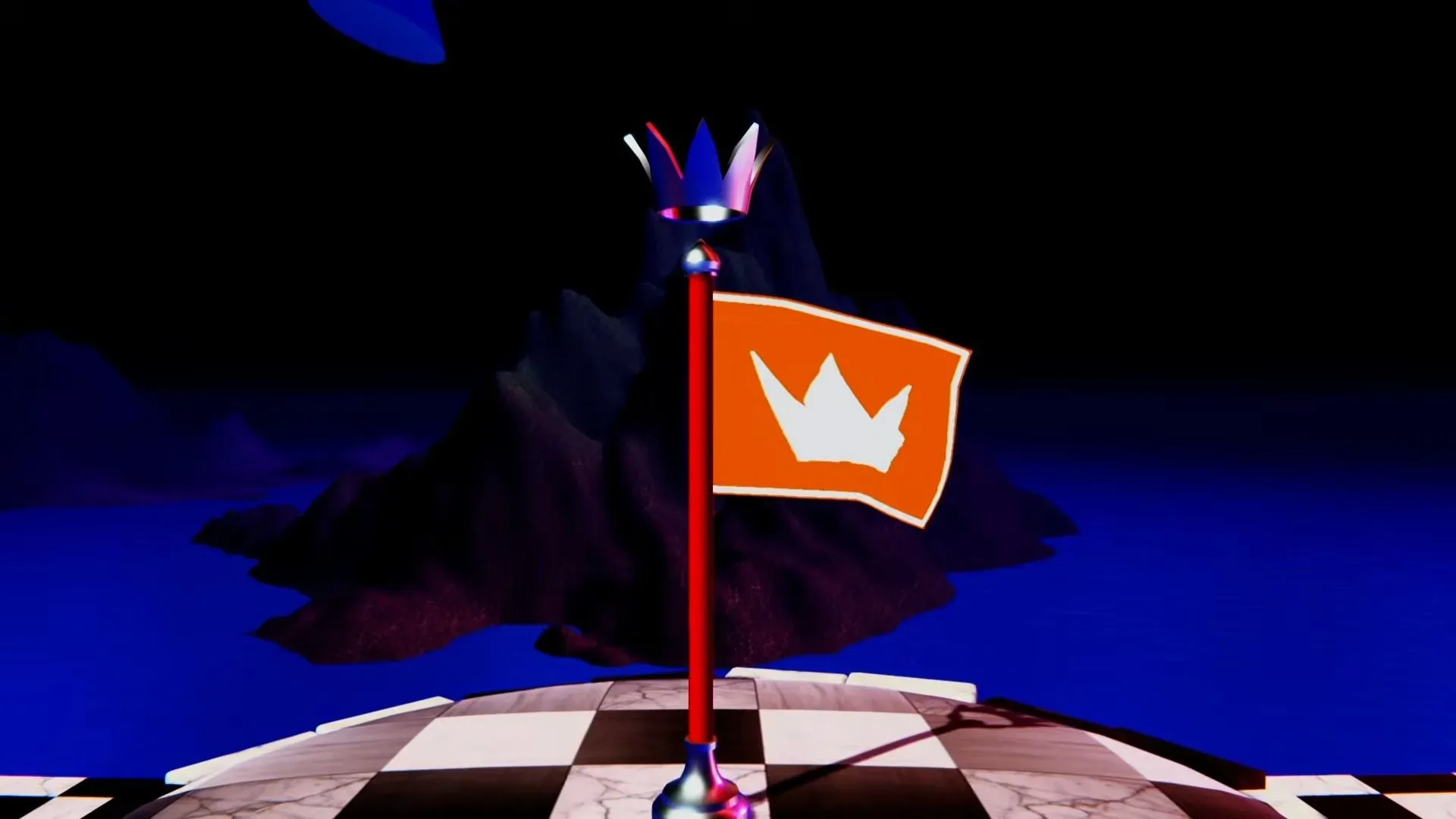
Refund This Game is a title that declines to bury the joke. Built by dofhouse and Cactile Games, the first-person 3D platformer asks players to scale a towering, surreal environment using a bendable pole, then challenges them to finish before a two-hour clock runs out. Do it quickly enough and the game explicitly invites the player to seek a refund afterward—assuming they still can.
That premise makes the game a direct, playful response to a recent debate over Steam’s two-hour refund window. The argument was sparked in part by Mateo Covic, known for Paddle Paddle Paddle, who voiced frustrations around the limit. Yet the discussion was not simply a case of developers opposing refunds. Covic and many other participants maintained that they were strongly in favor of players being able to refund games, even while recognizing that a time-based system can create edge cases and opportunities for misuse.
Refund This Game embraces that tension rather than trying to resolve it with a slogan. Its central trick is to make the two-hour boundary into the game’s finish line. The player is not merely trying to reach the summit; they are trying to reach it while preserving the possibility of getting their money back. It is an unusual challenge design because the real-world platform policy is part of the stated fantasy.
A timer with real thematic weight
The game’s description frames it as a climb: stick the pole to surfaces, bend it, then launch forward at speed. A mistake can send the player all the way down. The setup is comparable in spirit to punishing “rage game” platformers, where deliberate, physics-driven movement and harsh consequences turn progress into pressure.
In this case, the pressure has two layers. First, there is the usual platforming risk: a failed move can erase a great deal of climbing. Second, there is the visible countdown. An on-screen timer tracks the remaining time, and there is a Steam achievement for completing the climb in under two hours. The developers have even framed a successful qualifying run as earning the refund.
“We celebrate players’ right to refund games, and we wanted to create something that invites players to give it a shot, no strings attached.”
That statement from co-developer dofhouse is important because it clarifies the joke’s target. The game is not presented as a trap meant to punish players for using refunds. Instead, it turns a consumer-protection mechanism into a voluntary dare. A player can buy the game, attempt the summit, and see whether their skill, composure and route choices can beat the clock. If they do, the developers openly suggest refunding it if they wish.
It is a clever inversion of a common anxiety around short games. Players sometimes worry that a brief experience will not justify its cost; creators sometimes worry that a game designed to be completed quickly will be disproportionately exposed to refund requests. Here, the possibility of a refund is not an unfortunate side effect of the structure. It is integrated into the pitch.
Related coverage includes Refund This Game Turns Steam's Two-Hour Refund Window Into a Platforming Challenge.
What a “rage game” means here
The term “rage game” is informal, but it generally describes a game designed around difficult, failure-prone challenges that can provoke frustration as much as satisfaction. The appeal is not necessarily raw precision alone. These games often make recovery difficult, give movement unusual physical behavior, and let a single error create a dramatic fall. Every gain therefore feels precarious.
Getting Over It is an obvious reference point for this format. Its climbing challenge, in which a character in a pot uses a sledgehammer to navigate obstacles, has become closely associated with long falls, painstaking recovery and the spectacle of players trying to keep their cool. Refund This Game takes a different mechanical route: it is first-person, fully 3D and focused on physics-based stick-flinging. But the underlying proposition is familiar. Learn an awkward movement system, endure setbacks, and gradually turn instability into competence.
“Physics-based” matters in this context. It means progress is built around how the virtual tool interacts with walls and surfaces—where it attaches, how it bends and how that stored motion propels the player—rather than simply pressing a button to jump in a fixed arc. That type of movement can create expressive success and spectacular mistakes. A small adjustment in angle or timing may separate a clean launch from a huge loss of altitude.
The game reportedly offers exactly one checkpoint. That detail is doing considerable design work. Checkpoints are points at which a game records progress, allowing a player to resume from that location after failing. Limiting the player to one means the climb retains long stretches of genuine risk. It also makes the two-hour target more meaningful: the timer is not just measuring a sequence of isolated rooms, but a sustained attempt in which failures can demand a lengthy recovery.
Refund policy as a design constraint
A refund window is ordinarily external to a game’s mechanics. It is a store-level rule that may shape purchasing decisions, but it does not usually appear inside a game’s objectives or achievement list. Refund This Game deliberately collapses that distance. Its title, its countdown and its under-two-hour achievement all point to the same question: can the player experience the intended challenge and still remain within the window?
That does not mean every successful run is automatically a refund case, nor does it create a new rule. The game is built around the widely discussed two-hour threshold, while the actual eligibility question remains with the platform’s refund process. The developers’ wording—“if you still can”—acknowledges that uncertainty. The playful premise depends on the window, but it does not promise an outcome for every player or every circumstance.
This distinction is useful. The design tests a cultural understanding of the policy, not an independently verified guarantee. Players interested in treating the climb as a literal refund-speedrun should understand that an in-game timer and a storefront’s own record of play are not necessarily the same thing. More broadly, a player’s eligibility is a platform matter rather than something a developer can grant through an achievement.
Still, as an artistic and commercial gesture, the idea is unusually transparent. A low-cost game priced at $5, or $4 while on sale at the time described, is openly positioning itself as something players can test. There is no attempt to hide the intended length behind vague marketing. The developers have put the stakes in giant letters: finish fast, then decide whether the game has earned a place in your library or a return to your wallet.
The wider debate is not simply players versus creators
The earlier refund discussion exposed a genuine conflict between principles that can both matter. Players benefit from a practical way to reverse a purchase when a game is not for them, does not perform as expected, or is otherwise unsuitable. Independent developers, meanwhile, can be particularly sensitive to systems that allow someone to consume an entire short experience before returning it.
The available context does not establish a single solution to that conflict, and Refund This Game does not claim to have one. Its contribution is more mischievous and more specific: it makes the disputed line part of an optional challenge. In doing so, it highlights an important point from the debate: support for player refunds and concern about particular incentives are not mutually exclusive positions.
There is also a practical lesson in the game’s framing. Clear expectations can change how players interpret a short or replayable project. The developers are telling potential buyers what kind of experience this is, how it works and why the clock matters. Players are free to approach it as a hard platformer, a speedrun-style challenge, a joke with consequences, or a small experiment in storefront culture.
That level of candor is especially useful in an era when PC game conversations often move rapidly between design, discoverability, pricing and platform rules. Other current PC discussions are focused on more conventional systems—such as how Wardogs is approaching player loadouts and experimentation—but Refund This Game shows that even a platform policy can become part of a game’s mechanical identity when creators choose to foreground it.
Early players appear to be accepting the dare
The initial response has been positive, with player reviews indicating that at least some people have reached the top in time to pursue the joke to its logical endpoint. One review reportedly landed at exactly two hours and consisted of a sad face, an outcome that may be the purest possible summary of the game’s intended emotional territory.
That anecdote captures why the premise works. The game asks players to race an unforgiving climb while watching a deadline that is meaningful outside the game world. Missing it by moments is not merely a missed personal-best time; it is the punchline. Winning means overcoming the mountain. Losing means, at minimum, having participated in a very pointed bit about the pressure created by a two-hour threshold.
For players, the sensible approach is to treat it as a difficult physics-platforming challenge first and a refund stunt second. Expect setbacks, recognize that the lone checkpoint raises the cost of errors, and do not assume that a displayed timer guarantees a particular refund result. For those who enjoy games built around persistence, dramatic falls and eventual mastery, though, the premise is unusually direct: grab the pole, start climbing and try not to let the clock—or gravity—have the last laugh.