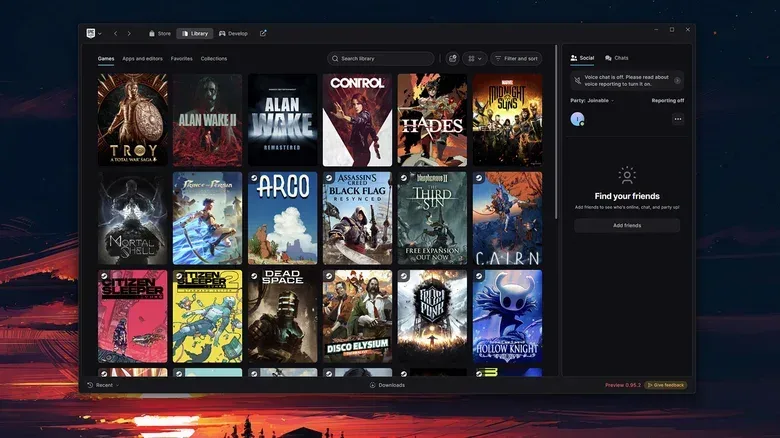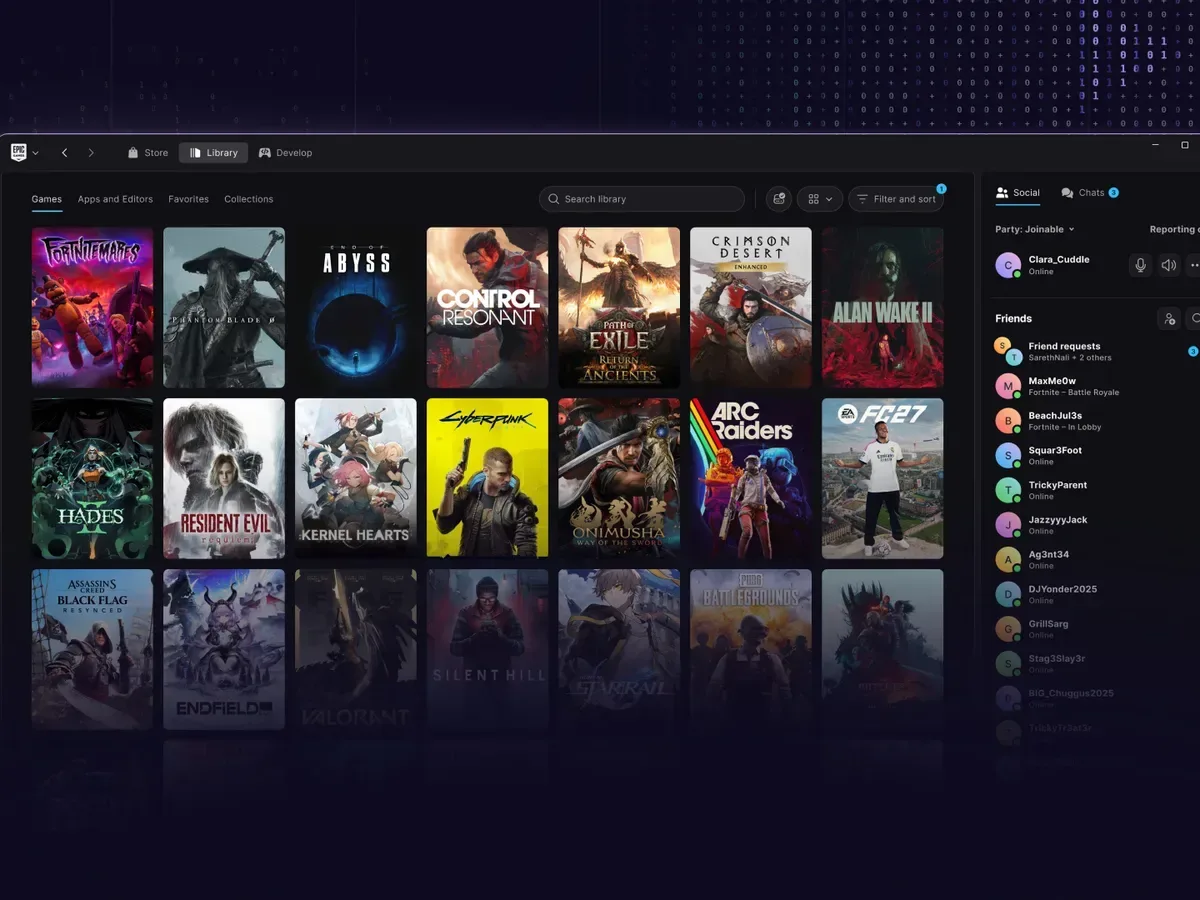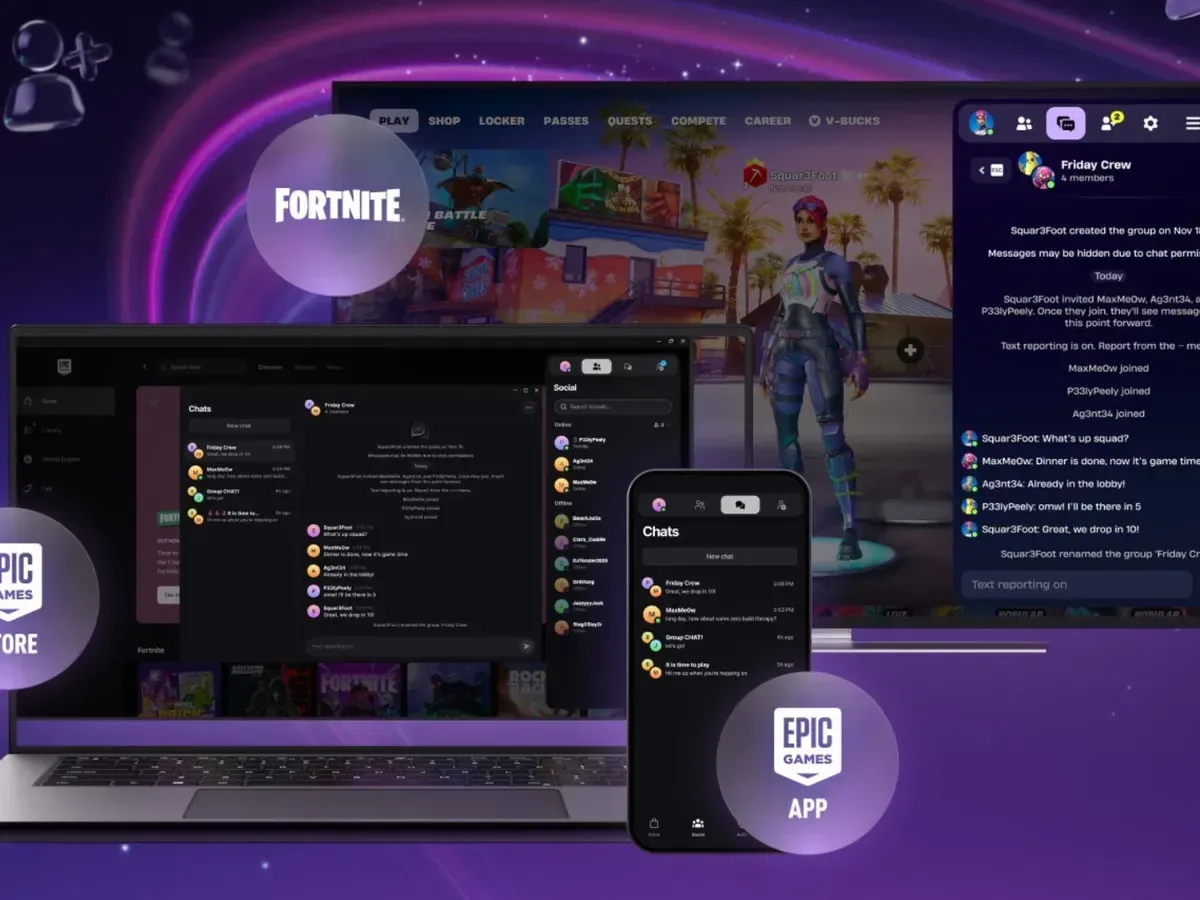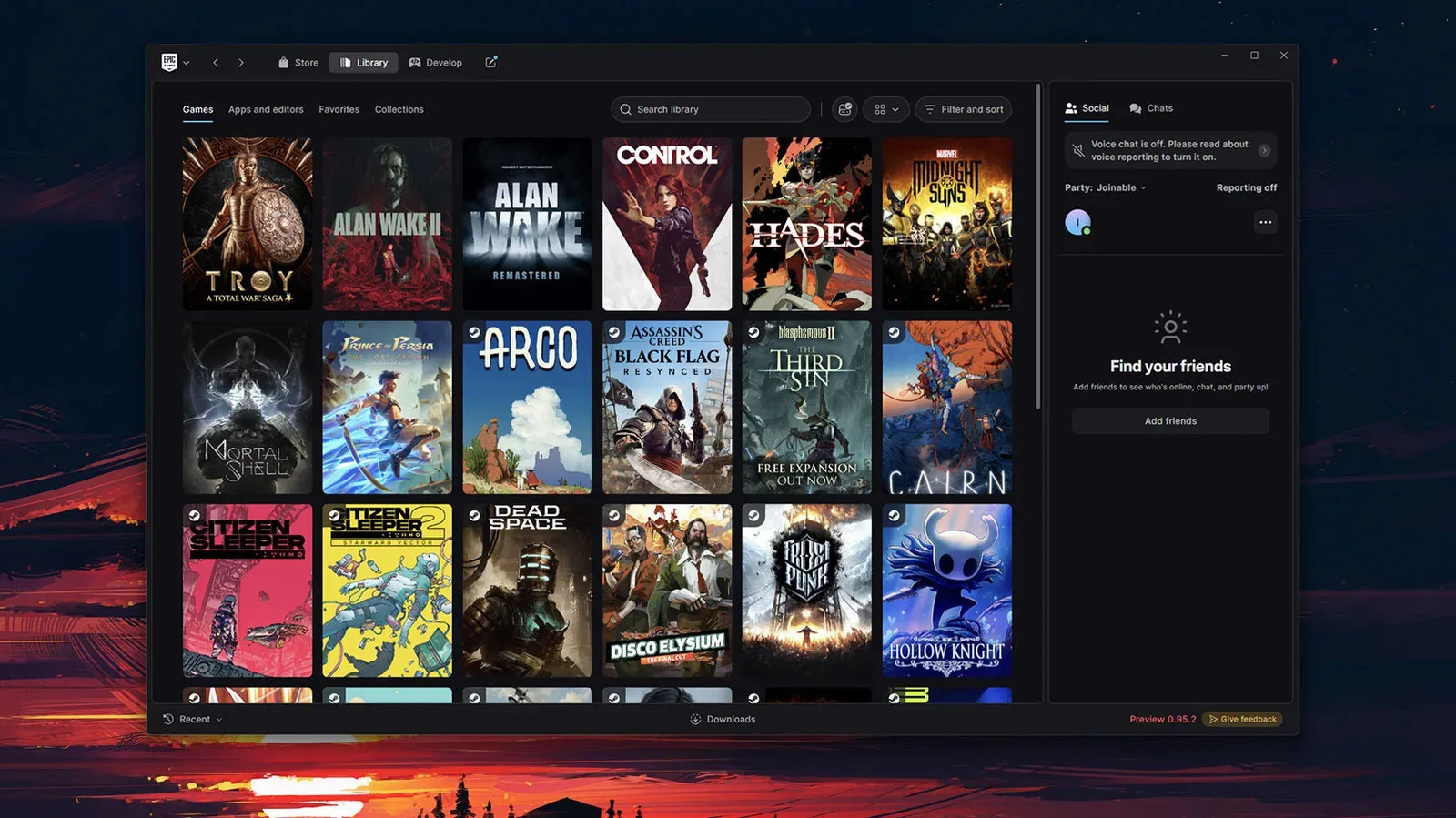
Epic Games has presented a redesigned Epic Games Launcher as a faster, more responsive replacement for an interface that even company CEO Tim Sweeney previously characterized as clunky. On the product side, the stated changes are meaningful: a new look, quicker launch performance, the ability to view games installed through Valve’s Steam launcher, and Linux availability for the redesigned launcher.
But Epic’s framing has become the bigger story. The company introduced the work with a playful “vibe coded” label—language commonly used to describe directing AI-assisted coding tools through natural-language prompts rather than writing every piece of code conventionally. That phrase may be intended as an internet-native joke about software development. In this context, however, it lands badly.
The new launcher arrives immediately after Sweeney described Epic as being in a major AI pivot, with the stated objective of allowing teams using Unreal to create more and better work rather than simply maintaining output with fewer people. It also follows substantial workforce reductions: 1,000 jobs were cut in March, after an earlier round of layoffs in 2023. Against that backdrop, celebrating a shortcut-sounding approach to programming risks sounding less like a clever launch message and more like a dismissal of the engineers whose work maintains, improves and secures a storefront used to buy and launch games.
A better launcher is still a useful improvement
There is an uncomplicated user benefit at the center of this story. A PC game launcher is not glamorous software, but it is software players repeatedly encounter. It opens before a game starts, manages installations and updates, connects accounts, displays libraries and often serves as the storefront itself. Slow startup, awkward navigation and unreliable responsiveness can therefore make a library feel worse to use even when the games in it are excellent.
Epic says the new launcher can start faster than Steam. That is a direct performance claim, and it should be treated as a claim rather than a universal guarantee: launch time can vary with hardware, installed applications, local library size and system conditions. Still, the priority is easy to understand. If a launcher is merely the doorway to a game, it should get out of the player’s way quickly.
The Steam-library angle is potentially helpful, too. The redesigned Epic launcher can surface games already installed through Valve’s launcher from within Epic’s interface. That does not erase the fact that the games are tied to different storefronts and ecosystems, but it could reduce the day-to-day friction of remembering where a particular installed game lives. For players whose PC libraries are split between launchers, even a partial view of installed titles can make a desktop feel less cluttered.
Linux support is another noteworthy change. The redesigned launcher is available on Linux, a first for the company. That matters to players seeking an alternative to Windows, as well as to anyone who wants the Epic experience to be less dependent on a single desktop operating system. The available information does not establish which games, account functions or storefront capabilities work in every Linux configuration, so players should avoid assuming complete parity from the platform’s arrival alone. Nevertheless, official launcher availability is a concrete expansion.
What “vibe coding” means—and what it does not prove
“Vibe coding” is loose slang, not a precise engineering standard. It generally refers to using generative AI to produce or alter code from high-level instructions, with the developer steering toward a desired result instead of manually composing every line from the start. The term emphasizes speed and improvisation, sometimes proudly and sometimes critically.
It does not tell players how much of a project was generated, which parts were AI-assisted, whether the result received conventional review, or how testing and maintenance were handled. Epic’s phrasing should not be read as technical documentation for the launcher’s development process. Nor does the available information establish that AI replaced the remaining engineering work on this project.
That distinction is important because software is more than the first version of a feature. A launcher that handles purchases, personal libraries, downloads and installed games needs ongoing maintenance. Bugs need reproduction and fixes. Performance regressions need investigation. Accessibility, account behavior, security concerns and platform compatibility require sustained work. AI tools may assist some tasks, but a promotional slogan does not remove those responsibilities.
There is a broader trust issue here as AI-generated and AI-assisted work becomes more visible across entertainment technology. Labeling can at least give audiences context; YouTube Music’s addition of labels for tracks made with generative tools is one example of a platform attempting to make that context clearer. Epic has taken a different route in this instance: using AI language as part of the launcher’s sales pitch. The reaction is likely to depend not only on the technology, but on the labor conditions surrounding it.
The timing makes the joke feel harsher
Companies have long tried to make technical work sound effortless. “Magic,” “one-click,” “automated” and “powered by AI” are familiar ways to promise convenience. The danger is that such language can obscure the people required to make the experience dependable—particularly when a company has recently reduced its workforce.
Epic’s recent cuts are not a footnote that can be cleanly separated from a boast about avoiding difficult programming. The company cut 1,000 employees in March. The source material also describes that reduction as bringing Epic’s staffing down by roughly a quarter from the 4,000 employees remaining after its 2023 layoffs. Those figures give the “vibe coded” message an unavoidable human context.
Sweeney’s stated AI goal—that it should enable people to make more and better things, with benefits across Unreal teams—sets a reasonable aspiration. Tools that remove repetitive work or enable smaller teams to experiment can be useful. But a promise that AI will empower workers is harder to accept at face value when workers have recently lost their jobs. The issue is not that a company may use new tools; it is whether management can demonstrate that efficiency gains are being used to support people and product quality rather than to normalize a smaller workforce.
For users, the immediate test is practical: does the launcher become less frustrating? For employees and the wider game-development community, the question is larger: what does Epic’s AI pivot mean for the people who build, test and support its products over time? A jokey phrase cannot answer either question.
The missing reason to choose Epic over its rivals
Speed and interface polish address obvious weaknesses, but they do not automatically solve the Epic Games Store’s longer-running identity problem. Epic is competing in a PC storefront market where Steam and GOG already offer established libraries, discovery systems and user habits. The source material identifies no exclusive new hook in the redesign that cannot already be found in those competitors.
That does not mean improvements are pointless. A better launcher can make existing Epic purchases more pleasant to access, and Steam-library visibility may make the app a more convenient hub for some players. But a refreshed front end is fundamentally a baseline expectation for a mature launcher, not necessarily a reason to move one’s purchasing habits.
For Epic, that makes execution especially important. The company needs the redesign to be consistently fast, understandable and reliable—not simply improved relative to an earlier, clunkier version. It also needs future features with a clear player-facing purpose if it wants the launcher to stand apart rather than remain another necessary app on a crowded PC desktop.
Players should separate the update from the messaging
It is possible to hold two ideas at once. The new Epic Games Launcher may be a genuine improvement, especially for people who value faster startup, a redesigned interface, installed Steam game visibility or Linux support. At the same time, the “vibe coded” campaign is a poor fit for a company that has recently enacted major layoffs while publicly emphasizing an AI pivot.
Players do not need to pretend that useful software changes are worthless because the marketing is distasteful. Equally, they do not have to accept an AI joke as harmless merely because it accompanies a welcome speed upgrade. The product deserves to be judged on its behavior; the company deserves to be judged on how it talks about technology, work and the people affected by its decisions.
Epic’s redesign may finally make its launcher feel less like an obstacle before playing a game. That is progress. Yet the rollout demonstrates how quickly a company can squander goodwill when its chosen punchline sounds like it is laughing past recent job losses. In a launcher war, responsiveness helps. So does reading the room.