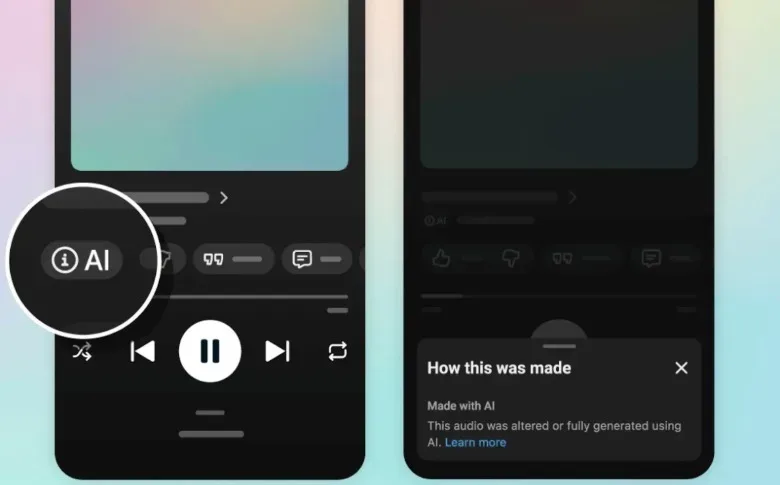
YouTube Music has introduced a visible AI label for tracks made wholly or substantially with artificial intelligence tools. It is a small interface change with a large practical purpose: listeners can more readily tell when a song was generated by a model, or when a model created a major component of it, before deciding whether to press play.
The oblong label appears directly under a track’s name. Selecting it opens further information about the role AI played in the recording. The system is intended to cover more than songs produced entirely by generative software. It also applies where AI was used for significant elements, including vocals.
What the new AI marker means
“AI-generated” can mean different things in music, and YouTube Music’s approach acknowledges that ambiguity rather than treating every release as either completely human-made or completely machine-made. A track may be built by an AI system from the ground up, but it may also contain an AI-created vocal or another central musical part while involving people elsewhere in its production.
The key standard is whether AI had a significant role. That phrasing matters. It signals that the label is not necessarily a broad warning for any use of software in a music-production workflow. The stated scope instead concerns fully generated tracks and releases in which a model made major components.
For listeners, the most immediate benefit is clarity at the point of choice. Rather than needing to infer a track’s origins from an artist name, a thumbnail, a comment section or the sound of a vocal, users can see the AI marker alongside the title. Opening the label provides additional detail on how the technology was used.
The label is designed for tracks where AI played a significant role, including music fully generated by AI and songs using AI for major elements such as vocals.
Why placement in the music interface matters
A disclosure policy only helps if listeners can actually find the disclosure. Putting the indicator directly beneath a track name makes it part of ordinary browsing rather than a detail buried in credits or an external help page. That is especially relevant in a streaming setting, where people often make listening decisions quickly while scanning search results, playlists, albums and recommendations.
The tap-through explanation is equally important. A short “AI” badge identifies that generative technology was material to a track, but the expanded information is positioned to answer the obvious next question: what did the AI do? That distinction can matter to listeners who draw different lines between a wholly generated song and a production that used AI for one major element.
This does not tell listeners whether they should like, reject or avoid a particular song. It gives them information with which to make that decision themselves. Some people may be comfortable with AI-assisted music but want to avoid fully generated recordings. Others may seek out generative work specifically. A legible label serves both groups better than obscurity.
A response to a crowded and confusing music feed
The growth of AI-made audio has made identification more difficult for users navigating large music libraries. The concern is not only sonic quality. A listener may want to know whether a track is attached to a genuine artist, whether the voice is synthetic, or whether the work was materially generated by a model. Without a consistent disclosure system, that information can be uneven, absent or difficult to assess.
YouTube Music’s label addresses the identification problem rather than trying to make an aesthetic judgement. The badge does not claim a track is good or bad, and it does not establish that every AI-involved work is the same. Its role is descriptive: it indicates meaningful AI involvement and offers a route to more detail.
That distinction is useful because generative AI is not one uniform production method. In plain terms, a model in this context is a system capable of producing content from patterns it has learned. When used for music, it can be used to create entire tracks or major elements within them. The new labeling system is aimed at making that involvement visible when it reaches a consequential level.
Video labeling is planned too
The change is presently focused on YouTube Music, but the company has said equivalent labels are also planned for the video player in the regular YouTube app. That is a meaningful extension because music videos and music-related uploads occupy a major place on the main video service.
The video platform already uses labels for AI-generated video content, so a music-specific expansion follows an existing pattern of disclosure. Still, the two environments create different browsing habits. A music listener may be choosing a track based on title and artist, while a video viewer may be evaluating an upload through its thumbnail, title and visuals. Bringing AI information to both surfaces could make disclosure more consistent for people who move between them.
No date was provided for the video-player rollout. Until that arrives, users should not assume that the music label’s presence in YouTube Music means every related music video will display the same notice in the standard YouTube player.
How this fits the wider platform response
YouTube Music is not alone in confronting questions around synthetic audio. Spotify has started labeling fake artists, while Deezer is working on a filtering system intended to remove AI material from discovery. These are different approaches to a shared platform challenge: listeners need ways to distinguish, understand and control what they encounter.
Labeling and filtering are not identical. A label leaves a track accessible but attaches context to it. A filtering system changes what is surfaced or excluded in certain discovery contexts. A service can choose either route—or combine them—depending on whether its goal is transparency, listener control, discovery management or some mixture of all three.
YouTube Music’s current move is firmly in the transparency column. It does not, from the information available, promise a filter that removes AI-marked tracks from results or recommendations. Instead, it provides a visible designation and an explanatory menu. Anyone hoping for a universal opt-out tool should treat that as a separate feature question, not something guaranteed by the presence of the label.
What listeners can do now
For users who want more control over what they hear, the practical process is straightforward:
- Look beneath a track title for the oblong AI marker.
- Select the marker to view information about how AI was involved.
- Use that disclosure to decide whether to listen, save the track, or continue browsing.
That may sound modest, but it changes a previously uncertain piece of metadata into information presented during normal use. It can also reduce the need for listeners to make snap judgements based on a track’s production sound alone—an unreliable way to determine how music was made.
The bigger question is trust, not just technology
The wider significance of the change is about trust in digital catalogs. Recommendation systems and search tools work best when audiences feel they understand the items placed in front of them. A clear AI disclosure helps a listener make a more informed selection, even where the listener ultimately decides the label makes no difference to their choice.
That same broad issue—how platforms communicate the provenance or reliability of material and activity—also appears in other online systems. For example, temporary economy holds aimed at suspicious gold trading in World of Warcraft: Forever show how digital services can add friction or context when user confidence is at stake. The methods differ, but the underlying design challenge is familiar: give people clearer signals in environments where scale makes independent verification difficult.
For music, the effectiveness of the YouTube Music label will depend on whether the disclosures are consistently applied and whether the expanded panel gives listeners meaningful, understandable detail. The announced design is promising because it puts the first signal in a highly visible place and makes further context available with a tap.
It also avoids pretending that every listener shares one standard for AI use. Instead of making that decision on their behalf, the service is supplying a tool for informed listening. As generative audio becomes more common across streaming platforms, that kind of plain, track-level disclosure may become one of the most useful ways to keep music discovery understandable.