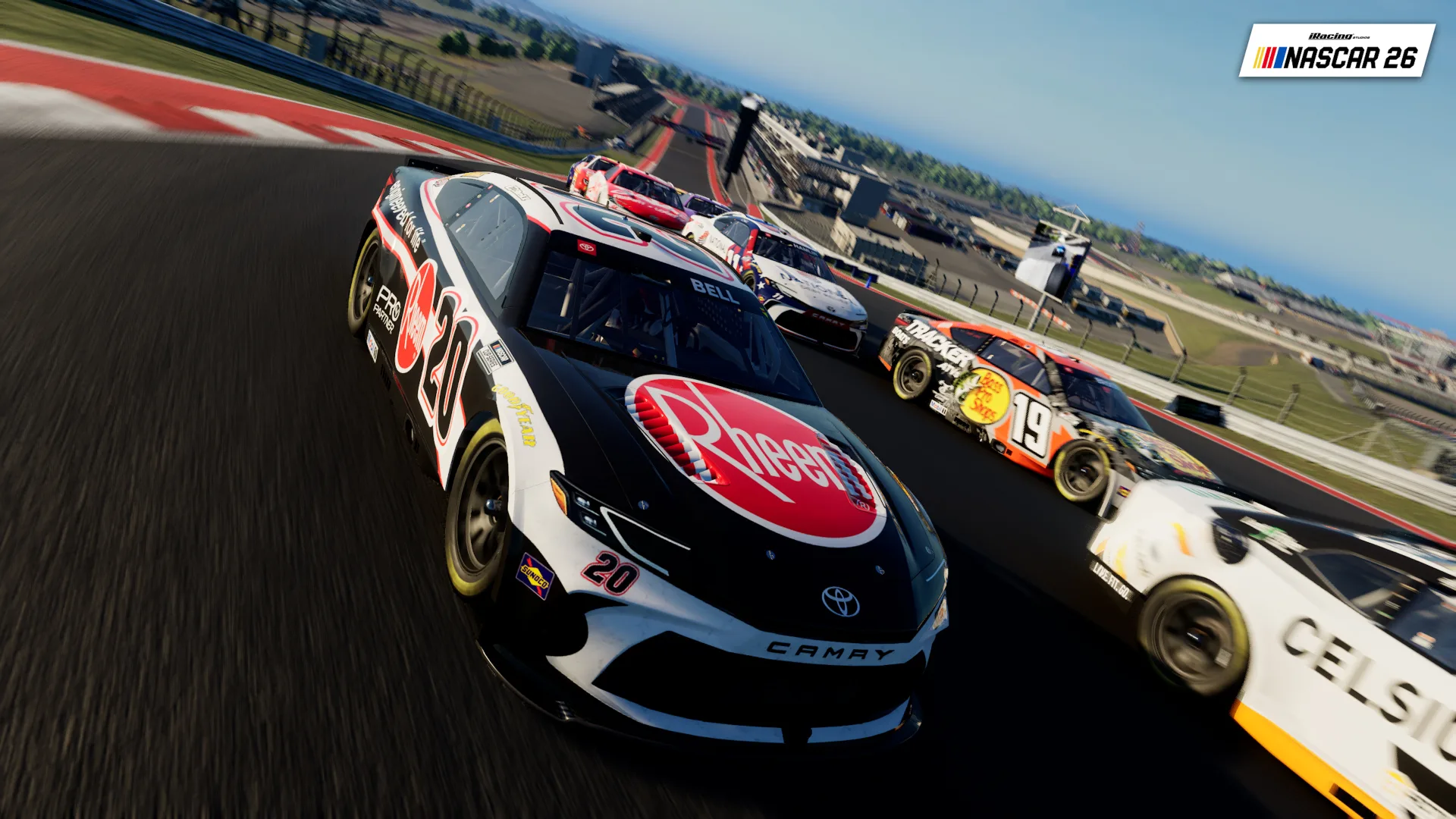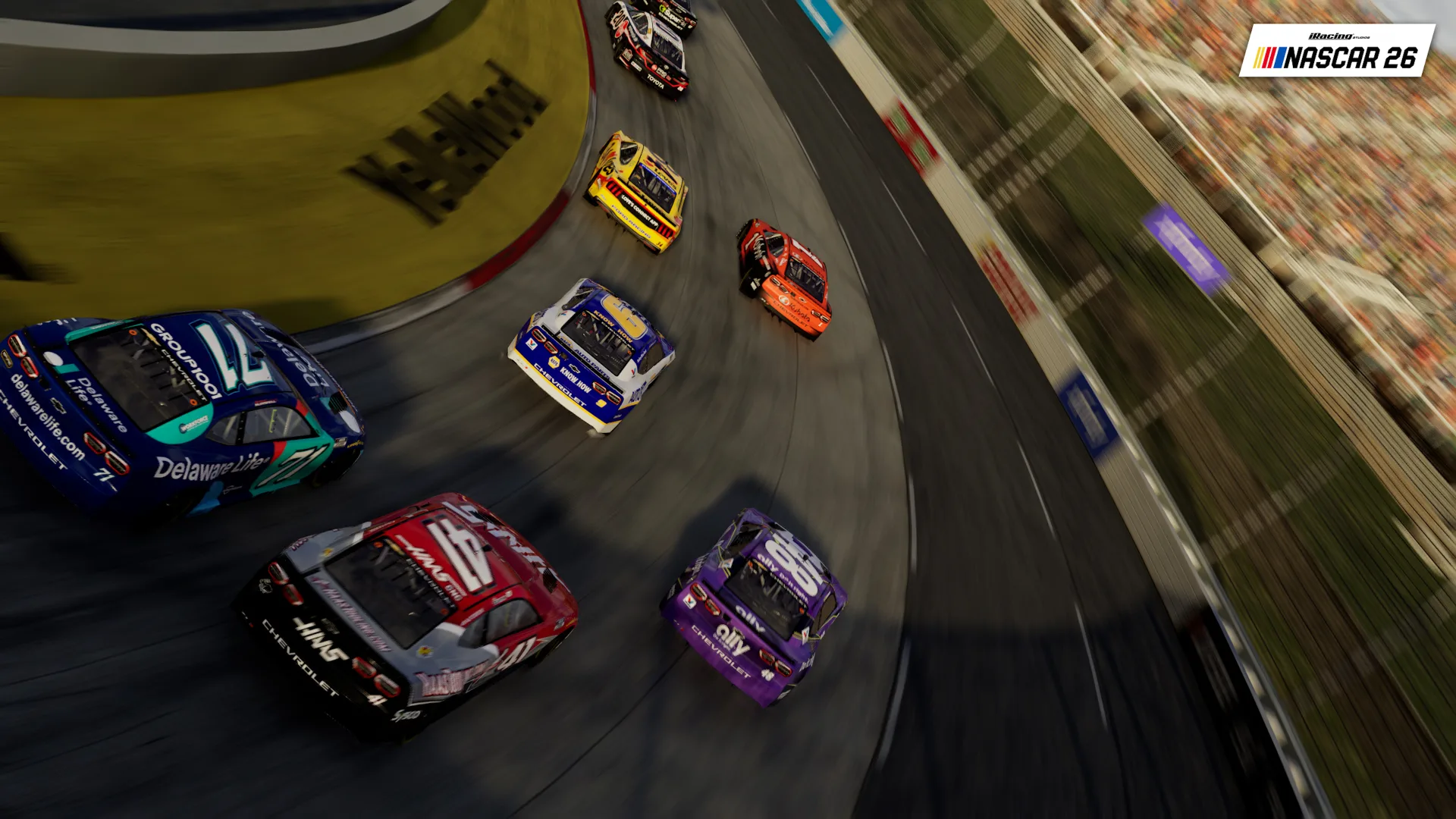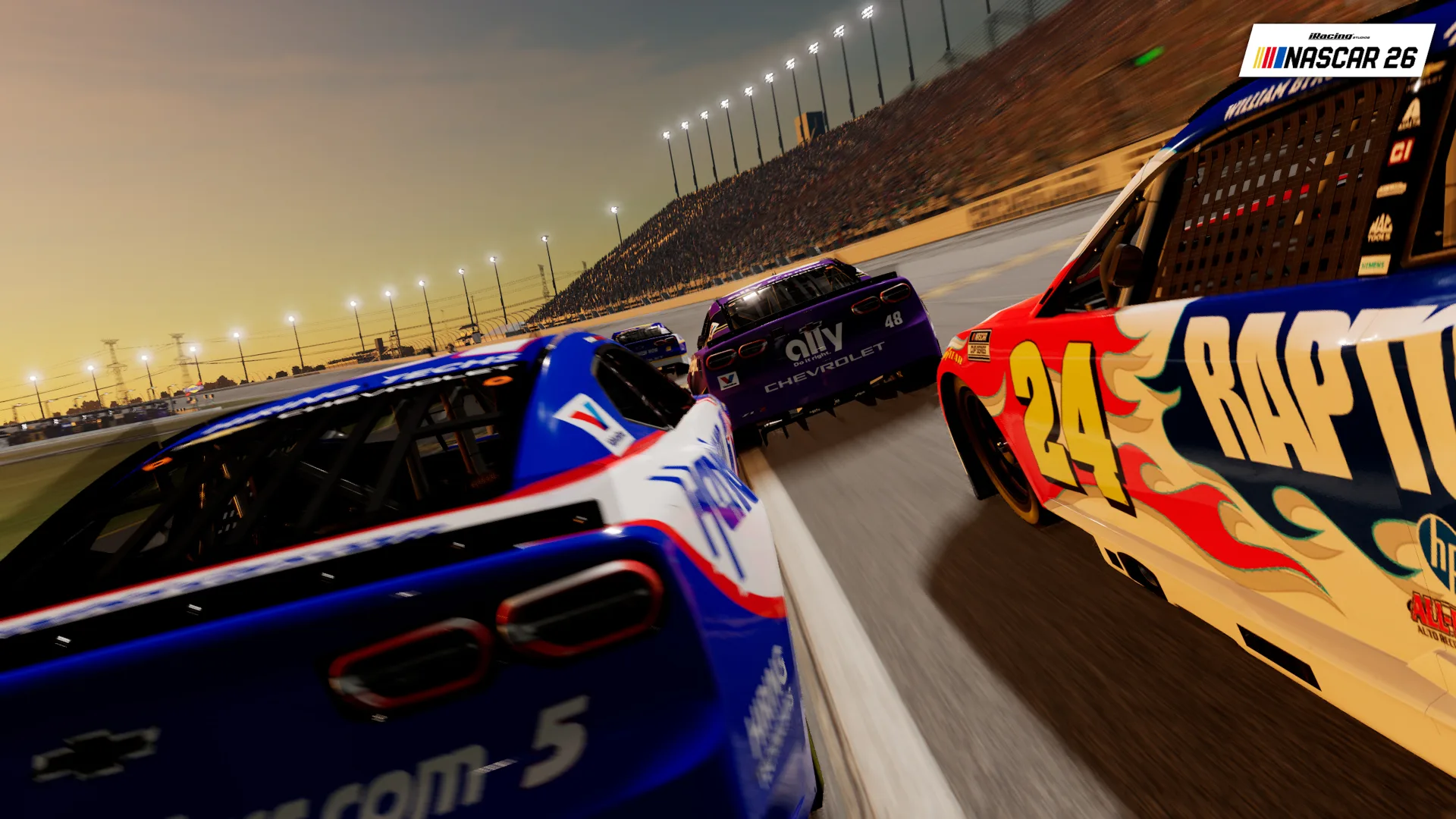
NASCAR 26 is now available on PC and consoles. iRacing Studios NASCAR 26 is available digitally for PlayStation 5, Xbox Series X|S and PC through Steam. NASCAR identified September 18 as the Standard Edition launch date, while Steam displays September 17. Storefront timing and date-display conventions can differ, but the important buying information is straightforward: the game is now available on all three confirmed platforms.
This is a post-launch news explainer rather than a hands-on review from Joking Joystick. The assessment reflects the game’s documented official feature set alongside published evaluations from reviewers who have played it. NASCAR 26 has a substantial licensed foundation: four included series, a structured Career mode, a configurable Chase championship, training content, editable driver ratings and cross-platform multiplayer. At the same time, published evaluations describe the release as an iterative step and report reservations around team-management depth, AI consistency, race procedures, controls and some presentation elements. Those reports are useful context, not findings independently reproduced by this publication.
For prospective players, NASCAR 26 is best approached as a broad stock-car racing package with several ways to participate. Players can run individual events, build a longer campaign in Career, use The Chase for a compact championship, learn through Peak Performance or race online across supported platforms. iRacing Studios and NASCAR also emphasize an evolving track surface plus revised tire and braking systems. Those are official feature claims; they should not be read as a guarantee that every track, control setup, race length or online lobby will produce the same experience.
For our critical recommendation and the limits behind it, read the NASCAR 26 review.
Four included series provide the core racing package
NASCAR 26 includes the NASCAR Cup Series, NASCAR O’Reilly Auto Parts Series, NASCAR Craftsman Truck Series and ARCA Menards Series. These four categories are confirmed parts of the base game, not Season Pass additions. Their inclusion gives the game multiple competition classes and racing contexts before any optional downloadable content enters the picture.
That scope matters beyond the number of logos on a feature list. A player who mainly wants top-tier Cup racing can focus there, while someone looking for a wider progression structure has other series through which to compete. The lineup also gives standalone races, championships and Career mode more than one vehicle category to draw upon. NASCAR’s launch material additionally references a 750-horsepower package, reinforcing the game’s focus on the particular demands of modern stock-car competition.
Published reviewers have said the series can feel meaningfully different during play. That is an observation from their sessions rather than a universal promise for every player, but it helps explain why the four-series structure is more valuable than a simple volume claim. The confirmed takeaway is that NASCAR 26 covers Cup, O’Reilly Auto Parts, Craftsman Truck and ARCA Menards competition in its core offering. Official information does not establish every possible custom rule, event setting or season parameter, so buyers should avoid assuming options that have not been detailed.
The four-series selection is nevertheless central to the game’s value proposition. It gives racers alternatives in the cars and competitive settings they use, while providing Career with a broader ladder than a single championship category could offer. For players whose interest is specifically NASCAR-sanctioned stock-car racing, that licensed breadth is one of the clearest strengths of the release.
Career combines weekly planning, facilities and persistent progress
Career is a major single-player pillar in NASCAR 26. iRacing Studios and NASCAR describe an improved Career experience built around weekly planning and facilities, with a trophy room also included. Taken together, those elements establish an ongoing mode designed to connect race weekends rather than simply presenting a sequence of disconnected events.
Weekly planning indicates that Career places races within a wider schedule. Facilities add an organizational layer to the player’s campaign, and the trophy room provides a persistent record of achievements. In practical terms, these features are aimed at players who want results, advancement and accomplishments to exist within a continuing structure instead of treating every race as an isolated start.
There are clear boundaries to what the available evidence supports. Published reviews have characterized team development and the wider Career world as limited in depth. That does not contradict the presence of planning, facilities or a trophy room. It does mean the announced features should not be mistaken for confirmation of an exhaustive ownership, finance, personnel or business-management simulator. The official material establishes a racing progression framework, not detailed control over every function behind a real-world race organization.
Career is therefore likely to be most relevant to players seeking a guided route through the game’s competitive structure, visible progress and an ongoing record of success. Those whose priority is complex administrative management should give proper weight to the published reservations. A mode can provide meaningful progression and still leave some of the broader team-running fantasy less developed.
The official September 23 update made several specific Career-related corrections. Its notes say worn-part identification and repair-progress displays were improved, while Career text was corrected. Better information about condition and repairs can be particularly useful in a continuing mode. However, the patch should not be described as a wider Career overhaul: the published notes identify targeted display and text changes, not a redesign or expansion of the mode’s systems.
The Chase offers a configurable ten-race championship
NASCAR 26 includes The Chase, which is described as a configurable ten-race championship. It offers a middle ground between a one-off event and a longer Career commitment. Ten races can give standings and finishing positions cumulative importance while still presenting a defined, relatively compact competitive arc.
The mode has timely real-world context. NASCAR returned to The Chase championship format for the actual 2026 Cup Series after using an elimination-style playoff format. That sporting decision should remain distinct from the game feature. The real-world change concerns the 2026 Cup Series, while NASCAR 26 presents The Chase as an optional game mode. Its presence does not establish that every mode follows the same format, and the supplied information does not define every configuration choice beyond the ten-race description.
For players with limited time, a shorter championship can create points pressure and a clear endpoint without requiring an extended Career run. It may also appeal to groups that want a standings-driven competition with a manageable calendar. The practical attraction is consequence across multiple races without the larger commitment implied by a long-running campaign.
Peak Performance and driver ratings add learning and customization tools
Peak Performance is NASCAR 26’s confirmed training feature, and it includes Steve Letarte and Jamie McMurray. The official information establishes its training role and its featured personalities. Editorially, that makes it a potentially useful entry point for players who want structured preparation before moving into more competitive races, whether they are new to NASCAR games or simply unfamiliar with the game’s systems.
A training feature cannot ensure that a player will master every racing situation. Drafting, braking, traffic management, restarts, defending track position and reacting to changing conditions still require application during events. Its practical purpose is to provide a designated learning space rather than asking every player to work out the basics only through full races. With four included series and varied track types in the package, that kind of onboarding has a clear place.
Driver ratings are a separate customization feature. Official information says Racing Insights-backed driver skills are divided into Superspeedway, Speedway, Intermediate, Short Intermediate, Concrete, Road Course and Martinsville categories. Players can view both detailed and overall ratings, and individual driver ratings can be edited.
This gives users a way to inspect how the game represents drivers across distinct track classifications and then alter the field to suit their own preferences. A player can retain supplied values or build a more personalized competitive environment. What the documentation does not establish is a fixed result from any one edit. The ability to change ratings is confirmed; a guaranteed AI outcome from a particular adjustment is not.
Dynamic track grip and revised physics are major official claims
The driving systems most likely to shape race decisions are NASCAR 26’s revised tire and braking model and dynamic track grip. NASCAR and iRacing Studios present these as key parts of the game’s on-track design. Their stated role is to make tire behavior, braking, car control and the evolving race surface meaningful factors during an event.
Dynamic grip is intended to ensure that the track does not remain entirely static across a race, while the tire and braking changes are intended to put greater focus on managing the car. These remain official design claims, not evidence that the systems will have identical results at every venue, difficulty level, input method or event distance.
Published evaluations provide a mixed but useful perspective. Reviewers have positively discussed car control, on-track battles, wheel feedback, lighting and track detail in their own play. Other reported observations include steering or braking quirks, inconsistent AI behavior, and issues involving pit or caution procedures. Neither side of that evidence should be inflated into a certainty for every owner. It does, however, explain why the game’s documented racing ambitions come with legitimate questions about refinement.
The broad conclusion is that NASCAR 26 places substantial importance on what happens during a race, not only on licenses, menus and progression. Players are meant to respond to changing conditions, other cars and the behavior of their own vehicle. The evidence supports describing these systems as central to the game’s identity; it does not support calling them flawless.
New venues and presentation features expand the setting
iRacing Studios highlights Chicagoland Speedway, the St. Petersburg street circuit and Qualcomm Circuit at Naval Base Coronado among NASCAR 26’s additions. Those locations span a speedway, a street-course environment and a circuit situated at a naval base. Different layouts and settings can affect how players approach an individual race, a Career weekend or an organized multiplayer event.
The game also advertises lighting and replay-camera upgrades. These kinds of changes can matter for following a race, examining incidents and saving highlights from organized competition. Published reviewers have favorably noted lighting and track detail, while some also flagged interface and replay oddities. The evidence supports the conclusion that presentation received attention, but not the claim that every camera view or menu interaction is free of problems.
Other announced elements include Freddie Kraft as spotter and the Ram truck. These features contribute to the overall licensed presentation and content package. They are less likely to determine a purchase by themselves than Career or cross-play, but they help define the game as more than a basic chain of starts, finishes and results screens.
Cross-play connects platforms, with lobby limits to consider
Cross-platform multiplayer supports PlayStation 5, Xbox Series X|S and Steam. This gives groups split among the three supported platforms a way to race together and can broaden the available online player pool. There is also a console-only cross-play option for players who want PlayStation and Xbox participation without Steam users.
Password-protected lobbies are available on all three platforms. Private lobbies are available only on consoles. That difference matters to organizers: a password can coordinate a cross-platform group, while anyone who specifically requires the private-lobby option needs to account for its console-only availability. The September 23 update also added a car-adjustment slider to multiplayer lobbies when custom setups are disabled. That is the stated scope of the change, rather than proof of a broader multiplayer revision.
On PC, keyboard, gamepad and wheel controls are supported with remapping, but mouse input is absent. Steam Deck is listed as playable but not officially supported. There are no Nintendo Switch, Switch 2 or VR versions. Steam additionally discloses that some voice lines and other user-interface presentation elements use AI-generated material. Readers considering console wheel hardware can also see our report on Moza’s official PlayStation racing wheels.
Pricing, Season Pass content and the September 23 update
NASCAR 26 is digital-only. The Standard Edition costs $59.99. The Gold Edition costs $79.99 and includes the Season Pass, which is also available separately for $24.99. According to the official FAQ, the pass covers four monthly DLC packs featuring paint schemes and Career bonuses. Standard is the direct route to the confirmed four-series base game; Gold is the more logical choice for buyers who already expect to want the scheduled DLC.
The official September 23 update is live on Xbox, PlayStation and Steam. Beyond its Career and multiplayer-lobby changes, the listed fixes address female driver models missing from some race cinematics and an incorrect button prompt on the News screen. These are meaningful launch-period corrections, but they should not be expanded into claims about fixes that are not listed in the official notes.