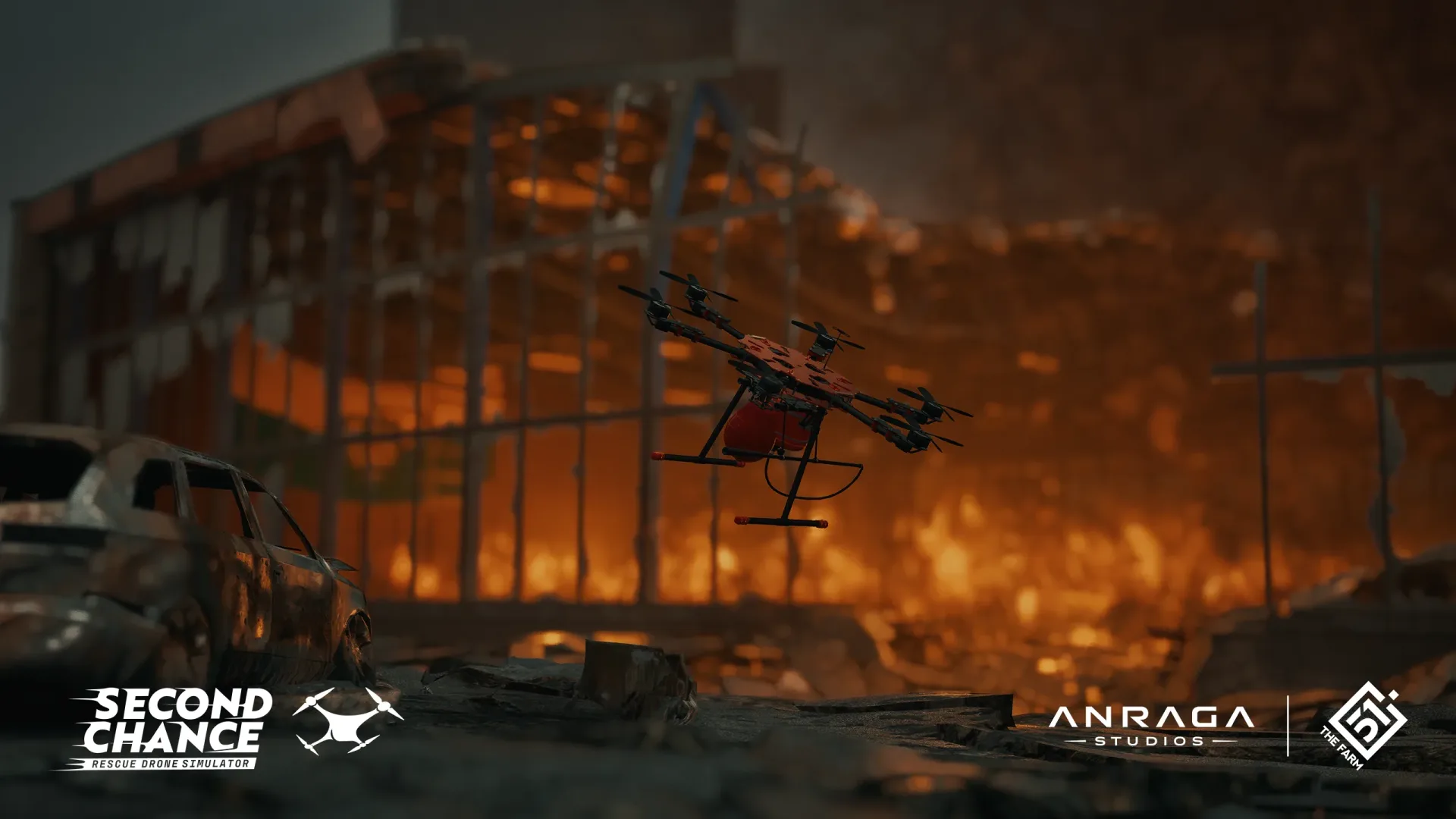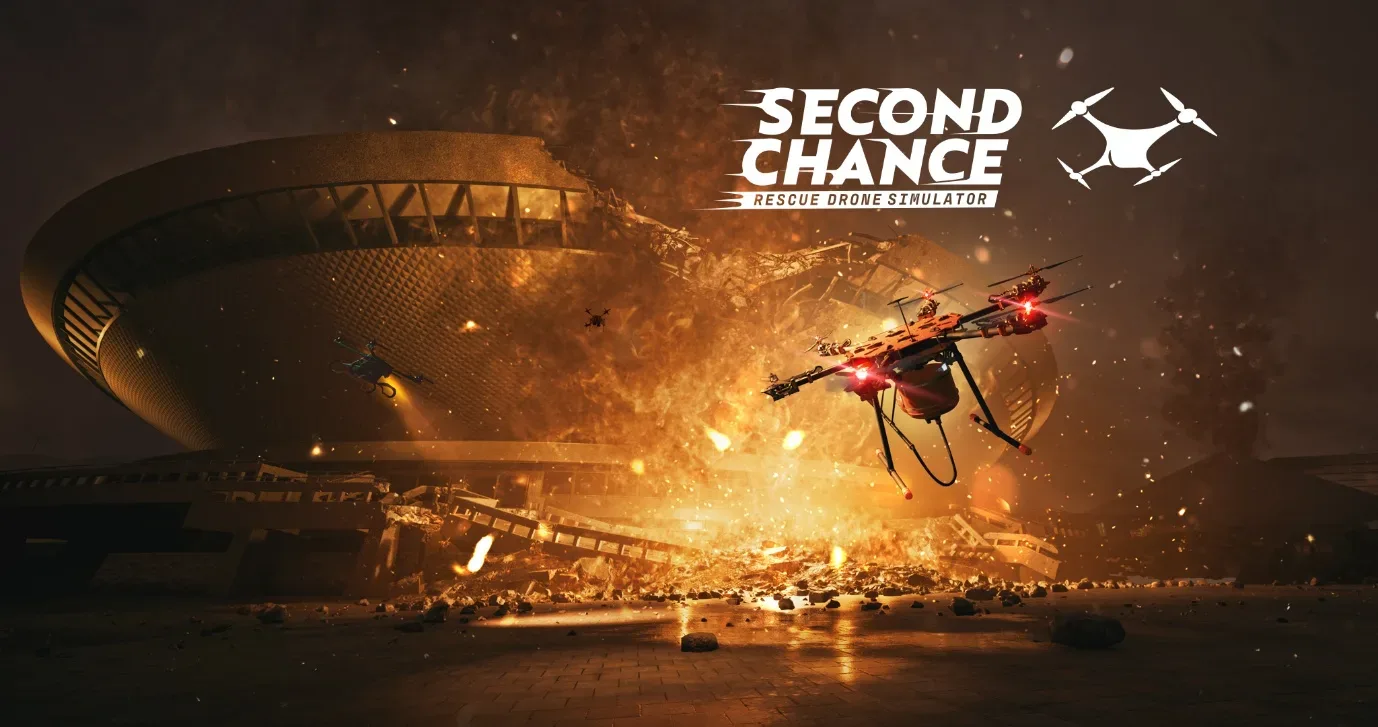
Rescue Drone Simulator: Second Chance has received its first gameplay trailer, bringing its emergency-response premise into clearer focus ahead of a planned Q1 2027 launch. The footage places the camera at the drone’s point of view as an operation unfolds amid fire, smoke and terse radio traffic, while also identifying two cooperative roles: a Firefighting Drone and a Medical Drone.
Anraga Studios and The Farm 51 have said the game is planned for a simultaneous release on PC via Steam, PlayStation 5, and Xbox Series X|S. Its Steam page is already open for wishlisting. The trailer begins in a burning Katowice map before cutting through further locations, presenting a rescue setting where navigating the scene appears to be as important as carrying the right equipment.
Viewers can watch the official gameplay trailer to see the drone-camera framing, active fire scenario and snippets of the radio atmosphere in motion.
Two drone roles, one emergency operation
The most concrete gameplay detail from the footage is the pairing of firefighting and medical drones. Rather than depicting a single all-purpose remote aircraft, the trailer frames the response as a cooperative effort in which different machines work side by side.
The Firefighting Drone’s purpose is readily suggested by its name and the burning Katowice scenario: it is tied to managing the active fire emergency. The Medical Drone is positioned as the complementary role within the rescue operation. Beyond those broad roles, the footage does not establish a full list of tools, objectives, player counts, progression systems or exact cooperative rules. Those remain details to be clarified later.
Still, the split matters because it establishes a design direction. Cooperation in games can mean simply having multiple players performing the same task near each other. A role-based setup instead suggests that teams may need to consider responsibility and timing: one drone’s work can create the conditions for another drone to act effectively. That is an interpretation of the trailer’s framing, not confirmation of specific mission mechanics.
What “payload weight” means for flying
The developers specifically identify payload weight as a factor affecting drone handling. A payload is the item or equipment a vehicle carries beyond its own essential operating components. In this context, that could mean mission equipment associated with a drone’s emergency-response job, though the footage does not spell out every item that can be carried.
The important point is that the game does not present the drone as a frictionless camera floating above an incident. Weight affecting handling means the act of transporting equipment is connected to movement. Players may need to account for how the machine responds while it is carrying a load, especially when conditions are already hazardous.
Related coverage includes Rescue Drone Simulator: Second Chance Shows Firefighting and Medical Drone Gameplay.
That distinction can make a rescue scenario feel more deliberate. If movement changes with what a player brings along, selecting or transporting equipment is not only a visual detail; it becomes part of the pressure of getting through an emergency. Exactly how large that effect is, whether it varies by drone, and whether players can adjust loadouts have not been detailed.
Wind and smoke are presented as operational hazards
The gameplay trailer also calls out wind and smoke as environmental factors that influence handling. Wind is a familiar complication for aerial vehicles because it can push a drone away from its intended route or make stable positioning harder. In game-design terms, it can turn a straightforward trip from one point to another into an exercise in correction and control.
Smoke serves a different but equally meaningful purpose in the trailer’s emergency setting. A dense, active scene full of smoke can limit visibility and make the drone’s camera perspective less clean or certain. The supplied details say smoke affects handling, but do not explain the exact system behind that effect. It would therefore be premature to claim that smoke has a particular visibility model, damage effect or sensor interaction.
Together with payload weight, these conditions point toward a simulator-minded approach: the player is operating a machine subject to circumstances rather than merely directing it through a trouble-free airspace. The trailer’s firefighting scene makes that idea easy to understand. The emergency is not just the destination or backdrop; the surrounding conditions are part of what the operator must manage.
A first-person drone view shapes the tension
The footage is shot from the drone’s perspective. That choice places the player close to the operational view of the incident, with fire and smoke taking up the frame rather than being observed from a distant overview. The trailer uses fragmented audio and voice chatter amid static to reinforce the sense of an unfolding response.
Radio communication is especially central to the trailer’s tone. It provides a connection to the team during an emergency, but the game is not presenting every voice on the frequency as reassuring. The campaign includes an additional narrative thread in which the team’s voices are not the only ones heard, and some of the voices encountered will not be friendly.
That is a deliberately limited tease, and it leaves major questions open. The available information does not identify the hostile voices, explain their motives, or define how they will affect missions. It does, however, establish that Second Chance is aiming for more than a sequence of disconnected technical tasks. Its campaign intends to layer unease and uncertainty over the rescue work.
The use of static and incomplete-sounding communication is effective for that premise because the radio is already a practical emergency tool. When an essential channel becomes unreliable or suspicious, it can add dramatic tension without requiring the game to abandon its drone-operation focus. Whether that idea appears primarily in scripted campaign moments, emergent missions, or another format has not been specified.
Katowice is the trailer’s opening incident
The trailer opens on a large-scale rescue and firefighting operation set on a burning Katowice map. After that opening, it moves through a rapid montage of other locations. Katowice is therefore the clearest confirmed setting shown so far, while the other environments are presented without enough supplied detail to name or characterize them further.
For prospective players, the montage demonstrates that the game is not being introduced solely through one static scene. But it should not be read as a confirmed map list. The footage indicates multiple locations; it does not provide their names, scope, mission types or any guarantee about the number included at launch.
That restraint is useful when evaluating an early gameplay reveal. A trailer is often designed to establish mood, basic systems and visual variety quickly. Here, its strongest confirmed takeaways are the emergency-response setting, the two drone functions, and external factors that complicate piloting.
Platforms and timing
Rescue Drone Simulator: Second Chance is scheduled for Q1 2027 on Steam for PC, PlayStation 5 and Xbox Series X|S. The stated plan is a simultaneous release across all three platforms. No precise launch date, pricing details or edition information has been provided in the available announcement.
The cross-platform plan puts the game among the upcoming PC releases seeking a console audience from the start. For another look at a different forthcoming PC project built around a distinct traversal idea, see Nyra and the Garden of Moros’ choice-driven climbing adventure reveal.
At this stage, players interested in Rescue Drone Simulator: Second Chance can wishlist it on Steam and use the trailer as the best current indication of its direction. The footage makes a clear pitch: coordinated drone work during high-pressure rescue calls, piloting shaped by wind, smoke and carried weight, and a campaign frequency where not every transmission can be trusted.