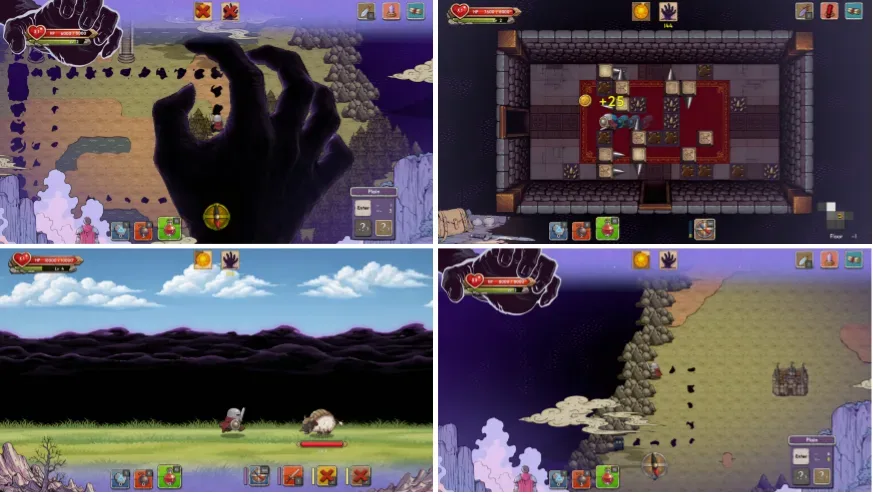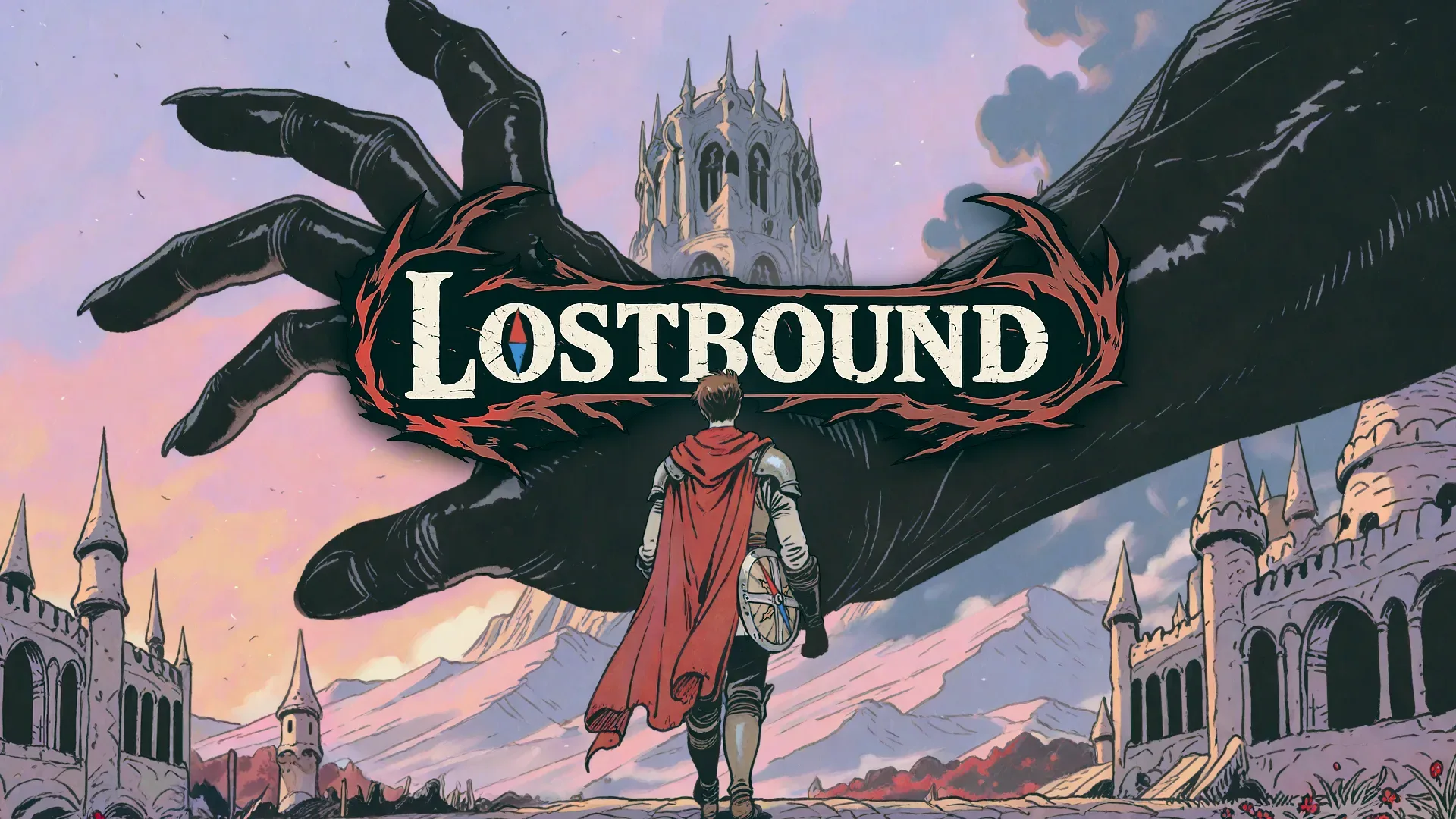
Lostbound is now available on PC through Steam. Developed by Tenkarider and published by Tambù Digital, the action-adventure roguelite asks players to survive an ancient curse in a world where movement itself is a costly decision: the terrain behind the player is consumed by a force called The Hand.
The launch was announced on October 6, 2026. Lostbound is priced at $6.99 / €6.99 / £6.99, with a limited-time 30% launch discount. A free Steam demo is also available, offering a lower-commitment way to see whether its particular brand of route pressure clicks before buying.
A roguelite where the return trip may not exist
Lostbound’s central idea is not merely that a hazard follows the player. The world reacts permanently to each step, while The Hand destroys the ground behind them. That makes ordinary exploration decisions considerably more consequential. Going toward a dungeon, testing an unfamiliar branch of a route, or simply pausing too long can change what remains reachable.
In many exploration games, a player can safely double back after finding a locked route, missing an item, or deciding that an enemy encounter is too risky. Lostbound’s setup instead frames retracing footsteps as a potentially unavailable option. The intended tension comes from keeping forward momentum while still making room for planning.
That distinction matters because it turns navigation into part of the run’s resource management. A route is not simply a line between a player and an objective; it is a temporary opportunity that can be erased. Players will need to weigh the possible value of a detour against the cost of losing ground, and to make decisions without assuming that an earlier area will still be there later.
What The Hand changes
The Hand is the persistent force at the center of Lostbound’s pressure system. It consumes the path behind the player, limiting escape options and encouraging continual movement. At night, it becomes more aggressive, making the game’s day-and-night change more than a visual backdrop. Nightfall is presented as a direct escalation in urgency.
The practical implication is a changing rhythm within each attempt. A player may have time to consider their route during one stretch, then face a sharper need to commit as conditions worsen. The game does not present lingering as a neutral choice: time spent looking around may reshape the path forward and the chance of getting out.
This is also why Lostbound’s premise should not be read solely as a chase mechanic. The destruction behind the player affects future choices. A pursuer that only deals damage asks for quick reactions; a pursuer that removes terrain can also force strategic decisions about direction, timing, and how much uncertainty a run can absorb.
Procedural runs and artifacts
Lostbound combines that route-management hook with familiar roguelite structure. Its worlds are randomly generated, and artifact locations vary between attempts. The result is that players should encounter different paths, opportunities, and problems from run to run rather than following a fixed map with a fully repeatable solution.
Procedural generation means that game content is assembled through variable systems rather than appearing in precisely the same pre-authored layout every time. Here, the confirmed procedural elements are the worlds and artifact placements. That variability is especially relevant to a game built around irreversible movement: a strong-looking route in one attempt may not exist, or may not lead to the same reward, in the next.
Shadowy dungeons are the key destinations within those changing worlds. They contain powerful artifacts, which shape a run and can be combined with abilities to create different builds. A build is the particular set of powers, upgrades, or synergistic effects a player assembles during an attempt. Rather than committing the game to one prescribed approach, artifact combinations are intended to support experimentation.
That design creates two interlocking questions for every run. First: which direction is worth taking before the world closes off? Second: which artifacts best fit the abilities already acquired? Lostbound’s appeal will likely rest on how often those questions create meaningful trade-offs—choosing between a potentially valuable dungeon and a safer route, for example—rather than offering obvious answers.
The game’s announced feature set supports build variety without promising a fixed list of artifact effects or ability types. That is an important boundary. What is clear is that artifacts are powerful, found in dungeons, and designed to combine with abilities. Exactly how broad, rare, or transformative those combinations are will be something players discover in the demo and the full release.
Failure is part of the progression loop
As a roguelite, Lostbound treats unsuccessful runs as part of the larger learning process. The announced design emphasizes gaining knowledge and improving the chance of travelling farther into the cursed world on a later attempt.
“Roguelite” is a broad term, but in this context it points to repeatable attempts with variable conditions and progress based on learning. A failed run need not be wasted if it teaches the player how quickly The Hand changes the map, when night becomes most dangerous, which routes suit a given build, or how valuable a dungeon detour may be. Lostbound specifically positions that growing understanding as a reward of continued play.
Its permanent world changes give failure a specific educational role. Players are not only learning combat or the value of individual artifacts; they are learning to read a map that can disappear behind them. A choice that ends a run may still reveal how much space a future attempt needs to preserve. This creates room for the sort of planning-oriented mastery that roguelite players often seek, while retaining uncertainty through randomized maps and artifact positions.
There is a natural risk in any system built around irreversible choices: it must make a loss feel understandable enough to learn from, while preserving enough unpredictability to stay interesting. Lostbound’s stated focus on random worlds, variable artifact locations, and route consequences suggests it is aiming for that balance. The free demo provides the most direct way to evaluate how clearly those pressures are communicated in practice.
Who Lostbound may suit
Lostbound appears best aligned with players who enjoy roguelites where planning matters as much as forward action. Its structure emphasizes exploration, flexible artifacts, repeated attempts, and decisions made under increasing time pressure. Players looking for a fixed map that can be thoroughly cleared at a leisurely pace may find its disappearing paths deliberately restrictive; that restriction is the premise, not an incidental obstacle.
The game may also appeal to people who like adapting a build to what a particular run offers. Because artifacts are placed differently across procedurally generated worlds, the player’s available options can influence both combat or ability choices and navigation priorities. The desired artifact could be in a dungeon that is reachable now but costly to pursue, and the safer road may offer a less ambitious setup.
For PC players browsing new Steam releases, Lostbound joins a field of games using focused mechanical hooks to distinguish their repeatable runs. Another upcoming oddball Steam concept, Crack, takes its premise in an entirely different direction, but both underline how a sharply defined interaction can shape a game’s identity.
Lostbound launch details
- Game: Lostbound
- Developer: Tenkarider
- Publisher: Tambù Digital
- Platform: PC via Steam
- Release date: October 6, 2026
- Price: $6.99 / €6.99 / £6.99
- Launch offer: Limited-time 30% discount
- Demo: Free demo available on Steam
Lostbound’s immediate proposition is easy to state but potentially demanding to master: keep moving, choose a direction, and accept that the place you have just left may no longer be available. With dungeons, artifacts, build experimentation, randomized worlds, and a more dangerous night cycle layered on top, the game is designed to make every run a fresh attempt to outthink a curse that erases the past one step at a time.