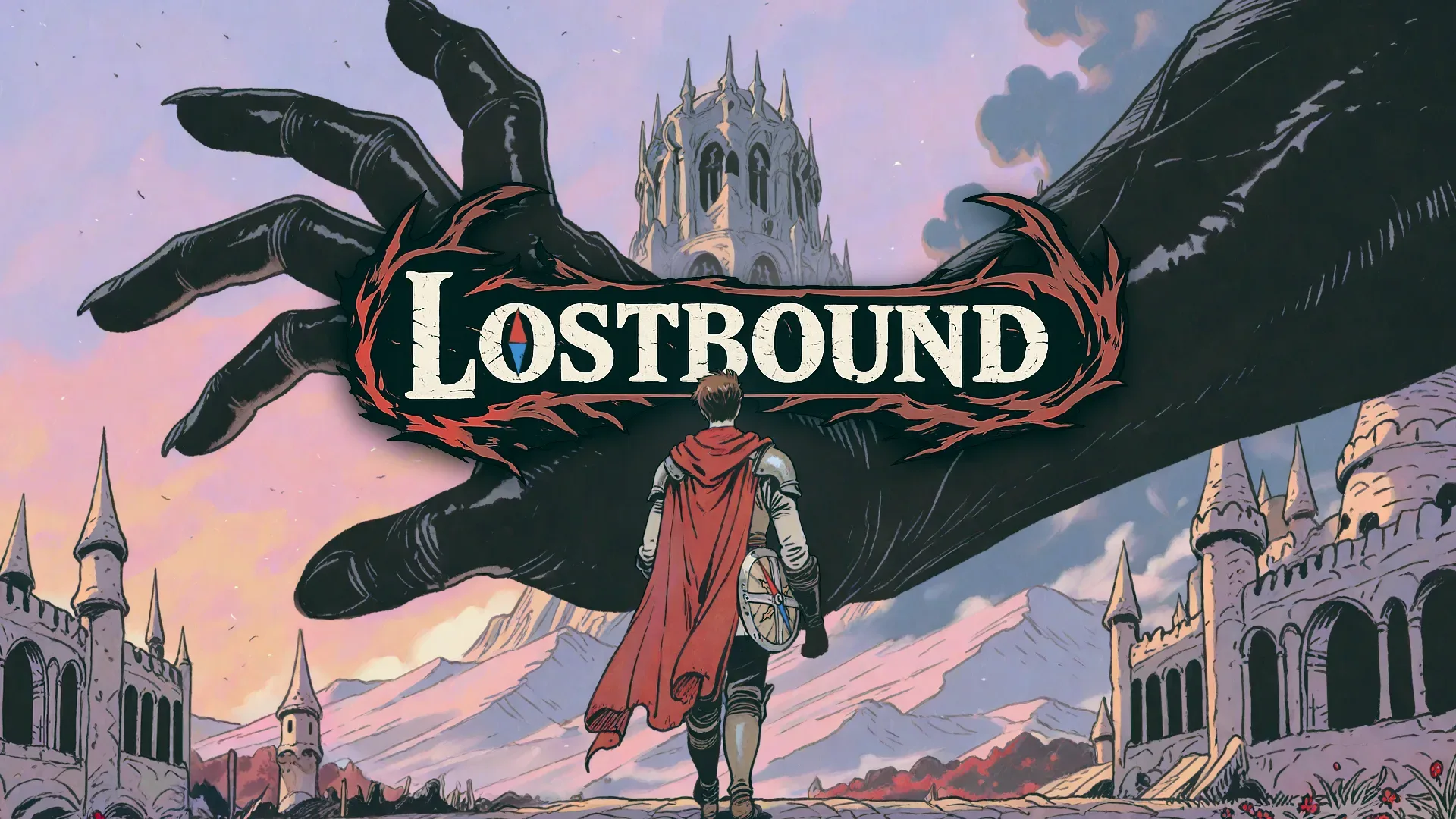
Lostbound, the dark roguelite action RPG from developer Tenkarider and publisher Tambù Digital, is scheduled to launch on PC through Steam on October 6, 2026. Its central problem is wonderfully impolite: players are trying to escape a world that collapses behind them, while a mysterious force known as The Hand steadily gives chase.
That premise puts pressure on more than combat. Previously explored routes can be destroyed, meaning a trip back to a familiar area may not be an option. Lostbound’s exploration is therefore built around decisions with consequences: press farther into the unknown in search of progress, or retreat while a route remains available. The game also asks players to account for nightfall, limited resources, hostile dungeons and a pursuer that apparently has no interest in letting anyone stop to admire the scenery.
A free demo is available now, offering a look at the game’s world, exploration, dungeon-delving and the ever-present threat posed by The Hand. The PC launch will arrive through Steam, a platform whose place in PC gaming has a history explored in our look at the early circumstances that helped set the stage for Steam.
A roguelite where the map refuses to be a comfort blanket
Lostbound combines retro-inspired, nonlinear exploration with roguelite progression. “Nonlinear” here means exploration is not presented as one strictly prescribed route from point A to point B. Players can investigate, choose directions and weigh possible paths. In many exploration-focused games, previously visited territory becomes a useful safety net: a known route back, a remembered cache of supplies, or simply a place to reorient after a dangerous discovery.
Lostbound complicates that familiar arrangement. The Hand destroys paths that have already been explored. This turns the changing world into a core system rather than background decoration. A decision to move on carries an opportunity cost: whatever lies behind may cease to be reachable. Conversely, turning back may preserve safety in the immediate moment but consume valuable time while darkness approaches and the pursuit continues.
The announcement does not detail exactly how quickly routes vanish, what form every destroyed path takes, or every circumstance in which The Hand closes distance. Those particulars will matter to the final rhythm of a run. What is established is the intended tension: players are not merely uncovering a map. They are moving through a map that is actively removing their ability to revise earlier choices.
That is a clean fit for a roguelite structure. A roguelite generally builds repeated attempts around variation and learning, rather than treating every failure or ending as the end of the experience. Lostbound specifically emphasizes adapting across runs. Its randomly placed Artifacts and collapsing routes should mean that knowledge is valuable, but never enough to make the next trip entirely routine. The world has apparently decided that a dependable commute is against its values.
Artifacts are the variable in each escape attempt
Players will search for randomly placed Artifacts that modify their builds. In action RPG language, a build is the collection of capabilities and modifications that shape how a character operates. It can influence the approach a player takes to danger, whether that means leaning into a particular strength, compensating for a weakness or responding to whatever the run has made available.
The announcement does not specify individual Artifacts or their effects, so it would be premature to assume particular combat styles, weapon types or character classes. The important confirmed point is that placement is random and Artifacts alter builds. That gives runs an element of experimentation: players will need to assess what they find, decide its value in the current situation and adapt their plans as the available tools change.
Random placement does not just add surprise for its own sake. In a game where routes can be lost, an Artifact’s location can affect the risk attached to reaching it. A useful discovery deeper in dangerous territory may encourage a player to commit to a route. A less immediately helpful find can still be part of the broader calculation if it supports survival in the dungeons ahead. The available information suggests Lostbound wants those choices to feel connected rather than separated into neat boxes labelled exploration, loot and escape.
Dungeons add enemies, traps, secrets and rewards to the clock
Exploration will lead players into dark dungeons containing enemies, traps, secrets and rewards. This is where Lostbound’s broader pressure systems have room to overlap. Dungeons are not described as optional or linear, and no details have been provided about their size, layout or boss encounters. Still, the announced ingredients make the intended mood clear: these are places to investigate carefully, but the larger game is not interested in granting unlimited time for careful investigation.
Traps and secrets reward attention, while enemies require action-RPG responses. Rewards offer a reason to take risks. Yet the pursuing Hand and the approach of night mean that “one more room” may be a strategic choice rather than a harmless impulse. Players must manage both time and resources, which places a practical limit on how long they can spend extracting every possible advantage from a dungeon.
Resource management refers to making limited supplies, health, tools or other finite advantages last long enough to meet an objective. The announcement does not identify the precise resources in Lostbound, so players should not read that as confirmation of a specific inventory, currency or crafting system. It does confirm that resources matter and must be managed. In context, that means a successful run is likely to depend on judgment as much as on overcoming individual threats.
Night is another part of that pressure. The game explicitly asks players to consider the passing time as night approaches, alongside the advancing Hand. It is not yet clear what night changes mechanically beyond contributing to the urgency. It may be a threshold players want to avoid, an escalating state, or simply a strong signal that the world is becoming more dangerous. Until more is detailed, its exact effects remain unknown. The key takeaway is that Lostbound gives its escape a clock, even if the clock is expressed through the world rather than a prominently stated timer.
The Hand is more than a monster at the end of a hallway
The Hand is described as a mysterious force that relentlessly pursues the player and destroys already explored paths. That makes it distinct from a conventional enemy waiting in a fixed room. It acts as a continuing source of spatial pressure: it changes where players can go, makes return trips uncertain and turns the route already travelled into something temporary.
This is also why the game’s retreat-or-advance decisions matter. Retreat is usually a defensive choice, but a crumbling path can make retreat impossible or costly if it is delayed too long. Advancing can be risky because it leads toward unknown enemies, traps and dungeons, but it may be necessary because the familiar ground is disappearing. Lostbound’s tension comes from this uncomfortable symmetry. Neither direction is guaranteed to be safe; the task is to decide which danger is more manageable at a given moment.
For prospective players, that framing may be more useful than treating Lostbound as simply another game with randomized loot. The advertised hook is not randomness alone. It is the combination of changing builds with a changing route, all under pursuit. Learning the geography of a world is ordinarily a way to gain control. Here, knowledge still helps, but physical access to that geography is unstable. The game is built to make mastery feel provisional.
What the demo can establish before launch
The currently available free demo is the clearest way for interested PC players to see how these systems read in motion. It provides a preview of Lostbound’s setting, nonlinear exploration, dungeons and The Hand’s persistent threat. It should be especially useful for players who want to know whether the game’s pressure feels compelling rather than merely stressful, because that balance is central to the concept.
There are a few sensible things to focus on when trying the demo. First, observe how exploration choices are communicated: whether paths, hazards and possible returns are easy to read under pressure. Second, pay attention to how Artifact discoveries influence decision-making. An item that changes a build is most interesting when it creates a new plan, not only a larger number on a character sheet. Finally, consider how quickly the threat of The Hand changes priorities. A pursuit mechanic succeeds when it produces meaningful choices, not when it simply makes every detour feel pointless.
The demo is a preview, not a complete statement of the final release, and no broader feature list beyond the announced systems should be assumed from its existence. But it offers an immediate chance to engage with the game’s defining idea before the October 6 release: escape is not just about finding the correct way forward when the world behind you is being erased.
Lostbound release details
- Game: Lostbound
- Developer: Tenkarider
- Publisher: Tambù Digital
- Platform announced: PC via Steam
- Release date: October 6, 2026
- Genre: Dark roguelite action RPG
- Demo: Available now
Lostbound’s proposition is straightforward, even if surviving it may not be: explore a hostile, nonlinear world, assemble a run-specific build from randomized Artifacts, take risks in secret-filled dungeons, and keep moving before The Hand turns your carefully retraced route into geological history.