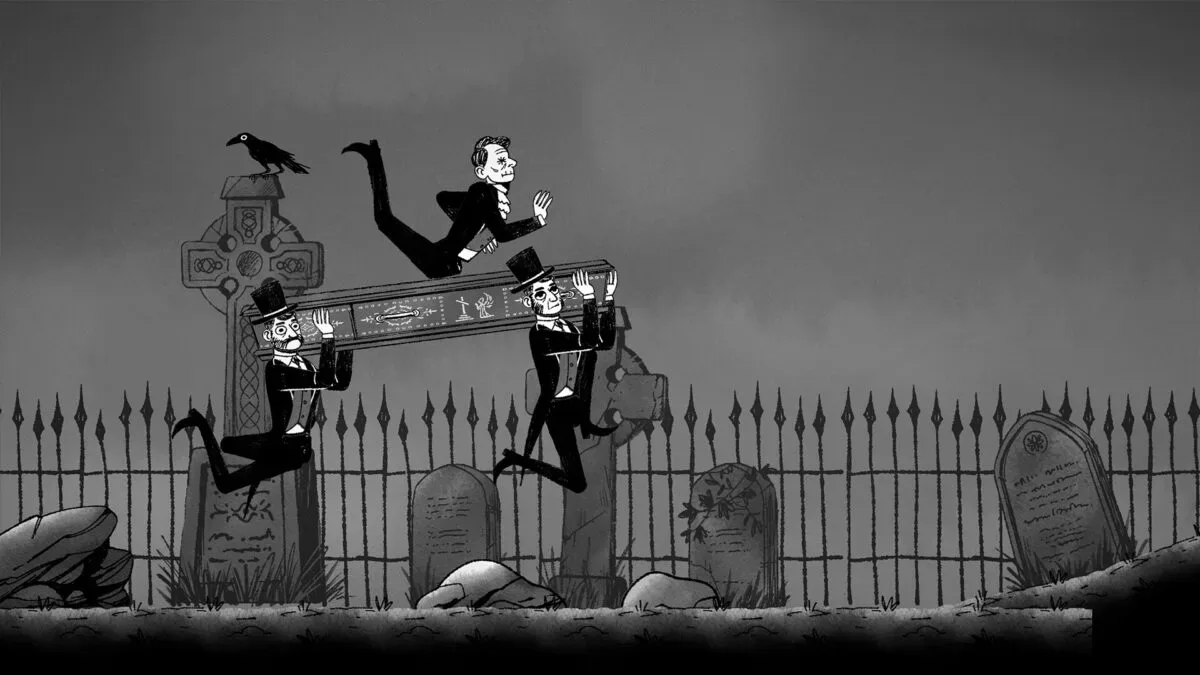
Fallbearers has a premise built for instant disaster: guide a pair of Victorian-era pallbearers from a hearse to a grave while making sure their coffin—and the body inside it—stays where it belongs. The Steam Next Fest demo frames that simple funeral errand as a deliberately ungainly physical challenge, playable alone or with a second player.
The two pallbearers move automatically. The player’s job is not to steer every footstep, but to manage their pace, their jumps and the height at which they carry their slippery burden. That distinction is the heart of the concept. Progress is less about executing a conventional run-and-jump platforming route than continuously making small corrections as the environment tries to turn a solemn procession into a catastrophe.
Busy Victorian streets supply the immediate problems. Manholes, sharp changes in elevation and even an antagonistic bulldog can interrupt the route. The demo is short, but its rules establish a clean comic tension: a route may be survivable, a team may have a limited number of failures depending on the selected difficulty, yet letting the corpse tumble from the coffin ends the attempt outright.
A co-op game built around shared instability
Fallbearers belongs to a recognizable strain of games in which awkward control is not an accidental inconvenience but the principal design language. Its comparison point is QWOP, the famously difficult track-and-field game associated with intentionally unwieldy movement. Here, however, the challenge is expressed through a paired load rather than an individual runner’s limbs.
That makes the coffin more than a visual gag. It is the object that connects the two characters’ actions. Move too quickly, jump at the wrong moment or hold the load at an unhelpful height, and the players can create the very instability they are trying to prevent. In technical design terms, it is a shared-state problem: success depends on maintaining one fragile condition jointly, rather than having each participant independently reach a checkpoint.
Solo play should still offer a manageable version of that balancing puzzle, because one person controls both pallbearers. Two-player play changes the texture of the task. Coordination becomes part of the obstacle course. The players must effectively agree, through actions and timing, on how fast to proceed, when to clear an obstruction and how to adjust the coffin’s position. That can create funny failures, but it also gives successful runs a more collaborative character than a game where two players simply fight separate enemies on the same screen.
The setup is also unusually readable. A coffin slipping, tilting or ejecting its occupant needs little explanation. Players can immediately see both the desired outcome and the disaster to avoid. That clarity is valuable in a brief demo: the game can spend its limited time teaching the rhythm of speed, jumping and carrying height rather than burying its joke under a dense rulebook.
Why the failure condition matters
Fallbearers uses two layers of failure. The available number of mistakes can vary with difficulty, creating some room to recover from trouble. But the corpse leaving the coffin is a hard stop. This creates a hierarchy of hazards. Not every collision or misstep is equally serious, yet every adjustment is made in the shadow of the one outcome that cannot be repaired.
Related coverage includes Fallbearers Turns Victorian Funeral Duties Into a Brilliantly Unsteady Co-op Challenge.
That structure is a useful fit for a comedy game. The route does not need a huge number of complicated systems to generate stories; ordinary obstacles become memorable because they threaten a visibly absurd, all-or-nothing result. A steep incline is no longer merely terrain. A manhole is not merely a hole in the road. Each asks whether the carriers can preserve their balance and dignity at the same time.
The dark humor comes from the contrast between subject matter and treatment. Pallbearing is typically associated with restraint and ceremony, while Fallbearers makes the task physical, precarious and prone to slapstick. The game’s tone has been likened to the “Coffin Flop” sketch from I Think You Should Leave, a comparison that communicates the central image without suggesting the game is simply repeating a television joke. Its gameplay hook is the sustained act of preventing the flop.
Terrain can change the puzzle, not just the scenery
The planned full game is set to expand beyond the demo’s street obstacles with more varied terrain, including snowy areas that require skis. That detail matters because it suggests the routes may alter how players manage motion rather than only introduce different backdrops.
Snow and skis could make the core carrying challenge more demanding by changing the relationship between movement and control. The available information does not detail exactly how those sections work, so it would be premature to assume specific mechanics. Still, the stated need for skis indicates that environments are intended to have gameplay consequences. For a game centered on balance and pacing, that is the more interesting kind of variety: conditions that force players to rethink how they transport the coffin.
A larger set of terrain types could also help Fallbearers avoid relying on one gag. The basic image of two people struggling with a coffin is strong, but a full game needs situations that ask different questions of that idea. Steep slopes already test elevation management; street hazards test timing and jumps; snowy routes may test stability under altered movement. If those challenges remain legible and build on the same carry-and-coordinate foundation, the game’s premise has room to develop without losing its identity.
Finding a concise demo amid an overwhelming event
Steam Next Fest can be difficult to navigate because of the sheer volume of available demos. Fallbearers stands out in that context through a sharply stated premise and a demo that gets to its central activity quickly. There is no announced release date for the complete game, so the demo is currently the clearest indication of what it aims to be: a compact physical-comedy challenge where a funeral procession is one misplaced jump from total collapse.
For players browsing the event, the practical appeal is straightforward. This is not presented as a long campaign preview or a game that requires extensive onboarding before its identity becomes clear. Its basic loop—move, lift, jump, compensate, and above all do not drop the body—can be understood quickly. The co-op option is particularly relevant for people looking for a session built around communication and spectacular mistakes rather than meticulous competitive play.
That makes Fallbearers a different kind of social game from the broad party-game approach discussed in Nintendo Switch Sports Resort. Where a party collection may spread players across multiple activities, Fallbearers narrows everyone’s attention to one comically fragile objective. The constraint is the attraction: both characters are tied to the same coffin, the same route and the same looming game-over condition.
What is confirmed—and what remains unknown
- Confirmed: Fallbearers is a dark-humor game about transporting a coffin from hearse to grave with two Victorian pallbearers.
- Confirmed: It supports solo play and play with a friend.
- Confirmed: Players manage movement speed, jumping and the carrying height of the coffin while dealing with hazards including manholes, inclines and a bulldog.
- Confirmed: Dropping the corpse from the coffin ends the game, while the number of other failures can depend on difficulty.
- Confirmed: The full game is intended to include additional terrain, including snowy sections involving skis.
- Unknown: A release date has not been announced.
- Unknown: The available details do not establish the full range of stages, modes or the precise mechanics of the snow-and-ski sections.
The strongest promise of Fallbearers is not merely that it is funny when things go wrong. It is that the same systems that produce slapstick also demand concentration. Players must judge the route, monitor the load and coordinate their choices under pressure. When the joke and the challenge are driven by the same mechanic, every clean crossing can feel earned—and every airborne coffin has a reason to be terrifying.