There is something immediately disarming about a browser game that lets players raise dogs, plant crops, catch fish, cook enormous lists of food, trade items, dress up their pets, and then send those pets into a dangerous tower full of turn-based battles. Dog Online is built around that wonderfully mismatched proposition, and its recent rise past 10,000 users suggests plenty of people were ready for exactly this sort of weird little digital place.
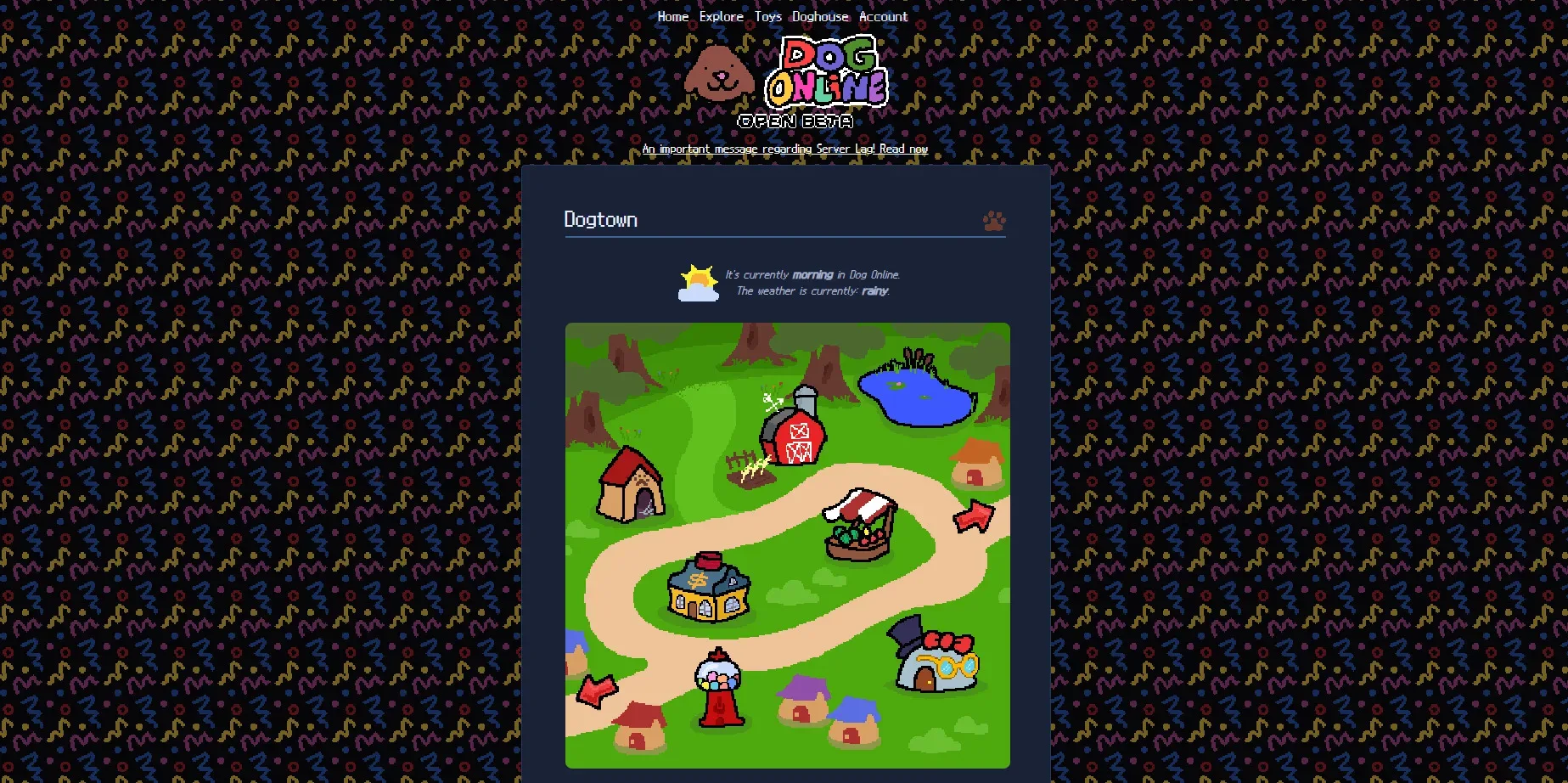
The game remains in open beta, but it is already unusually broad for a small browser project. Players can adopt and level multiple dogs, visit a central area called Dogtown, fish, farm, make recipes, buy clothing, trade, sell goods, exchange gifts with friends and display favorite finds on a personal Dogpage. There is no chat feature, yet its social layer still exists through gifting, personal pages and the community activity forming around the game.
Its visual tone is deliberately scrappy and hand-drawn rather than polished into sameness. That approach supports the game’s old-web energy: Dog Online looks less like a product trying to capture every available second of attention and more like a strange website someone made because it would be funny, satisfying and fun to explore. For a useful overview of the game’s premise and recent momentum, see this look at Dog Online’s browser-RPG revival.
A pet sim with considerably more on its plate
Calling Dog Online a virtual pet game is accurate, but incomplete. Its dog-raising framework provides the center, while a network of collecting, crafting and combat activities gives that center a surprising amount of weight. The current game includes 73 fish, 238 foods, 57 enemies and 76 crops or other harvestable goods, alongside weapons, enemy drops, creatures and other discoverable items.
For more context, explore Carrie Season 2: Is Mike Flanagan’s Prime Video Horror Series Returning?.
Those counts matter because they indicate what kind of game this is. Dog Online is not presented as a short, linear tale with a single checklist of missions. It is a discovery-oriented game in which a player’s next useful activity may be dictated by a newly found ingredient, an unfamiliar fish, an item worth selling, a farm plot that needs time, or a monster that has not yet been defeated.
That breadth also makes the game’s silliness more effective. It has references and deliberately online jokes: a clothing shop called Hot Dog Topic, scene-style outfits, Freaky Tokens, and glasses associated with Deltarune’s Spamton. None of that replaces mechanics. Instead, the humor acts as a wrapper for a surprisingly dense set of systems. The ridiculous names tell players not to take the setting too seriously; the item lists and progression rules give them reasons to come back.
The Lonely Tower gives the game its RPG bite
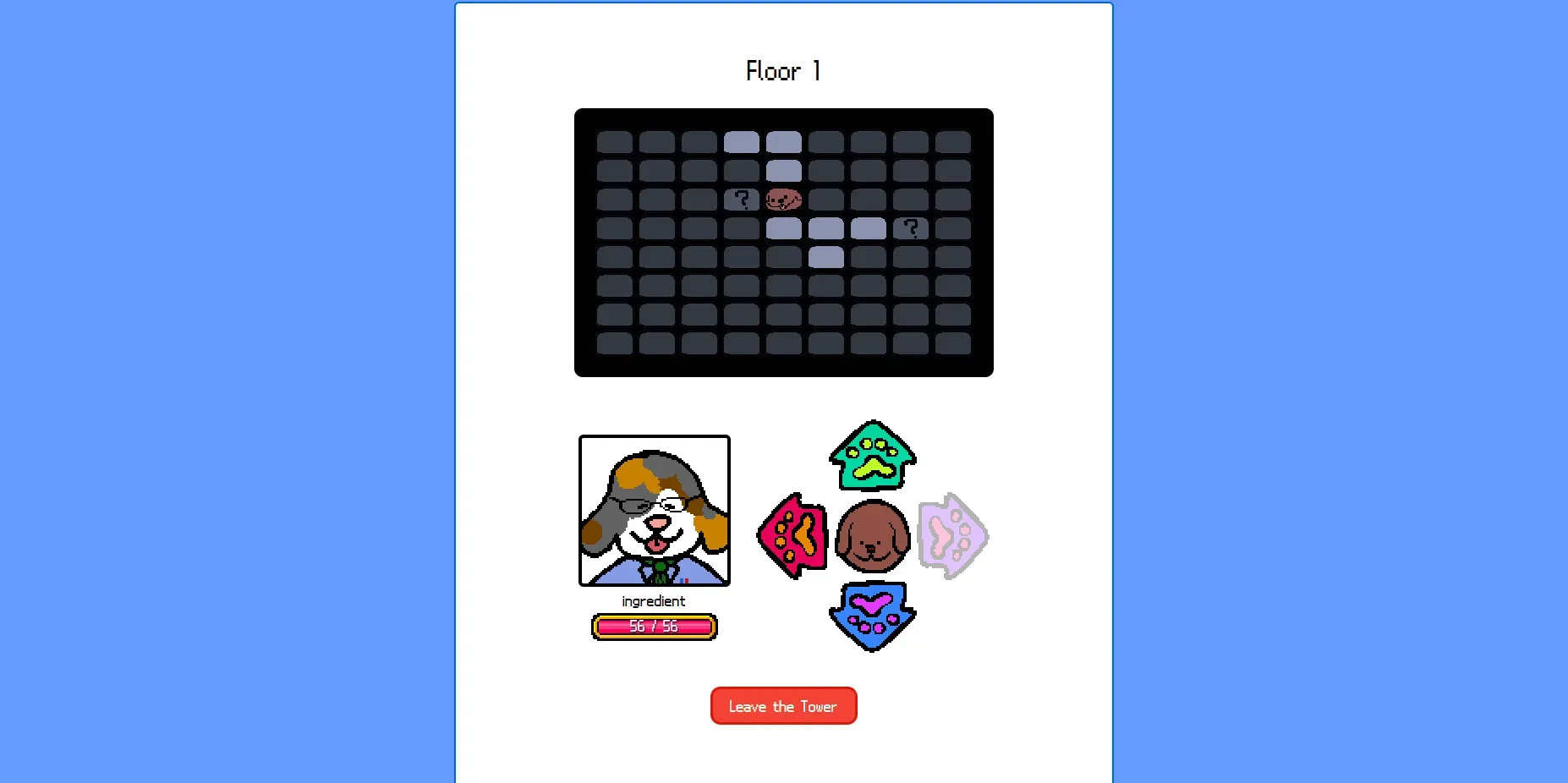
Dog Online’s most demanding component is the Lonely Tower, an enemy-filled dungeon using turn-based RPG combat. Turn-based means actions resolve in discrete turns rather than requiring split-second inputs: players make a choice, the opposing side takes its action, and the encounter develops step by step. In Dog Online, navigating the Tower involves a grid and can lead to tougher foes, fresh floors and unpredictable discoveries.
The Tower is not simply a combat menu repeated until the numbers get bigger. Runs can produce treasure chests, healing fountains, status effects and alternate floors with their own enemy groupings. A status effect is a temporary condition that changes how a battle plays out, potentially helping or hindering a dog. The possibility of alternate routes and changing conditions helps make exploration itself part of the challenge.
This matters for the game’s wider rhythm. Fishing and farming offer measured routines, cooking and trading provide reasons to care about materials, and the Tower introduces risk. The different activities are not interchangeable. A player who wants a calmer session can tend crops or look for a new fish; somebody after a tougher obstacle can push deeper into the dungeon.
That split is one reason the game can appeal to players who remember browser pet worlds but want more than decorative collecting. Dog Online’s dogs are cute avatars, certainly, but they are also the focus of a progression system that asks players to interact with the world rather than merely wait for a generic experience bar to fill.
Progression is about first discoveries, not pure repetition
Each dog has five principal stats. The notable twist is that stat growth is tied to encountering something new. Bravery, for example, increases when a player defeats a previously unseen enemy type for the first time. Coordination rises by catching a fish species not caught before. In practical terms, the game rewards variety.
This is a meaningful distinction from a conventional grind. A grind is repeated play aimed primarily at accumulating resources, levels or currency through the same activity. Dog Online still permits extended Tower runs, but its stat rules give players a stronger reason to change course when they hit a familiar loop. Catching a fresh species or beating a new monster can be more valuable to progression than doing the same successful action over and over.
The design also makes incomplete knowledge useful. If the reward comes from seeing something for the first time, then wandering into a new area, trying an unfamiliar recipe or taking on a different opponent is not wasted time. It is potentially the point. Community members have created a fan Discord and a Wiki to document the game, which will be helpful for players stuck on a particular question. But Dog Online’s systems also make a convincing case for holding off on exhaustive lookup guides at the start. A complete database can be convenient; it can also erase the uncertainty that the game specifically converts into progress.
Time gates encourage a different kind of routine
Dog Online’s pace is shaped not only by what players find, but by when they can do it. Fishing attempts are limited each day, and crops may require real-life days to grow. These restrictions are commonly called time gates: mechanics that make some rewards unavailable until a set period has passed.
Time gates can be frustrating when they exist only to slow a player down. Here, though, they appear closely aligned with the game’s broader emphasis on patience and return visits. A player may have a productive Tower session, plant something before leaving, then return later with a farm plot ready to harvest and another chance at fish. That cadence turns the game into a place to revisit instead of an experience that demands an uninterrupted marathon.
There is an appealing contradiction in this approach. Dog Online is unquestionably an online game: it is browser-based, it has a player economy, and friends can exchange gifts. Yet it does not appear to insist that players remain connected every moment. Its most effective loop may be to log in, make a few choices, discover something, set up tomorrow’s possibilities and log out again.
That is a practical advantage for players looking for a game that can coexist with a busy day. Progress does not depend solely on mastering fast inputs or committing to a huge session. The sources of advancement are distributed across a range of activities, including ones deliberately limited by real time.
Word of mouth meets a sudden scaling problem
The game’s growing audience has not come from a large, visible social media campaign. Its public profile has been relatively small, with a Bluesky account that occasionally shares fan art, and its plainly named title is difficult to search for. The project has largely moved through word of mouth—an appropriately old-internet route for a game built around discovery.
Lead developer Mimi said the small team began work less than a year before the game’s public beta launched on April Fools’ Day. A surge over the following two weeks pushed the game beyond 10,000 users and required the team to upgrade servers. That is an encouraging milestone, but it is also a real operational challenge for a small team. Server capacity is the infrastructure that enables many people to access an online game at once; sudden growth can create performance and reliability pressure even when the interest itself is welcome.
For players, the open-beta label is worth remembering. It signals a publicly playable work still in development, rather than a declaration that every part of the game is final. The existing scope is substantial, but server upgrades and a quickly expanding audience show that Dog Online is still actively navigating the less glamorous work behind a growing online project.
Why the nostalgia lands
Dog Online’s appeal is not simply that it reminds players of earlier pet sites. Nostalgia gets people in the door, but its structure gives them a reason to click around after the reference jokes have landed. The game combines the personal investment of naming and styling a pet with a dense inventory of fish, crops, ingredients and battle rewards. Then it refuses to make all progress immediate.
That combination carries a quietly distinctive idea: an internet game can be social without chat, deep without becoming impenetrable, and persistent without demanding permanent presence. Its visual roughness and goofy names are not evidence of a lack of ambition. In this case, they help establish a place where experimentation feels safer than optimization.
“When things feel strange and scary, sometimes the best thing to do is respond with creativity, absurdity, and joy from your heart!” Mimi said.
That outlook is visible in the game’s design. Dog Online lets a player care about a dog in ridiculous clothes, chase a previously unseen fish, wait for crops, take a risky route through the Lonely Tower and perhaps discover an item whose purpose is not immediately clear. It is a web game that values the next curious click—and, just as importantly, gives players permission to step away until tomorrow.