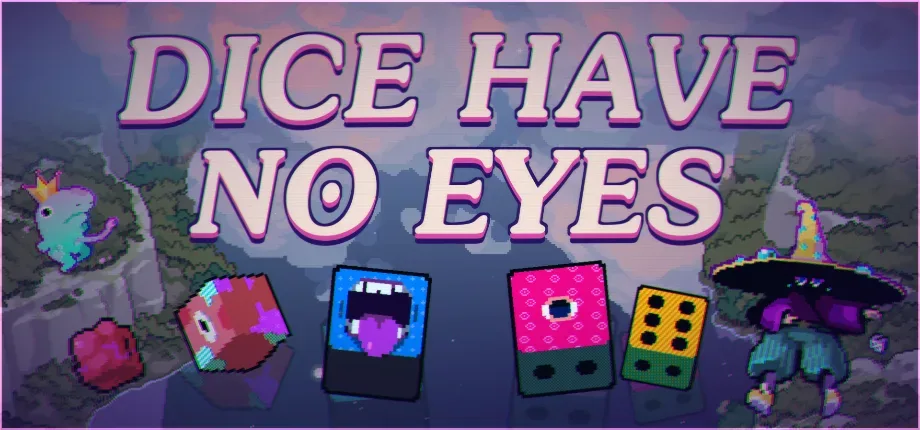
Dice Have No Eyes, the luck-and-greed-focused dice roguelike from indie duo Franek and Max Cahill, has reached version 1.0. The full-release update adds the game’s ending while also expanding its assortment of boards, characters, items, babies and Steam achievements.
At its core, Dice Have No Eyes is built around rolling, managing and changing dice over successive levels. Players can swap and upgrade dice, gather trinkets, use spells and snacks to feed their dice, and pursue powerful combinations—while accepting that a run can still go bust. The game frames that push and pull through an intentionally surreal “fever-dream” presentation and a system it calls the God n’ Fate RNG engine.
The new ending is particularly meaningful for a 1.0 release because Dice Have No Eyes already presents rolling enough sixes as a route to different endings. That makes dice results more than a simple score check: they are tied to long-term run goals. Version 1.0 now completes that side of the game while broadening the possible tools and circumstances players can encounter along the way.
What version 1.0 adds
The update brings an ending to Dice Have No Eyes, as well as new boards, characters, items and babies. Steam achievements are also part of the release. The announcement refers to additional content beyond those named additions, but does not specify every individual inclusion.
For a roguelike, new boards and characters can matter in very different ways. A board generally suggests a new space or setup in which a run unfolds, while a character can change the options available to a player. However, the specific rules or effects of the newly added boards and characters have not been detailed. It is safest to view the additions as a larger pool of variables rather than assume how they alter balance or progression.
The inclusion of Steam achievements gives players platform-level milestones to chase. Achievements are separate from a game’s internal ending structure: an ending is a designed outcome inside the game, whereas a Steam achievement is a recorded platform objective. They can overlap in practice, but no specific achievement requirements have been provided.
A roguelike where the dice are both resource and risk
Roguelike is a broad term, but here the important part is the run-based structure described for Dice Have No Eyes. Players progress across levels while making choices about their dice and the effects attached to them. The game’s stated focus on luck and greed signals a familiar strategic tension: cash in an advantage now, or keep pushing for a potentially stronger payoff and risk losing momentum.
Dice are not presented as passive random-number generators. They can be swapped and upgraded, given magic effects, and fed with spells and snacks. In practical terms, that turns a roll into something players can influence before it happens or reshape after acquiring new options. The randomness remains central, but the player’s build decisions determine what that randomness can do.
Related coverage includes Dice Have No Eyes Reaches 1.0 With Endings, Boards and Achievements.
The possibility of going bust is the other half of the equation. A bust is a failure state triggered by taking a risk too far, though the precise conditions are not outlined. What matters is that the game does not treat every action as a free attempt at improvement. A player pursuing more sixes, another upgrade, or one more payoff may be exposing a run to a setback.
What RNG means in this context
RNG means random number generation: the process that produces uncertain outcomes such as a die result. Dice Have No Eyes labels its system the God n’ Fate RNG engine. That name establishes chance as a central theme, but the surrounding feature list suggests chance is modified by player-selected effects rather than left entirely untouched.
That distinction is important in a dice-driven design. Pure randomness asks players to react to whatever appears. Randomness shaped by upgrades, trinkets, companions and magic dice effects asks players to construct a situation in which more outcomes become useful. A six may still be desirable, but a build can potentially make other results valuable too—or make the route to sixes more viable. The exact interactions will depend on the individual items and effects encountered in a run.
Build-making through trinkets, companions and consumable effects
The game lists more than 100 trinkets, more than 40 spells and snacks, 13 companions with unique powers, and magic dice effects. That is a sizeable menu of moving parts for a game centered on combinations. The announcement explicitly highlights the ability to discover “broken synergies,” meaning interactions that become unusually effective when particular effects are combined.
Synergy is the useful interaction between two or more mechanics. In a dice game, an upgrade might improve one kind of outcome, a trinket might reward that outcome, and a companion might change how often the outcome occurs or what it produces. None of those components necessarily needs to be dominant alone. Together, they can form the engine of a successful run.
The word “broken” is often used by players to describe a combination so strong that it feels like it bends the intended limits of a system. It does not necessarily mean the game is technically malfunctioning. In this case, the stated emphasis on broken synergies indicates that finding excessive-feeling combinations is part of the appeal rather than an accidental edge case.
Spells and snacks are described as things used to feed dice. That wording gives consumable effects a deliberately odd role in the game’s world, but it also establishes them as another tactical layer. Players are not only deciding which dice to keep; they are deciding when and how to spend effects on them. Since no individual spell or snack effects have been outlined, their strategic value cannot be ranked from the available details.
The 13 companions add another source of distinct powers. Companions commonly function as persistent run modifiers in games with build crafting, though the announcement only confirms that each has a unique power. Their presence means a player’s approach can be influenced by more than the dice themselves, especially when paired with trinkets and magical effects.
Five worlds, night mode and multiple destinations
Dice Have No Eyes includes five dreamy worlds and a night mode. The announcement does not explain whether night mode changes gameplay, visuals, or both, so players should not read a particular mechanical function into its name. Still, it joins the game’s surreal tone alongside the unusual language around dice, fate, snacks and babies.
Multiple endings are also part of the feature set, with enough sixes identified as a factor in reaching different outcomes. This creates an additional reason to think beyond immediate survival. In a typical run-based game, simply staying alive or clearing levels can be the primary aim. Here, dice results appear to connect the moment-to-moment rolling loop to a broader endpoint.
That does not mean every run will be about pursuing the same ending. Multiple endings imply alternative destinations, and the range of trinkets, spells, snacks, companions and dice effects gives players numerous possible builds while they work through the game’s worlds. The version 1.0 addition of the ending makes that long-range structure a more complete part of the experience.
What players can reasonably expect from the full release
The clearest takeaway from Dice Have No Eyes reaching 1.0 is completeness and expansion rather than a narrowly focused patch. Its ending arrives alongside more boards, characters, items, babies and Steam achievements, while the game retains a feature set built around dice management and unpredictable combinations.
Players interested in strategic randomness should find the key idea easy to identify: roll dice, but do not merely accept the roll. Trade dice, improve them, attach effects, collect trinkets, enlist companions and spend spells or snacks to shape a build. Then decide how much danger is worth inviting in pursuit of a better result. The game promises that greed can create dramatic upside, but it can also send a run bust.
For more PC-game release coverage with a surreal angle, see The Journey Home’s planned Steam launch.
Dice Have No Eyes also features music sourced from independent musicians. Along with its five worlds and night mode, that detail reinforces the project’s interest in creating a particular mood around its dice-first systems. With version 1.0 now live, the game’s final outcomes sit alongside its expanding catalogue of ways for a promising roll to become either a carefully built victory or a very expensive mistake.