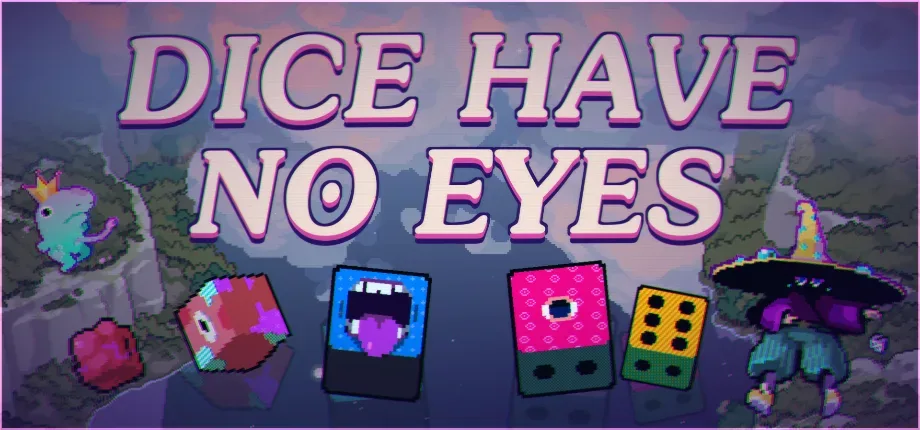
Dice Have No Eyes, the dice-rolling roguelike built around luck, greed and deliberately strange presentation, is scheduled to reach version 1.0 on November 20. The release is described as a major update for the game, with an ending at its centre and a substantial set of new systems and content around it.
Created by indie duo Franek and Max Cahill, Dice Have No Eyes turns dice management into the heart of its run-based structure. Its pitch is that a roll is never merely a number appearing on screen: players can alter the dice and the conditions around them using trinkets, spells and snacks. That makes the game’s risk-and-reward framing especially important. The objective is not simply to hope for a high roll, but to build a setup that changes what a roll can mean.
Version 1.0 gives the roguelike a destination
The headline addition is the game’s finale, presented with the teasing suggestion that players may “meet God.” The precise form of that encounter has not been detailed, but the ending matters beyond its mystery. Roguelikes are often designed for repeat attempts, experimental builds and unpredictable outcomes; a proper ending gives those cycles an eventual narrative destination without necessarily reducing the value of replaying the game.
Dice Have No Eyes will also add character endings. That indicates the final version will connect at least some playable-character choices to their own outcomes, rather than treating every successful run as one identical resolution. Multiple endings are already part of the game’s stated gameplay highlights, so the 1.0 update appears set to expand and formalize that side of its structure.
For players returning after earlier versions, the practical takeaway is straightforward: progression may now encompass more than getting farther through a single run. Different characters, their associated endings, newly added boards and the finale together suggest reasons to vary approaches and continue uncovering paths through the game.
The Rift promises an extended new level
Among the most intriguing additions is a new level called the Rift, described as one that “goes on and on.” That phrasing leaves the exact rules deliberately open, so it should not be read as confirmation of a particular endless mode or scoring format. Still, it clearly distinguishes the Rift from a conventional one-and-done stage.
In a dice-focused roguelike, a longer or repeating environment can put extra pressure on build construction. A setup that delivers one powerful turn may not be as dependable when it must keep functioning through continued uncertainty. Conversely, a modest effect that reliably improves many rolls could become more valuable across a longer stretch. That is analysis of the design implication, rather than a confirmed mechanical rule for the Rift, but it captures why a sustained level is a natural fit for a game about managing chance.
The update also brings new boards. A board is likely to be a key part of the play space given the game’s dice-management premise, but the announcement does not specify how boards change rules, layout or objectives. What is clear is that they are joining the content pool alongside new characters, items and babies, widening the combinations players can encounter.
Related coverage includes Dice Have No Eyes Sets November 20 Date for Its 1.0 Finale.
Items, babies and companions expand the possible dice setups
Dice Have No Eyes uses a notably eccentric vocabulary for its tools. Players can feed dice with trinkets, spells and snacks in order to change how those dice roll. The 1.0 update adds more items and babies, while the game also features companions and several playable characters.
That language points toward a game where modifying the die is as important as selecting an action. In conventional tabletop terms, a die is a fixed randomizer with a known range of results. Here, the advertised systems imply that the randomizer itself can be developed during a run. An item may be meaningful not just because it gives a direct bonus, but because it changes the behaviour, utility or stakes of future rolls. The supplied details do not define individual effects, so players should keep expectations to that broad design idea rather than assume a particular catalogue of modifiers.
RNG, short for random number generation, is the technical term for the process games use to create variable outcomes such as a dice roll. Dice Have No Eyes leans into that uncertainty rather than hiding it, even naming its random element the God n’ Fate engine. The title’s larger theme—luck versus greed—fits naturally with this approach: players are asked to make decisions around results they cannot fully control, while finding ways to influence the odds and consequences.
The comparison to Balatro is useful as a tonal and structural shorthand: it signals a run-based strategy game that reworks a familiar game object into something surreal, combinatorial and escalation-driven. It should not be treated as a claim that the two games share the same rules. Dice Have No Eyes is specifically about dice management, with its own trinkets, spells, snacks, characters and companions.
Achievements, leaderboards and quality-of-life work arrive with the full release
Version 1.0 will introduce Steam achievements and leaderboards. Achievements provide defined goals for players who want to chase milestones beyond simply reaching an ending. Leaderboards, meanwhile, create a way to compare results with the wider player base. The announcement does not identify the scoring categories, seasons or conditions that leaderboards will use, so any competitive details remain to be seen.
The update also includes “many” quality-of-life changes and fixes. Quality-of-life is the broad label for adjustments that make a game clearer, faster or less frustrating to use without necessarily changing its core challenge. Depending on the game, that can mean interface refinements, clearer information, smoother navigation or fewer awkward steps between actions. No individual change has been listed here, but the inclusion is notable for a system-heavy roguelike: when a game encourages players to assess changing dice, items and risk, readable feedback and clean interactions can matter as much as adding another rare effect.
Additional languages are planned as part of the 1.0 release as well. Specific languages have not been named. Players who need a particular localization option should therefore wait for the final list rather than assume it will be included.
Customization and music cassettes add personality between the rolls
Outside the core run structure, Dice Have No Eyes 1.0 adds new customization options and discoverable music cassettes. The cassettes can be used to assemble an in-game playlist. This is a small feature in comparison with the finale or the Rift, but it suits a game that embraces a fever-dream identity: it gives players a collectible way to shape the atmosphere of their sessions.
Importantly, these are in-game discoveries and should be understood as part of the game’s progression and customization, not as physical collectibles. Their stated function is to unlock music for an in-game playlist. The announcement does not say how many cassettes exist, where they can be found, or whether they influence gameplay.
The broader 1.0 package reads as a full-release moment rather than a narrow content drop. It adds closure through the finale, variety through boards and characters, extended uncertainty through the Rift, and longer-term targets through endings, achievements and leaderboards. Those components serve different kinds of players: the person who wants an ending, the experimenter searching for unfamiliar dice interactions, and the competitor interested in comparing results all receive something new.
What has been confirmed—and what has not
- Confirmed for November 20: the 1.0 launch, the finale, the Rift, new boards, characters, items and babies, character endings, customization options, music cassettes, quality-of-life changes, fixes, Steam achievements, leaderboards and additional languages.
- Confirmed gameplay framing: dice altered with trinkets, spells and snacks; companions; playable characters; multiple endings; and randomness tied to the God n’ Fate engine.
- Not specified: the exact nature of the finale, how the Rift operates, individual item effects, supported languages, achievement requirements, leaderboard categories, price, or platforms beyond the explicitly mentioned Steam features.
Dice Have No Eyes is arriving amid a busy period for PC game updates; for another recent example of an update expanding activities and technical support, see BLACKWOOD’s Act 1 Contracts Update. The comparison ends at the calendar, though: Dice Have No Eyes is pursuing a very different proposition, where the player’s most valuable tool is a mutable die and every tempting decision may make fate a little less friendly.