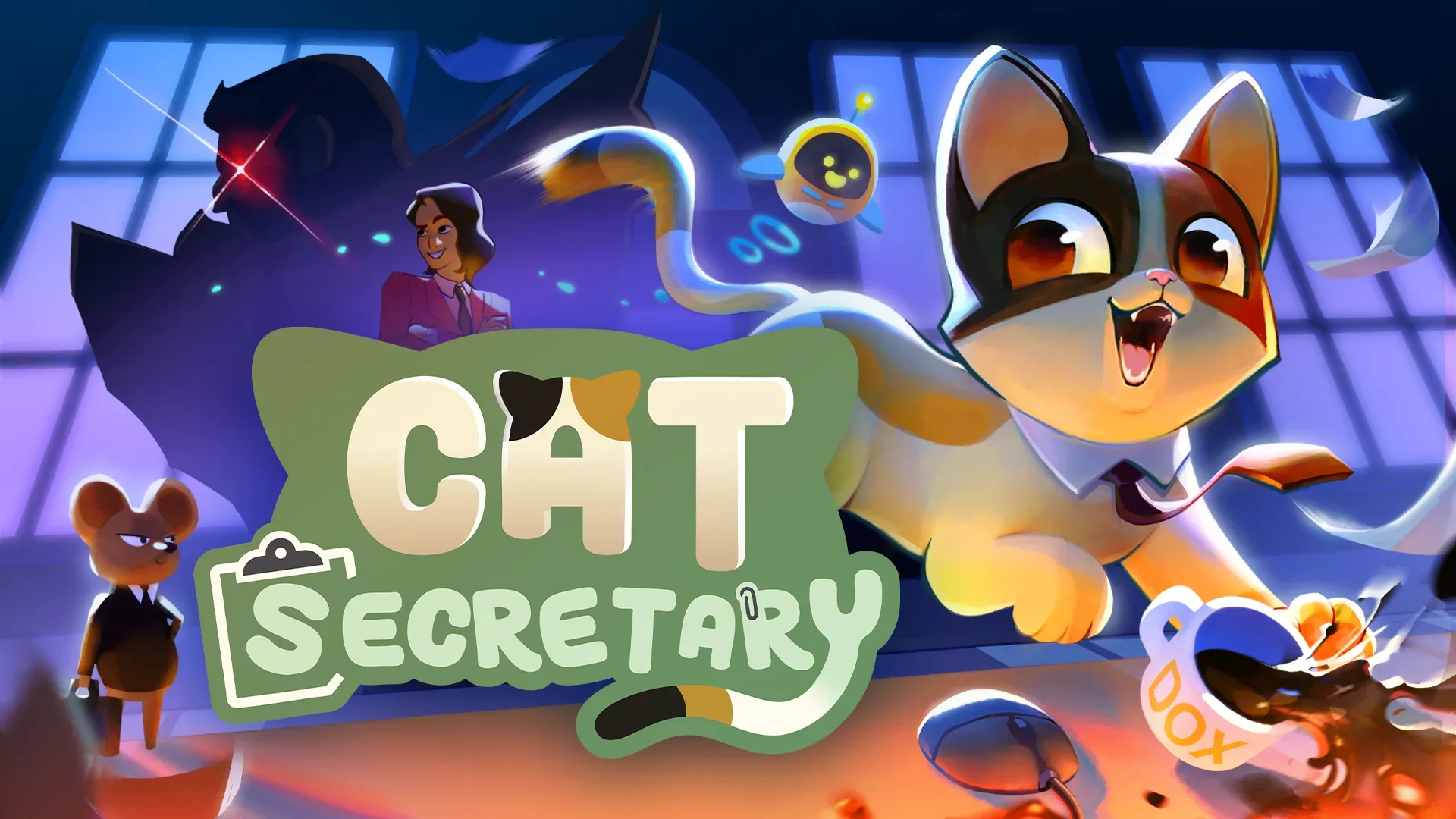
Cat Secretary, Good Story Guild’s cozy office adventure with an explicitly anti-AI narrative, will now launch on January 20, 2027. It had previously been scheduled for November 4, 2026, making this a delay of a little over two months.
The studio said the additional development time will go toward new features, bug fixing, incorporating feedback from the game’s free demo, and optimizing the experience for Steam Deck. It also directly framed the revised date as a way to avoid crunch: the prolonged periods of intense work that can accompany a game’s final push toward release.
For people who have already tried the demo, there is a practical upside beyond the extra polish. Demo save data will carry over to the full game when it arrives at its new date, so progress made in the available build will not need to be discarded.
A delay with a defined development focus
Not every delay comes with a detailed explanation, but the areas identified here give a useful picture of what the team is prioritizing. Bug fixes are straightforward: they address faults that can range from small visual errors to progression blockers. Incorporating demo feedback means the playable preview is functioning as more than promotion; player responses can influence the finished version.
The reference to extra features is broader, and no full list of those additions has been specified. It is therefore too early to assume exactly which systems or content will expand. Still, the existing outline points to a game with several interconnected activities: office work, character quests, progression, renovations, exploration and stealth. Extra time can be particularly consequential in a structure where daytime routines feed into a larger nighttime investigation.
Steam Deck optimization is another specific commitment. Steam Deck is Valve’s handheld PC hardware, and optimization generally concerns making a PC game work smoothly and comfortably within that device’s performance limits and portable control format. The announcement does not spell out the exact targets or settings planned for Cat Secretary, so players should not read more into the statement than an intention to optimize the game for the platform. Even so, calling it out during a delay signals that handheld PC play is part of the team’s release preparation rather than an afterthought.
The studio’s decision to name crunch matters as well. “Crunch” is an industry term for sustained overtime and unusually heavy workloads, often near a deadline. Delaying rather than forcing the original November date positions the schedule change as a production choice intended to give development work more room.
What Cat Secretary is about
Cat Secretary casts the player as the titular feline employee at a company called DOX. Its premise deliberately contrasts comforting presentation with a workplace under pressure: beneath the fur and everyday office jobs is a story concerned with protecting the company’s soul from unchecked generative AI and unsustainable growth.
Related coverage includes Cat Secretary Delayed to January 2027 as Team Expands Features and Steam Deck Support.
Generative AI refers to systems that produce new material, such as text or images, from learned patterns. In Cat Secretary’s fiction, it is not merely background technology. The game’s narrative takes an anti-AI position, and AI devices are part of the workplace the cat must navigate. That gives routine office tasks a larger thematic context: the player is not simply climbing a corporate ladder, but operating inside a company whose direction is in dispute.
The intended adventure is described as cozy and story-rich, with an estimated length of 15 to 20 hours. “Cozy” in this case should not be mistaken for a promise that there is no pressure or conflict. The daytime and nighttime structure specifically pairs low-key maintenance and social activities with stealth, discovery and a corporate conspiracy.
Day shift: coffee, routers and career progression
During the day, the cat secretary handles an assortment of office duties. The announced activities include making coffee, repairing the router, interacting with AI office equipment and keeping snacks organized. These are the small, recognizable jobs that establish the workplace setting, but they are also connected to progression.
Players can help coworkers through quests, develop skills and pursue promotions. They can also earn upgrades and a currency called DOXBux, which can be used for renovations and expansions. The available description does not explain every upgrade path or renovation option, but it does establish that workplace improvements are something players work toward rather than merely scenery.
There is an appealing tension in that setup. Career advancement and office expansion commonly suggest loyalty to a company’s ambitions. Cat Secretary, however, centers on trying to save that company from a direction portrayed as harmful. The player’s everyday labor, relationships with colleagues and advancement through DOX appear designed to coexist with skepticism about what the institution is becoming.
That dual purpose could give the office chores more narrative weight than a standard checklist of minigames. Fixing a router or serving coffee is ordinary on its face, while helping coworkers and earning their trust potentially supports the wider effort to protect the workplace. The exact consequences of particular tasks have not been detailed, but the day-to-night design establishes a clear rhythm between public employee life and the investigation happening after hours.
Night shift: stealth and upper-floor secrets
At night, the office becomes a space for exploration. Players will be able to sneak past AI security, take on quests across the upper floors and uncover underhanded schemes. The goal is not presented as a solitary mission: building alliances is a stated part of the effort to save DOX.
Stealth, in this context, means avoiding detection while moving through guarded spaces rather than confronting every obstacle directly. The announced nighttime security provides a mechanical expression of the game’s themes. The very systems connected to the workplace’s AI turn into barriers between the secretary and the information needed to understand what is happening.
The upper floors are significant because they suggest a shift in access and perspective. Daytime work begins from the position of a secretary handling the company’s immediate needs. The nighttime game opens parts of the organization that are normally out of reach, creating an avenue to investigate decisions being made higher up. No specific characters, villains or plot turns have been revealed, so the nature of those schemes remains deliberately uncertain.
That uncertainty is one reason the demo is useful. It gives prospective players a chance to get a sense of the game’s tone and foundational loop before release, while its save-transfer support means sampling it does not have to be separate from beginning the full adventure. Players looking for another PC project with a cozy premise can also check out Hokko Spaces’ PC and Switch release plans, though its diorama-building focus is distinct from Cat Secretary’s office stealth and narrative setup.
What the new date means for players
The important calendar change is simple: Cat Secretary is no longer targeting November 4, 2026, and is now planned for January 20, 2027. The free, fully playable demo remains available in the meantime, and its saves will transfer to the full release.
Good Story Guild’s stated priorities for the delay are feature work, fixes, demo-informed refinement, Steam Deck optimization and a schedule that avoids crunch. Beyond those stated areas, players should be cautious about assuming any unannounced changes. There is no detailed breakdown yet of the forthcoming features, the final Steam Deck performance profile, or how player feedback will alter individual systems.
What is clear is the shape of the game the team is continuing to build: a 15–20 hour adventure in which a cat secretary balances routine office responsibilities with after-hours stealth, forms alliances with coworkers and investigates a company threatened by generative AI and runaway growth. The delay gives that unusually pointed workplace story additional time to come together before its January 2027 launch.