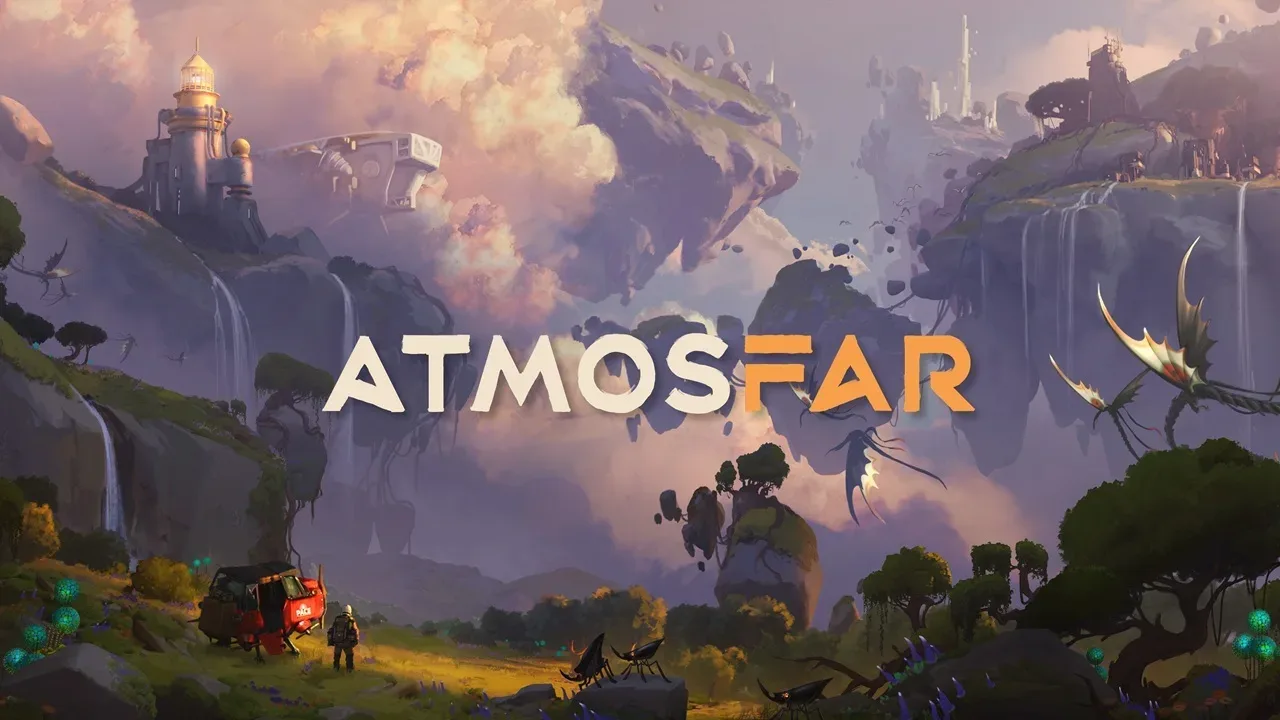
ATMOSFAR, the sci-fi survival adventure from Apog Labs and publisher Shueisha Games, is scheduled to enter Early Access on October 29, 2026. It will be available on Steam and the Epic Games Store.
The game is set on Tycos, where players head into the sky to investigate what happened to humanity’s most distant outpost. Its central idea is not merely travelling between locations in an aircraft: flight, material gathering, research, base development and expeditions on the ground are all presented as connected parts of the survival loop.
That makes the Cloud Cruiser—the player’s large, customisable airborne base—the key piece of the pitch. Rather than treating a base as a fixed settlement, ATMOSFAR puts it in the air and makes it the operational centre for moving through the world, developing technology and expanding a camp. The game is also designed for solo play or online co-op for two to four players.
A survival game built around staying airborne
ATMOSFAR’s setting gives familiar survival-game concerns a different frame. Resources still need to be scavenged, technology must be researched, and a camp must be expanded, but the route to each objective involves navigating an aerial world of uncharted islands. Apog Labs describes the flight model as physics-based, meaning the handling is intended to reflect simulated forces rather than functioning only as a simple point-to-point travel system.
In practical terms, physics-based flight can make the conditions around a vehicle matter as much as the destination. ATMOSFAR specifically identifies turbulent thunderstorms and forceful jetstreams as environmental threats. A jetstream is a fast-moving current of air; in the game’s context, it suggests that high-speed wind conditions may complicate a route or demand more deliberate piloting. Thunderstorms, meanwhile, are positioned as another form of extreme weather players must survive while moving between islands.
Those hazards are important because the game is not describing flight as a passive backdrop to crafting. Piloting is part of the core activity, alongside ground exploration and camp management. The design has room for different decisions depending on what a group needs: a run for materials, a trip to investigate an island, a heavy-lift operation, or a more combat-focused journey through dangerous conditions.
Three Wasp vessels have distinct jobs
Players will be able to pilot a fleet rather than rely on a single all-purpose craft. The revealed Wasp vehicles have clearly differentiated roles:
- Utility Wasp: deploys a mobile camp, giving players a way to establish a working presence away from the main Cloud Cruiser.
- Hauler Wasp: airlifts heavy scrap, making it the specialist for moving bulky recovered resources.
- Fighter Wasp: is intended for high-speed engagements.
This division of labour gives co-op a concrete purpose beyond simply increasing the player count. One player can focus on transport or camp placement while another takes a more direct combat role, for example. The announced information does not spell out the precise controls, upgrade paths or limitations of each craft, so it remains to be seen how rigidly those roles are enforced. Still, the basic setup suggests that vehicle choice will be tied to a specific task instead of being only cosmetic.
Related coverage includes ATMOSFAR Early Access Takes Flight October 29, 2026.
The Hauler Wasp also signals that scrap has practical importance in ATMOSFAR’s progression. Scavenging is one of the stated pillars of the game, and carrying heavy scrap by air links resource recovery directly to the flying systems. Rather than resources simply appearing in an inventory after discovery, at least some of the game’s materials appear to require transport back through the world.
The Cloud Cruiser is the campaign’s moving headquarters
The Cloud Cruiser is described as a colossal, fully customisable airbase. It is where players will research new technology, extend their camp and support longer-term survival. Customisation here refers to changing and developing the base, though the exact building pieces, research branches and progression requirements have not yet been detailed.
What is clear is the difference between the Cruiser and the mobile camp deployed with the Utility Wasp. The Cruiser appears to be the large-scale headquarters for a player or co-op group, while the mobile camp serves as a smaller forward position during exploration. That two-tier structure could be useful when distant islands, changing weather and resource hauls pull players away from the main base.
It also creates a natural chain of priorities: leave the Cruiser, locate useful material or a new point of interest, set up temporary support if needed, recover what can be carried, and bring the results back into the research and expansion cycle. The details of that cycle have not been announced, but all of its major components—exploration, scavenging, airlifting, research and camp growth—have been identified.
Ground expeditions remain part of the journey
Despite its focus on the skies, ATMOSFAR is not solely a flying game. Ground-based expeditions are part of the announced experience, giving the islands themselves a role beyond scenery beneath the aircraft. Players will explore diverse biomes while searching for resources and pursuing the mystery of Tycos’ isolated human outpost.
A biome is an area defined by its environmental character. In survival games, different biomes can matter because they change the types of conditions players must deal with and potentially the resources or points of interest they seek out. ATMOSFAR has confirmed diverse biomes, but has not yet specified their names, contents or how they will alter play. It is best to treat that variety as a broad environmental promise rather than a confirmed checklist of regions and mechanics.
The game’s story premise similarly establishes a direction without revealing answers in advance. Players are travelling across Tycos to uncover the fate of humanity’s furthest outpost. No further plot details, characters or narrative outcomes have been announced, so the mystery is currently the context for exploration rather than a fully defined story campaign.
What Early Access means here
Early Access is a release model in which a game is made available before its full 1.0 version. For ATMOSFAR, October 29 is explicitly the beginning of that Early Access phase, not the announced date for a finished 1.0 release. Apog Labs studio head Olof Kindblad said the team has large ambitions for the game and described the launch as a major step on its route to 1.0.
That framing matters for prospective players. The announced date confirms the start of public access on PC storefronts, along with the game’s headline systems: solo and two-to-four-player online co-op, multiple flying vessels, the Cloud Cruiser, resource scavenging, research, mobile camps, ground expeditions, weather hazards and combat-oriented flight. It does not establish a final feature list, a timetable for later additions, or a 1.0 date.
For another upcoming PC release built around cooperative play, see Marked for Mayhem’s planned public playtest.
ATMOSFAR’s confirmed launch details
- Early Access date: October 29, 2026
- Platforms: Steam and Epic Games Store
- Developer: Apog Labs
- Publisher: Shueisha Games
- Modes: solo play and online co-op for two to four players
- Setting: the aerial world of Tycos
- Major systems: physics-based flight, flying-vessel roles, scavenging, research, mobile camp-building, a customisable Cloud Cruiser, ground expeditions and extreme weather
ATMOSFAR’s strongest defining idea is the way its systems orbit a mobile aerial home. The Cloud Cruiser, the role-specific Wasps and the promise of weather-aware flight all point toward survival play where logistics are as important as simply reaching the next island. Players will be able to see how those moving parts come together when the game enters Early Access on October 29, 2026.