Apple is expected to stage a second October product reveal on Wednesday, October 28, under the name Pro and Tell. Rather than a conventional on-stage presentation, the plan is reportedly for product news to arrive through press releases while invited media members get time with the new hardware in Los Angeles.
The name points squarely at the MacBook Pro, and the reported lineup could be unusually consequential even if not every machine receives a major redesign. The biggest possibility is a high-end MacBook Pro with an OLED display and a touchscreen: two changes that would mark firsts for Apple’s Mac range. A 14-inch entry-level MacBook Pro and 24-inch iMac are also expected to receive M6 chips, while an iPad mini refresh could bring OLED, an A20 Pro processor and a more water-resistant construction.
As always before an official reveal, these details should be treated as expectations rather than settled specifications. There are still important unanswered questions, particularly around iPad mini display refresh rate, exact pricing, configurations and whether every rumored feature reaches the final products.
The rumored OLED MacBook Pro is the headline act
The potential high-end MacBook Pro models are expected in familiar 14-inch and 16-inch sizes, but the display is where the substantial change may arrive. OLED, short for organic light-emitting diode, differs from a conventional backlit panel because its pixels produce their own light. In practical terms, that can enable deeper blacks, higher perceived contrast, richer color and potential power savings, especially where dark interface elements or darker video scenes are involved.
OLED is already expected to be familiar territory for the iPad Pro, but bringing it to MacBook Pro would be a significant addition for a laptop line used for color-sensitive creative work, video playback and long stretches of general productivity. The reported benefit is not merely an image-quality upgrade; power efficiency matters on a portable computer, though real-world battery effects would depend on the panel implementation and how the laptop is used.
The other proposed change is even more notable: touch controls. The OLED MacBook Pro is expected to become the first Mac with touchscreen capability, alongside updates in macOS 27 for touch-oriented gestures. Crucially, touch is described as supplementary rather than a replacement for the keyboard and trackpad. That distinction matters. A person who prefers the established Mac workflow should still be able to use it normally, while touch could offer another way to navigate, scroll, manipulate on-screen items or work through compatible apps.
Apple is also expected to fit a reinforced hinge, intended to keep the display steadier when the user taps it. That small hardware detail is central to making a touchscreen laptop feel convincing: a screen that flexes or shifts noticeably under touch would undermine the point of the feature.
A lighter chassis and a different camera cutout
Beyond the display, the new premium MacBook Pro models are rumored to be lighter than the current versions, with no expected change to the 14-inch and 16-inch size options. The screen cutout may also change. Instead of the existing notch, the laptops are expected to use a Dynamic Island-style area.
Dynamic Island is the pill-shaped display region used to contain the front camera system while accommodating software status and activity elements around it. On a MacBook Pro, its actual behavior and interface role remain unclear. The important reported point is the physical shift away from a wide notch, not a confirmed list of new software functions.
One potentially awkward wrinkle is the processor story. The high-end OLED MacBook Pro models are expected to retain the M5 Pro and M5 Max chips used by MacBook Pro models introduced in March. Reports indicate Apple may skip M6 Pro and M6 Max variants, while M7 Pro and M7 Max chips are not expected until late 2027. If accurate, this would make the upcoming high-end machines a display, input and industrial-design upgrade rather than a straightforward leap in computing silicon.
That framing can help prospective buyers make sense of the choice. Someone whose work is limited by CPU or graphics performance may see less reason to move from an existing M5 Pro or M5 Max MacBook Pro. Someone more concerned with screen quality, the possibility of touch interaction or reduced carry weight could find the rumored model much more meaningful. Neither use case can be judged fully until Apple confirms the machines, their performance configurations and their pricing.
A premium tier may sit beside current MacBook Pros
The high-end OLED models could cost more than today’s MacBook Pros, which would not be surprising given the reported addition of both an OLED panel and touch hardware. Apple may reportedly continue selling current MacBook Pro configurations and position the OLED versions as a more expensive tier. Earlier speculation around a different MacBook name appears to have faded; the anticipated product is still expected to carry the MacBook Pro name.
That possible split would have practical implications. It could preserve a less expensive route into a pro-oriented Mac laptop while giving buyers who prioritize display technology another option. It would also mean the term “MacBook Pro” could encompass machines with a considerable difference in screen hardware and interaction methods. Buyers should therefore compare the precise display, chip and input specifications rather than assuming every MacBook Pro has the same capabilities.
For people working out a broader desk setup around a new Mac, display connectivity and storage can be just as important as the notebook itself. Our guide to what an HDMI port on a Ugreen NAS actually does explains one adjacent piece of that setup puzzle.
M6 updates may be simpler for the base MacBook Pro and iMac
Not every Mac in the reported October wave is expected to get new external hardware. The 14-inch entry-level MacBook Pro is rumored to move from M5 to M6, following an M5 update in October 2025. No design change has been reported for that model.
The 24-inch iMac is similarly expected to receive an M6 chip without an exterior refresh. These could be more conventional processor updates: potentially useful for shoppers coming from older hardware, but not necessarily a reason to replace a recent model solely for its chassis or display. Until specifications are official, it is not possible to say how the M6 changes performance, efficiency or supported features in either computer.
The apparent contrast is clear. The entry-level MacBook Pro and iMac may offer a newer main processor, while the rumored OLED MacBook Pros may emphasize a more ambitious display and input redesign while retaining their existing class of M5 Pro and M5 Max chips. That is not necessarily a contradiction, because Apple’s standard M-series chips and its Pro/Max variants target different performance tiers, but it would make this a more nuanced buying cycle than a simple “new number equals new everything” refresh.
iPad mini 8 could gain OLED and a tougher design
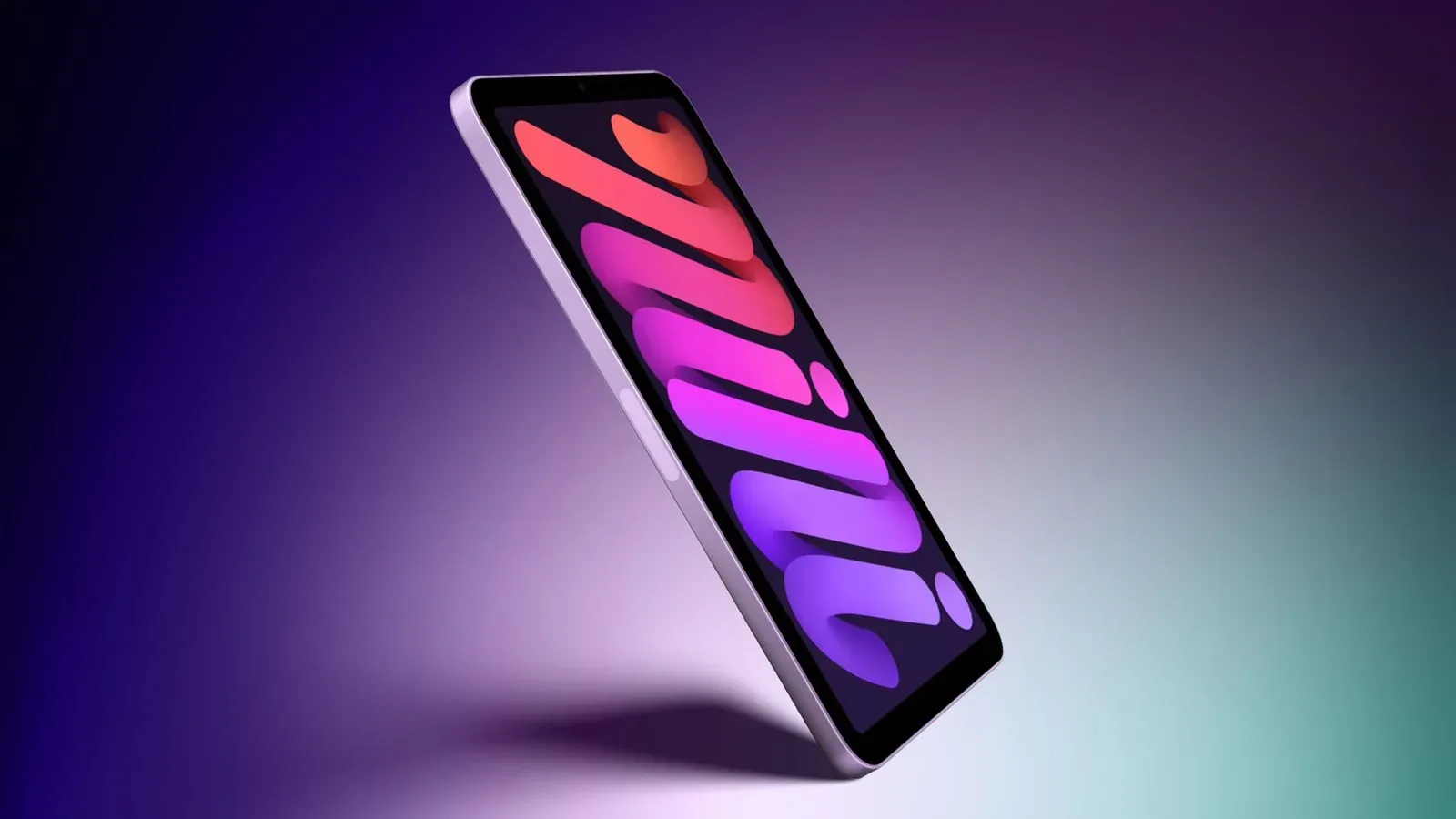
The other expected arrival is the iPad mini 8. The compact tablet is rumored to gain an OLED display, making it the first iPad outside the iPad Pro family expected to adopt the technology. For a small tablet often chosen for portability, reading, video and quick handheld use, the prospect of improved contrast and richer color is a meaningful one.
A redesigned audio system may also be part of the update. The iPad mini 8 is expected to use vibration-based speakers that remove speaker openings from the enclosure. The reported goal is a more water-resistant device, potentially making it the first iPad with an IP rating.
An IP rating is an ingress-protection classification used to describe resistance to dust and water. The rumor does not establish a specific rating, and that missing detail is important: water resistance for splashes is not the same thing as resistance to submersion. The expected iPad mini may withstand splashes and possibly immersion, but its real limits would need to come from Apple’s eventual rating and usage guidance.
The iPad mini 8 is also expected to use the A20 Pro chip found in iPhone 18 Pro models. Its front camera may move from the portrait edge to the landscape edge, a placement change Apple has already made on other iPads. That is a practical quality-of-life adjustment for users who place the tablet horizontally for calls, keyboards or video viewing.
One of the biggest unknowns is refresh rate. The available information does not establish whether the iPad mini remains at 60Hz or moves to 120Hz ProMotion. Refresh rate refers to how often a display updates each second. A 120Hz screen can make scrolling, animations and certain games look smoother than a 60Hz panel, but OLED alone does not answer that question. It is a specification worth watching closely because it could affect how substantial the upgrade feels in everyday use.
Pricing and timing remain the key caveats
OLED and increased water resistance could raise the iPad mini’s price by roughly $200 compared with the current $599 model, based on the expectations surrounding the update. That figure is not official, and it should be read as a possibility rather than a confirmed price. The same caution applies to the premium MacBook Pro: the added cost of OLED and touch components suggests a higher price, but no final pricing has been established.
The product reveal is expected on October 28. Press materials could arrive when the Los Angeles media experience begins at 10 a.m. Pacific Time, though earlier publication around 9 a.m. Eastern Time is also possible. If the rollout follows the earlier October home-product launch pattern, pre-orders may begin on October 28 and the new Macs and iPad could ship as soon as November 6.
For now, the most interesting part of the report is not simply a list of updated Apple hardware. It is the possibility that Apple could separate its Mac refreshes into two clear ideas: M6 processor updates for the more conventional 14-inch MacBook Pro and iMac, and an OLED, touch-enabled evolution of the high-end MacBook Pro. Add a potentially more durable OLED iPad mini, and October 28 could be a particularly important date for buyers who care as much about screens and everyday interaction as raw chip generations.