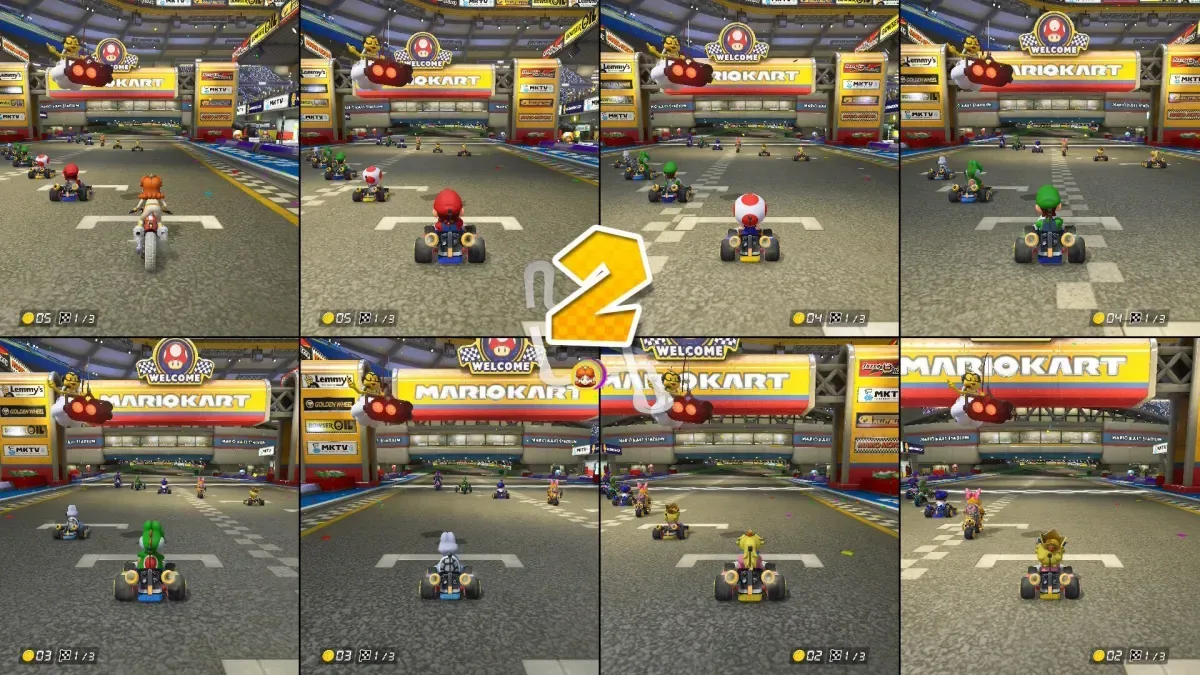
Mario Kart 8 Deluxe has received a substantial update that gives Nintendo’s 2017 racer new reasons to stay in the rotation on Switch 2. The headline feature is an expanded local multiplayer limit: up to eight people can now race together on one system. The patch also brings shorter loading times, higher-resolution output, USB-camera compatibility in selected modes, and several gameplay adjustments that apply on the original Switch as well.
That is an unusually generous second lap for a game approaching its tenth year. Mario Kart World may be the major new Switch 2 entry, but Mario Kart 8 Deluxe remains the best-selling game on the original Switch, with an enormous installed player base and a deeply established course roster. Rather than treating the older game as a museum exhibit with a “please do not touch” sign, Nintendo has given it practical upgrades that matter most to households, parties, and long-running local racing groups.
Eight-player local multiplayer is the big change
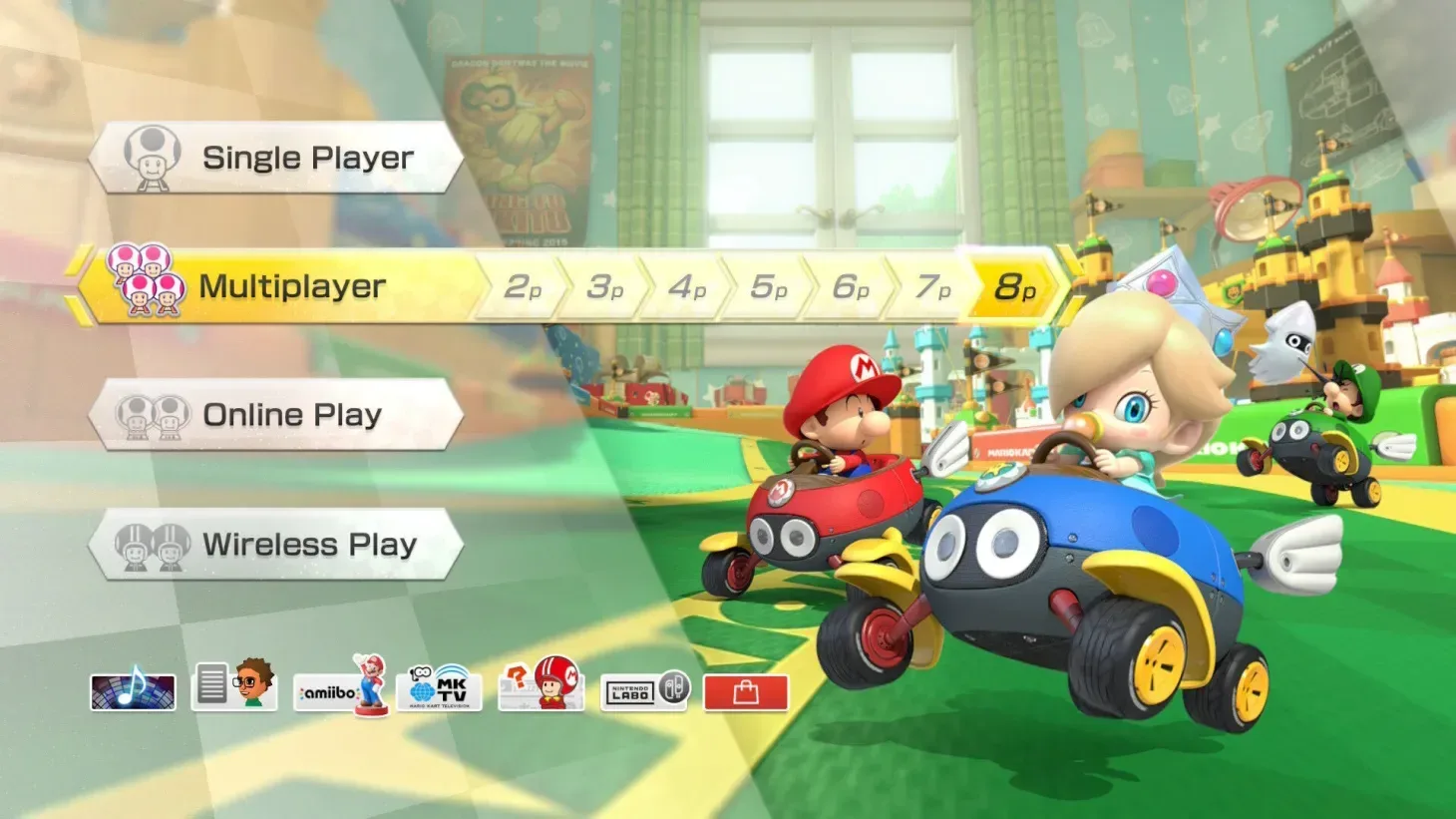
Before this update, local multiplayer in Mario Kart 8 Deluxe topped out at four racers. The new Switch 2 support increases that ceiling to eight. It is a simple number change with potentially chaotic results: more racers means more shells in circulation, more accidental bumps at the starting grid, and considerably more opportunities for someone to insist that the screen is “definitely too small” immediately after finishing eighth.
There is a catch, and it is an important one for anyone planning a full eight-driver setup. A Switch 2 can connect no more than seven Switch 1 controllers. As a result, an eight-player local session needs at least one Switch 2 Pro Controller or a Joy-Con 2 among its control options. In other words, a pile of eight older controllers alone will not complete the grid.
The display will naturally become crowded when eight players share it. That limitation is not eliminated by the update; every racer still needs their own portion of the screen, and dividing a television eight ways asks a lot of even a generous living-room setup. But the option is meaningful. Families, game nights, dorm lounges, and tournament-style gatherings can now put more players into a single race without rotating competitors after every cup.
It also adds a fresh wrinkle to the social contract that governs couch competition. The unofficial rules about seat selection, snack placement, victory celebrations, and the suspicious timing of a blue shell become even more vital when twice as many people are involved. For a refresher before handing out controllers, see The Unwritten Rules of Couch Multiplayer, Now Written Down.
Switch 2 owners get loading and resolution improvements
The update also improves the game’s technical presentation on Switch 2. Nintendo has added shorter load times and higher resolution, both when playing on the system’s own display and when the console is connected to a television. These changes do not rewrite the underlying game, but they address two everyday qualities that are felt repeatedly over a long session: how quickly players get into the next event, and how clear the action looks while it is happening.
For a racer built around repeated rematches, cup runs, time trials, and multiplayer lobbies, quicker transitions can make a difference across an evening. The waiting between races is rarely the dramatic part of Mario Kart, unless somebody is using it to litigate whether a red shell was “earned.” Reducing those pauses should make the overall rhythm feel more immediate on Switch 2.
Higher resolution on both portable and TV play is likewise a sensible addition for a game that remains visually busy. Racers need to read track edges, incoming items, rivals, shortcuts, and the occasional banana placed with what can only be described as premeditation. The patch’s stated improvement is resolution, so players should not assume other unlisted technical changes from it, but the declared visual enhancement is welcome for a title still getting plenty of mileage from its colorful tracks.
CameraPlay joins online and local multiplayer, with a four-player cap
USB camera support is another Switch 2-focused feature. The update lets players use a USB camera through CameraPlay in both Online Play and local Multiplayer. It is an optional, more personal way to bring player faces into a race session—useful for groups that enjoy seeing the exact expression produced by an ill-timed lightning bolt or a last-corner overtake.
There is a firm limit here: CameraPlay in local multiplayer supports up to four players. The new eight-player local race mode and camera use therefore do not fully overlap. You can host an eight-racer session, or use cameras in local multiplayer for as many as four participants, but an eight-person camera-equipped grid is not supported.
That distinction is worth making before anyone begins arranging webcams, controllers, charging cables, and chairs as though they are producing a very small esports broadcast. The eight-player feature is about expanding the racing field; the CameraPlay option is a separate social layer with a lower local-player limit.
Gameplay changes reach Switch 1 players too
The patch is not exclusively a Switch 2 affair. Several smaller but meaningful gameplay changes also apply to the Switch 1 version of Mario Kart 8 Deluxe. First, every player’s speed has increased by an amount described as equivalent to holding one coin. It is a universal adjustment rather than a perk that one racer can gain over another.
Because the speed boost affects everyone, the update does not inherently change the gap between racers simply by existing. It does, however, make the game’s overall pace faster. Track knowledge, drifting, item timing, and recovery after mistakes all happen within a slightly brisker flow. Regular players may notice the difference most clearly in familiar courses, where years of muscle memory meet a new baseline tempo.
The Boo item has also been adjusted. When Boo is active, racers are now immune to being slowed down, including while driving off-road. That gives the power-up an added defensive quality beyond its established ability to steal an item and temporarily render its user invisible. It could make Boo especially valuable during moments when a racer needs to cut through a risky line or preserve momentum across terrain that would normally punish them.
Finally, owners of the Booster Course DLC can use as many as 96 courses in VS Races. That expanded selection is particularly useful for groups that prefer custom rule sets and extended playlists over the structure of a standard Grand Prix. With a larger pool available for VS play, repeat sessions can pull from more of the game’s combined track library before familiarity turns every corner into a rehearsed family grudge.
- Local multiplayer: expanded from four racers to eight on Switch 2.
- Controller requirement: eight-player play cannot use only Switch 1 controllers; at least one Switch 2 Pro Controller or Joy-Con 2 is required.
- Switch 2 enhancements: shorter loading times and higher resolution in handheld and TV play.
- CameraPlay: USB cameras work in Online Play and local Multiplayer, but local camera support stops at four players.
- All applicable versions: racers receive a global speed increase and Boo prevents slowdowns, including off-road slowdown.
- Booster Course DLC: VS Races can include up to 96 courses for DLC owners.
Why this update matters for a long-lived kart racer
This is not merely a maintenance patch. The technical Switch 2 upgrades make a mature game more comfortable to revisit, while the eight-player option changes the practical shape of local gatherings. At the same time, the universal speed increase and Boo revision mean even veteran players have mechanical details to learn rather than treating the update as a purely visual refresh.
The decision to improve Mario Kart 8 Deluxe also recognizes that a newer series entry does not automatically replace an older one for every player. Course preferences, DLC ownership, existing controller collections, familiar handling, and a household’s established traditions all matter. The game has accumulated years of routines: the friend who always picks the same character, the person who claims they do not care about winning until they lose, and the track everyone somehow agrees never to choose.
Those are exactly the kinds of habits an eight-player local mode can amplify. More racers means more room for regulars and newcomers in the same event, even if the screen arrangement becomes a test of eyesight and diplomatic patience. Nintendo’s update is available now, giving Switch 2 owners the enhanced version immediately while ensuring Switch 1 players are included in the core gameplay revisions.
For anyone preparing a larger local setup, the most useful move is to count controllers before inviting eight racers, confirm that at least one is a Switch 2 controller, and decide whether the group values the full eight-person field or four-player CameraPlay. Then pick the courses, establish snack-table boundaries, and let the shells handle the rest.