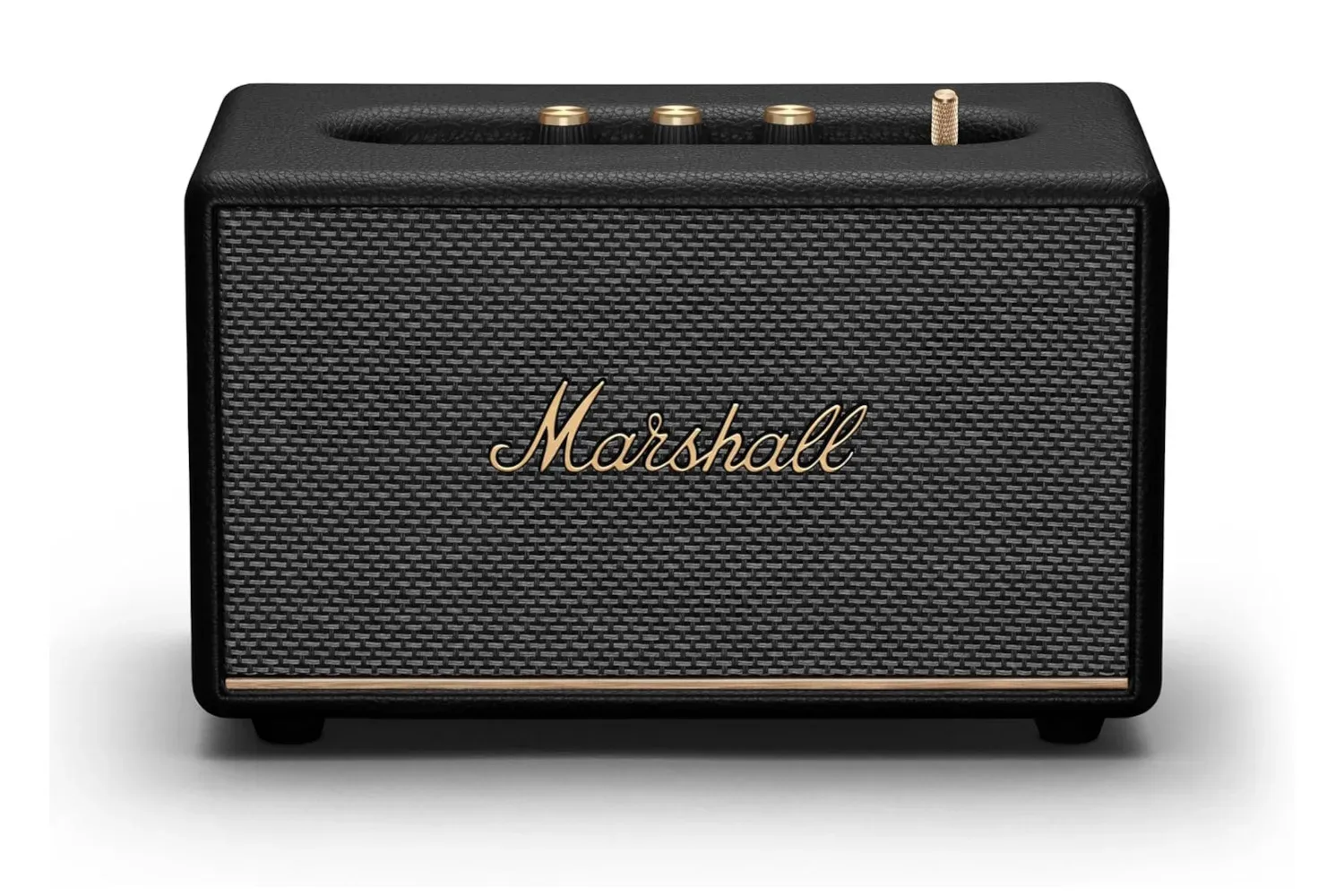
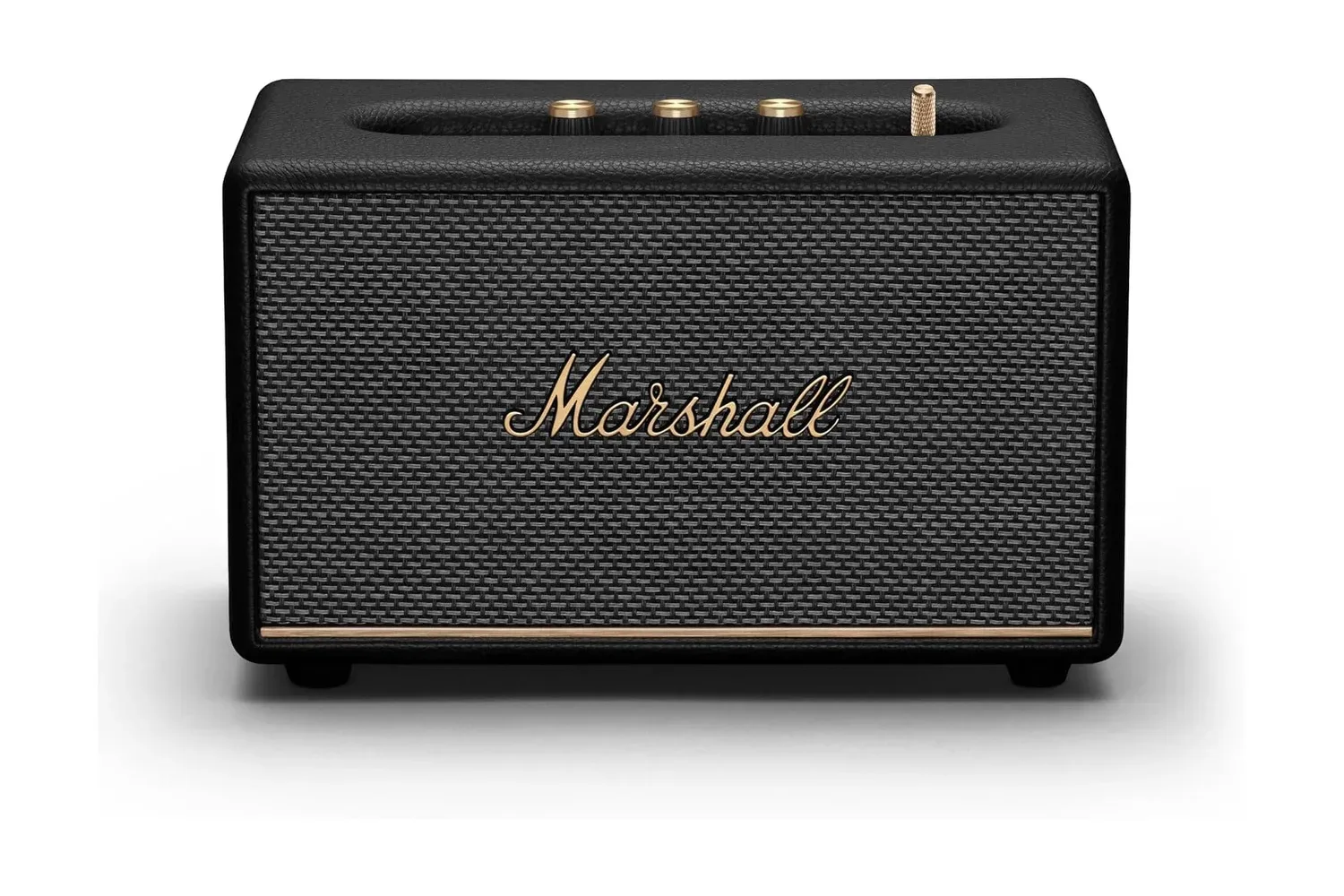
The Marshall Acton III Bluetooth Home Speaker is listed at $170, reduced from $300. That is a $130 reduction, or 43% off—not quite half price, but a notable cut for a compact home speaker with a stated 60 watts of amplification, physical bass and treble controls, Bluetooth 5.2, and a 3.5mm wired input.
For players putting together a desk, bedroom, or living-room gaming setup, the important distinction is that the Acton III is a home speaker rather than a portable, battery-powered Bluetooth speaker. It is designed to sit on a bookshelf, dresser, counter, or similar surface and provide room-filling playback from one fixed position. Its compact footprint may be the attraction for someone who wants sound larger than a small desktop speaker without dedicating substantial space to a full hi-fi system.
The listed dimensions are 10.24 by 6.69 by 5.91 inches, and it weighs about 6.23 pounds. Marshall’s design leans hard into the company’s familiar guitar-amplifier look: a vegan leather-like exterior, brass-colored top controls, and a script logo across the front grille. That styling will be a matter of taste, but the practical design choice is the control panel. Volume, bass, and treble can all be adjusted directly on the speaker, rather than requiring a phone and companion app every time a game, video, album, or podcast calls for a quick tweak.
A $170 home speaker with 60 watts of stated amplification
The Acton III uses three Class D amplifiers: a 30-watt amplifier for its woofer and a pair of 15-watt amplifiers for its tweeters. A woofer is the driver intended to handle lower frequencies, while tweeters reproduce higher-frequency detail such as cymbals, dialogue clarity, and many environmental sounds. Together, the stated amplifier output totals 60 watts.
Watts alone do not tell a buyer exactly how loud or how full a speaker will sound in every room. Room size, placement, content and listening distance all matter. Still, Marshall also lists a maximum sound-pressure level of 95dB at one meter. Sound-pressure level, commonly shortened to SPL, is a measure of sound intensity at a specified distance. The one-meter qualifier matters: it provides a consistent reference point, not a promise of the same perceived level elsewhere in a room.
The listed frequency response is 45Hz to 20,000Hz. Frequency response describes the range of tones a speaker is specified to reproduce. The low end of that range concerns bass and impact, while the upper end covers higher-pitched detail. The Acton III also uses a bass-reflex enclosure, meaning the cabinet design is intended to reinforce low-frequency output. That does not make it a replacement for a dedicated subwoofer, but it explains why the single-speaker design is meant to offer more low-end presence than its size might suggest.
Its tweeters are angled outward, with waveguides intended to spread sound more broadly around the room. A waveguide is a structure around a speaker driver that helps direct its output. In everyday use, that design is aimed at making the listening area less narrow: someone moving between a desk, couch, or kitchen should not need to remain in one precisely centered seat to hear the speaker’s stereo presentation as clearly as possible.
It is worth keeping expectations grounded. The Acton III houses its drivers in one enclosure, so its stereo effect is different from placing separate left and right speakers apart from each other. Its outward-angled tweeters are intended to widen the presentation from that single cabinet, which can be useful where there is limited room for a pair of speakers. Buyers seeking the widest possible separation for competitive positional audio may still prefer a conventional two-speaker arrangement or headphones, but that depends on the priorities and physical layout of the setup.
Related coverage includes Marshall Acton III Falls to $170, Bringing a 60-Watt Gaming Room Speaker Below $200.
Physical knobs are the defining convenience feature
The speaker’s top panel includes a power switch, source button, play/pause button, track-skip control, and three analog dials for volume, bass, and treble. The dials run from 0 to 10. That arrangement can be particularly useful in a mixed-use space, where the same speaker may handle a game one moment, background music the next, then a podcast or video.
Those controls allow immediate tonal changes without reaching for the paired phone. Raising bass can emphasize lower-frequency effects and music; lowering it may suit spoken-word playback or a room where bass becomes too prominent. Treble control provides a corresponding adjustment for the upper-frequency balance. These are broad tone controls rather than a detailed studio mixing setup, but they give the listener direct authority over the most common changes.
Marshall also includes Dynamic Loudness circuitry. In simple terms, this adjusts tonal balance as volume changes so bass and treble are less likely to seem diminished at lower listening levels. That is relevant for late-night sessions, apartment living, or any situation where turning up the master volume is not an option. The feature is intended to preserve a fuller sound at restrained volume, rather than asking the listener to constantly readjust bass and treble manually.
There is still an app for people who want software controls. The Marshall Bluetooth app is available for iOS and Android and provides equalizer adjustments, Placement Correction, and over-the-air software updates. An equalizer, or EQ, changes the level of selected frequency ranges. Placement Correction is intended to help tailor playback to wherever the speaker sits. A unit pressed close to a wall or situated in a particular corner can behave differently from one positioned in open space, so the feature is meant to address placement rather than assume every room has the same acoustics.
Bluetooth for convenience, 3.5mm for a wired connection
The Acton III supports Bluetooth 5.2 with a stated range of up to 30 feet, as well as Bluetooth LE Audio. Bluetooth is the straightforward option for a phone or other compatible device: pair it, select the speaker, and play. It is well suited to casual music and video use, especially when the controlling device is not permanently stationed beside the speaker.
The 3.5mm input is the more notable inclusion for a gaming-oriented room. A 3.5mm connection is the familiar analog audio jack found on many devices and adapters. It gives users a wired alternative where compatible hardware is available. A wired option can be valuable for setups where a player prefers a direct physical connection instead of relying on Bluetooth.
Compatibility should still be checked before buying. The supplied specifications establish that the Acton III has a 3.5mm input and Bluetooth 5.2, but they do not establish how every console, monitor, PC, television, controller, or headset setup will route audio. Anyone planning a specific connection should confirm that their display or source device has the necessary audio output. The speaker is positioned as a Bluetooth home speaker, not as a console-specific accessory.
That makes it a potentially flexible shared-room speaker rather than a narrowly defined gaming peripheral. It could serve music while working, game audio through a compatible wired source, and streaming playback from a phone. For retro-minded players who enjoy projects such as Pokémon FireRed running through an Excel-sheet adaptation, it is also the sort of shelf-friendly component that can fit beside unconventional hardware experiments without looking like another anonymous black plastic box.
Who the Acton III price cut best suits
At the listed $170 sale price, the strongest case for the Marshall Acton III is convenience combined with compact size. It offers a 60-watt three-amplifier configuration, a woofer plus two outward-angled tweeters, manual tone adjustment, app-based EQ and placement tools, Bluetooth 5.2, and an analog 3.5mm input. Those features speak to someone who wants one attractive, stationary speaker that is simple to adjust from the device itself.
Its physical controls may be the deciding advantage over app-only alternatives. The ability to turn a dial for volume or tone is small on paper but practical when a game becomes unexpectedly loud, a podcast needs less bass, or music needs a quick change without interrupting whatever is on screen.
Potential buyers should frame it around space and connection needs. It is compact enough for a shelf or desk-adjacent surface, but it is still a home speaker intended to remain plugged in and placed deliberately. Its single-cabinet approach favors a tidy setup and broad coverage over the separated speaker placement of a traditional left-right pair. And while Bluetooth is convenient, anyone buying specifically for wired game audio should verify their own device outputs first.
The $170 listing represents $130 off the stated $300 regular price. For shoppers who value Marshall’s amplifier-inspired presentation and want accessible controls alongside wireless and wired playback options, that discount makes the Acton III a more approachable option for a room-centered audio upgrade.
Shop the products
Check current price, model and availability at the retailer.