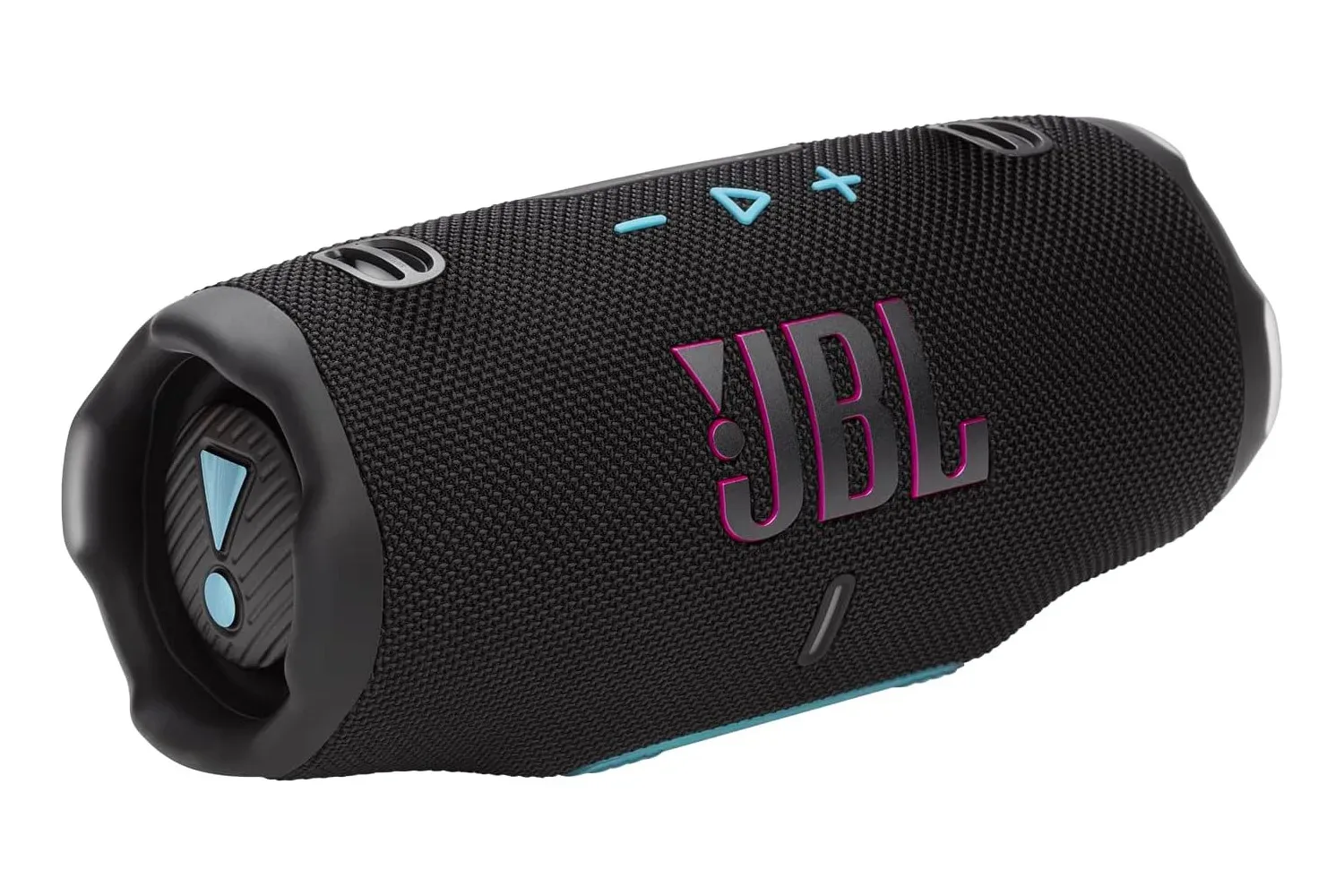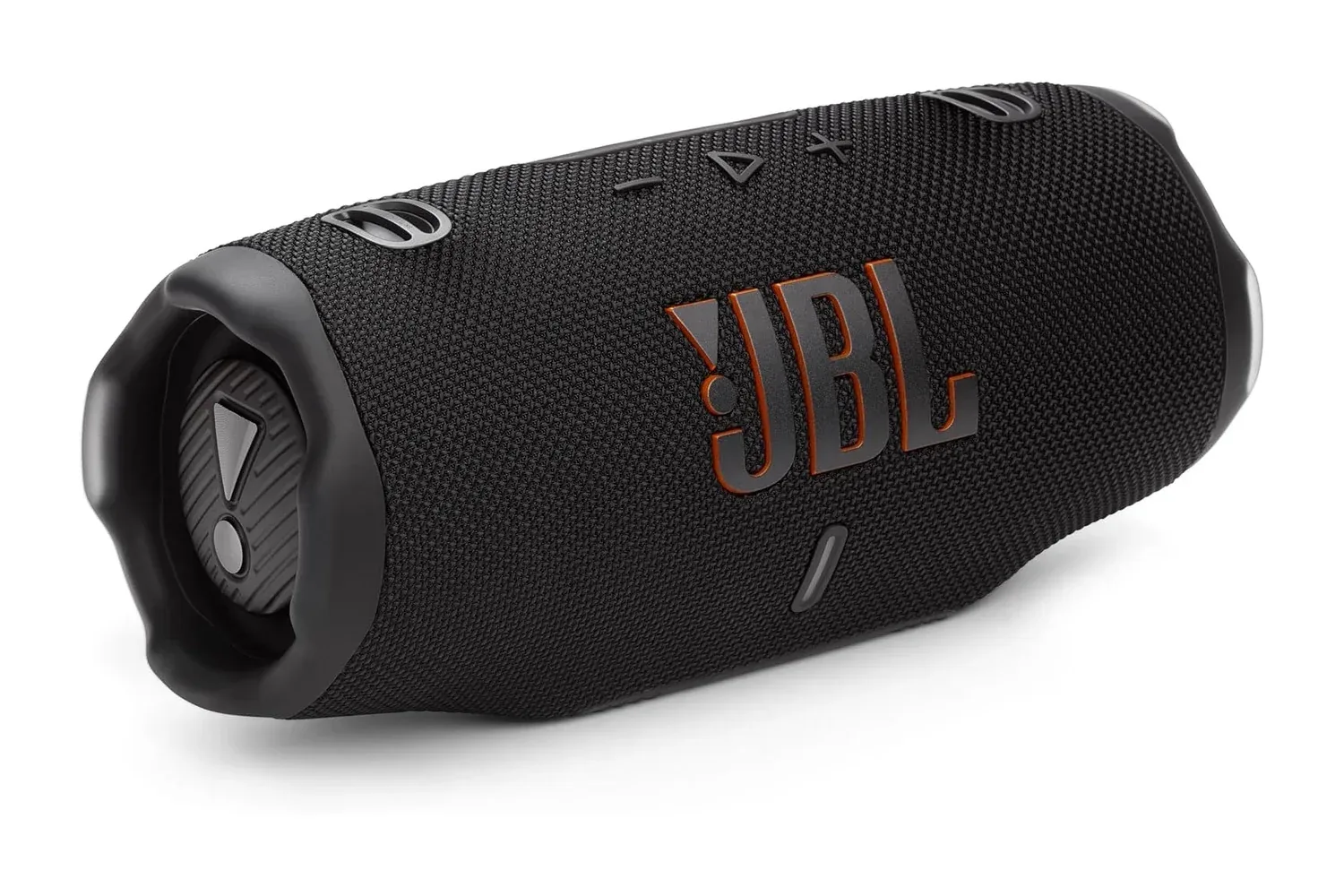
The JBL Charge 6 portable speaker is listed at $140, down from $200—a $60 reduction, or 30% off. For anyone assembling a living-room-to-backyard entertainment setup, the appeal is not just a lower price: the speaker combines long claimed battery life, rugged ingress protection, a USB-C power-bank function and options for linking compatible speakers.
It is a deal centered on portability rather than a tiny desktop audio accessory. The Charge 6 measures approximately 9 by 3.9 by 3.7 inches, includes a detachable strap, and is intended to travel to places where charging access, weather and accidental knocks can matter as much as raw volume. That can include a cookout, campsite, beach day, tailgate or a gaming session that has temporarily escaped the house.
The $140 price also puts a clearer question in front of prospective buyers: which of the Charge 6’s capabilities are genuinely useful for their setup? Its specification sheet has several practical answers, but a few terms deserve unpacking before treating them as automatic reasons to buy.
The core hardware: woofer, tweeter and wireless connection
The speaker uses a 30W woofer and a 15W tweeter. In basic speaker terms, a woofer handles lower-frequency content, including the weight behind kick drums, bass lines and cinematic effects, while a tweeter is responsible for higher-frequency detail such as cymbals and much of the crispness in dialogue. Separating those roles is a conventional way to cover a broader range of sound than a single driver designed to do everything.
JBL lists a low-end frequency response of 56Hz. Frequency is measured in hertz (Hz), and lower figures represent lower pitches. This specification gives useful context for the speaker’s bass ambitions: it is designed to reach into low-frequency material, though it should not be read as a complete prediction of how every song, game or room will sound. Speaker placement, volume and the track itself all affect the result.
For wireless playback, the Charge 6 uses Bluetooth 5.4. Bluetooth is the short-range wireless connection that lets a phone, tablet or other compatible device send audio to the speaker. The more important day-to-day consideration remains the device being used and the stability of its connection, but Bluetooth support is fundamental to the Charge 6’s role as a grab-and-go speaker.
A wired option is available as well. With an eligible device connected over USB-C, the Charge 6 can receive lossless audio. “Lossless” describes audio delivered without discarding data from the original digital file during compression. The practical value of that capability will depend on both the connected device and the audio being played, but it provides an alternative for listeners who want to use a cable rather than Bluetooth.
AI Sound Boost is designed to manage loud playback
One of the more technical features is JBL’s AI Sound Boost. The system continuously monitors the music and adjusts output in real time to help avoid clipping distortion. Clipping occurs when an audio signal is pushed beyond what a system can reproduce cleanly, potentially making loud passages sound harsh or broken up.
The stated goal here is richer, clearer output at higher volume. That makes particular sense for a portable speaker expected to work in open or noisy settings, where listeners may turn the level up to compete with conversation, wind or general outdoor activity. It is not a promise that every environment will become acoustically ideal; it is an output-management feature intended to preserve clarity when the speaker is working hard.
The JBL Portable app offers equalizer controls, or EQ. An equalizer lets a listener change the balance among portions of the frequency range. Raising low-end settings can emphasize bass, while adjusting the midrange can help tailor speech-oriented listening such as podcasts. This is a useful control for a speaker that may alternate between music, streamed video and game audio, since those uses do not always benefit from the same balance.
Battery claims and charging are a major part of the value
JBL rates the Charge 6 for up to 24 hours of playback on a charge. The company also lists up to four additional hours through Playtime Boost. As with any battery-life figure, “up to” is important wording: playback time can vary with listening level and usage. Still, the stated endurance places charging convenience at the center of the product’s pitch.
The quick-charge figure is also notable. A 10-minute charge is said to provide up to 150 minutes—about two and a half hours—of playback, while a full charge takes about three hours. For a person packing for an event or discovering a low battery shortly before leaving, the distinction between a full recharge and a quick top-up can be more meaningful than a headline battery maximum.
The Charge 6 can additionally act as a power bank through its USB-C port. In plain terms, the speaker’s battery can be used to charge a phone. That makes the device a two-in-one piece of kit for an extended outing, although it also creates a straightforward trade-off: drawing power for a phone uses energy that might otherwise have gone toward music playback.
That utility fits the same broader setup logic as the controller, display and audio discounts covered in other early Black Friday gaming-setup deals. A portable speaker will not replace a headset when private chat or positional audio is essential, but it can be a flexible shared-audio option for local multiplayer, trailers, sports streams and music between sessions.
What IP68 and drop resistance mean in practice
The Charge 6 carries an IP68 rating. An IP rating describes protection against intrusion. The first number here, 6, indicates dust protection. The second, 8, relates to water protection under specified test conditions. JBL says it tested the speaker submerged in fresh water to a depth of up to 1.5 meters for 30 minutes.
That is relevant for splashes, sand and the mishaps that accompany a poolside table or a damp camping trip. It does not make every water scenario identical, and the stated test condition is specifically fresh water at a defined depth and duration. The sensible takeaway is durability for the advertised outdoor use cases, not a reason to ignore the speaker after exposure to water or grit.
JBL also says the Charge 6 can withstand a one-meter drop onto concrete. This is a practical specification for a device likely to be carried with one hand, clipped to a bag by its strap or placed on a picnic table. It is still wise to treat that as a resistance rating rather than an invitation to repeatedly test gravity. Durability features are most valuable when they reduce the stakes of an accident, not when they turn accidents into a routine.
Auracast expands one speaker into a larger system
The Charge 6 supports Auracast with compatible JBL speakers. Auracast is the feature name used here for sharing audio among devices. Buyers who later add another Charge 6 can use two units as left and right channels in stereo mode. Stereo assigns different parts of an audio mix to two speakers, widening the apparent soundstage compared with a single speaker.
Alternatively, multiple compatible JBL speakers can play the same track together. That is the more relevant option for spreading sound across a larger backyard, campsite or gathering. An Auracast button on the Charge 6 is intended to simplify pairing without requiring a trip through phone menus each time.
There is an important compatibility boundary: the expansion feature is for JBL products that support Auracast. Anyone planning a multi-speaker arrangement should verify that the other speaker or speakers are eligible before assuming an existing device will join the group.
Who the $140 Charge 6 makes sense for
At its listed sale price, the Charge 6 is best understood as a rugged, portable shared-audio device with a few features that extend beyond music playback. The long stated battery life and quick charging matter most for people often away from an outlet. The IP68 rating and drop resistance are most useful for outdoor settings and travel. USB-C power-bank support can help when a phone needs a boost, while Auracast gives the speaker an upgrade path for buyers who may eventually need broader coverage or stereo separation.
Conversely, shoppers whose audio never leaves a desk may place less value on the strap, water protection and power-bank capability. The strongest case for this model is not simply that it plays audio over Bluetooth. It is that its particular combination of battery, durability, wired and wireless playback, equalizer controls and compatible-speaker pairing addresses the inconveniences that portable sound systems commonly face.
The advertised reduction brings that bundle from $200 to $140. For a buyer already looking for portable audio that can also survive outdoor use and support a phone in a pinch, that price change is the feature that may make the rest of the specification sheet matter.
Shop the products
Check current price, model and availability at the retailer.