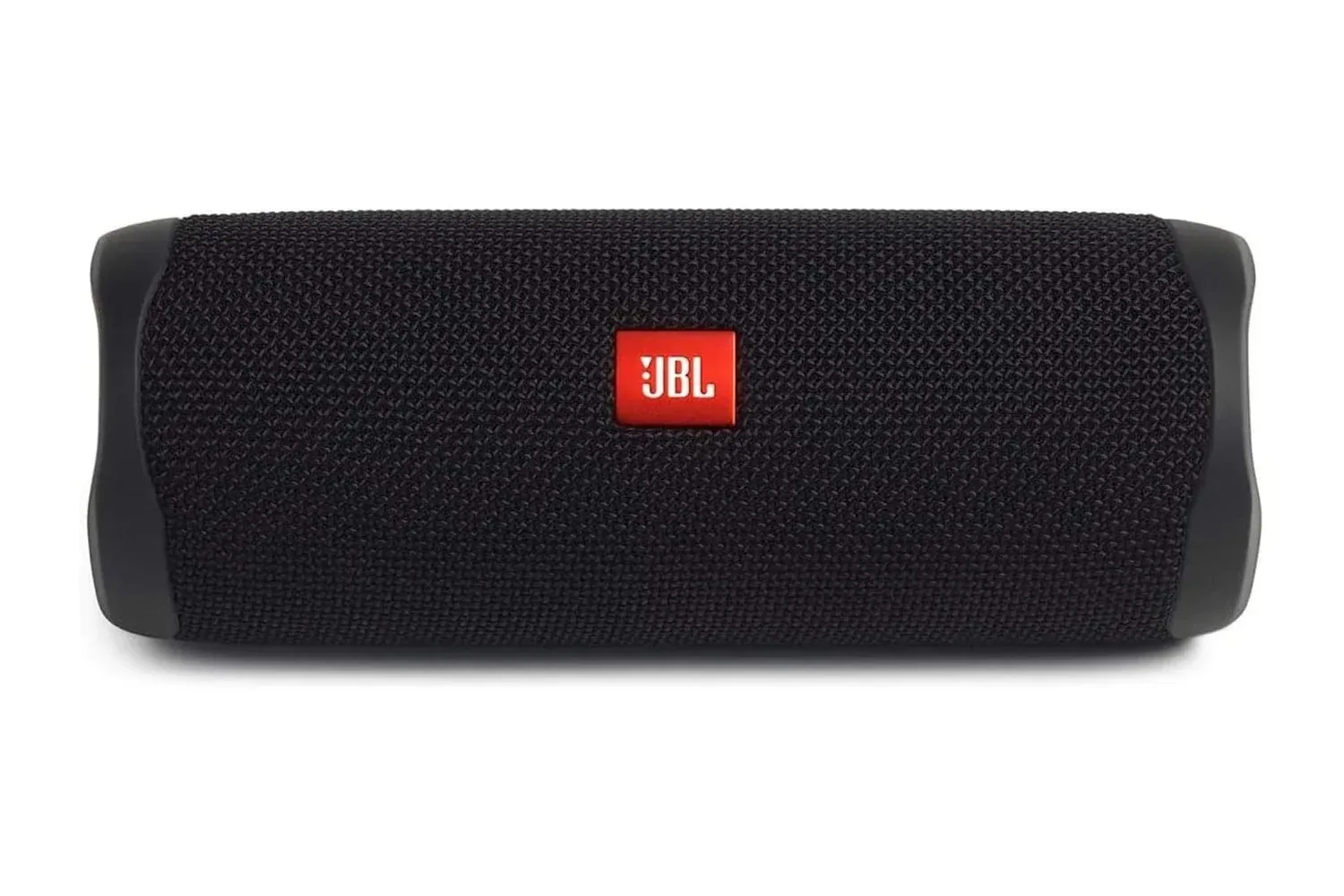
The JBL Flip 5 portable Bluetooth speaker is listed at $70, down from $100. That is a $30 reduction, or 30% off the stated regular price. For anyone looking for a compact speaker for game-night playlists, a patio session, travel, or a poolside gathering, the important question is not simply whether the number on the price tag is lower. It is whether the Flip 5’s particular mix of water resistance, battery capacity, physical controls, and expandable speaker pairing fits the way they will actually use it.
On the supplied specifications, the answer is strongest for people who prioritize portability and outdoor resilience over a feature-packed desktop speaker. The Flip 5 weighs 540 grams—about 1.2 pounds—and measures 181 x 69 x 74 mm. That puts it in the easy-to-pack category for a backpack or larger bag, while its fabric-and-rubber exterior is designed around day-to-day handling rather than a stay-at-home hi-fi setup.
The $70 listing in practical terms
A $70 portable speaker is still a purchase best judged by its use case. The Flip 5 is built around a single 44 x 80 mm, racetrack-shaped driver rated at 20W RMS, with two passive radiators at its ends. It connects through Bluetooth 4.2 to phones, tablets, and laptops, and it has playback and volume buttons on the speaker itself.
That last detail is small but useful. A speaker with onboard controls lets someone turn down an unexpectedly loud song, skip playback, or change volume without digging out the connected device. For shared spaces—whether that means a cookout, a living-room multiplayer session, or music alongside a laptop—the convenience is more meaningful than it sounds.
The listed price should also be treated as a snapshot rather than a permanent promise. Retail listings can change, so shoppers considering the Flip 5 should verify the current price and the exact color option before completing a purchase. JBL offers the model in 11 colors, which is a meaningful selection for a product likely to be carried around rather than tucked behind a television.
IPX7 explained: waterproof does not mean indestructible
The Flip 5 carries an IPX7 rating. “IP” refers to ingress protection, a rating system used to describe resistance to material getting into a device. The “X” means no dust-protection rating is specified here. The “7” is the water-resistance part: the supplied product information describes the speaker as able to withstand submersion in water as deep as three feet.
In real-world terms, that makes the Flip 5 suited to rain, pool splashes, and an accidental brief drop into water. Those are the situations where a waterproof portable speaker can remove a good deal of stress from outdoor listening. It is also worth being precise about what the rating does not establish. It does not provide a dust-resistance claim, and it should not be read as a blanket guarantee against every kind of wet or rough treatment. Water resistance is a practical safeguard, not a reason to stop handling electronics carefully.
For a patio, beach bag, lakeside outing, or kitchen where spills are possible, the rating is one of the Flip 5’s clearest advantages. Buyers whose trips involve fine sand or especially dusty environments may want to remember that the provided rating concerns water, not dust.
Battery, charging and the variables behind “up to 12 hours”
JBL rates the Flip 5 for up to 12 hours of continuous playback from a 4,800mAh lithium-ion polymer battery. “Up to” matters: playback time depends on volume. Louder listening requires more power, so an outdoor gathering where the speaker has to overcome surrounding noise should be expected to have different battery results than low-volume indoor background music.
Its reported full recharge time is about 2.5 hours with a 5V/3A charger. Charging uses USB-C, and a USB-C cable is included. USB-C is not a sound-quality feature, but it is a useful practical benefit. It can reduce the need to carry a special legacy cable if a user already charges other devices through the same connector. For a speaker intended to travel, fewer one-purpose accessories is a genuine quality-of-life improvement.
The sensible planning takeaway is straightforward: twelve hours is enough for a long afternoon and potentially into the evening under suitable volume conditions, but it is not a claim that every high-volume day will end with power to spare. Charging before a trip remains the least dramatic way to keep the party from becoming an acoustic incident involving someone’s phone speakers.
What the sound specifications indicate
The Flip 5’s driver is described as racetrack-shaped rather than circular. That shape gives the driver more surface area than a similarly sized round driver, which helps explain why a small cylindrical speaker can produce more substantial sound than its size suggests. The listed frequency response is 65Hz to 20kHz, while its signal-to-noise ratio is above 80 dB.
These figures are useful context, not a shortcut to declaring one speaker universally superior to another. Frequency response is the range of frequencies a speaker is specified to reproduce. A lower figure points toward bass capability; a higher figure reaches into high-frequency detail. The 65Hz low end provides a useful boundary for expectations: this is a portable speaker designed to deliver audible bass presence, not a substitute for a dedicated subwoofer.
The passive radiators help on that front. Unlike a conventional powered driver, a passive radiator does not have its own motor. It moves in response to air pressure inside the speaker enclosure and is used to reinforce low-end output. Here, the two end-mounted radiators are intended to give bass more weight, particularly when the Flip 5 is used loudly enough for outdoor listening.
Signal-to-noise ratio, meanwhile, is a measure comparing desired audio signal with unwanted background noise generated by the device. A rating above 80 dB supports the aim of keeping playback clear. It does not tell a buyer exactly how every song will sound in every location, but it is relevant to the claim that vocals can remain distinct.
In short, the technical picture supports a speaker focused on lively, portable playback: a compact unit with a 20W RMS output rating, a driver designed to use its available space efficiently, and bass support from passive radiators. “RMS” is a sustained-power measurement, more useful for judging ongoing output than an inflated peak-power number would be.
PartyBoost is the feature to check before planning an expansion
The Flip 5 supports JBL’s PartyBoost system. This permits two compatible speakers to be paired for stereo sound, or multiple compatible speakers to be linked for wider coverage. There are two different goals hidden in that description.
- Stereo pairing uses two compatible speakers to create left and right channels. This can offer a more spacious presentation than one speaker alone when the units are placed apart.
- Multi-speaker linking is about spreading the same music across a larger space. It is the more relevant option for a backyard, a larger room, or a group gathering where one compact speaker may not cover the entire area evenly.
The key word is “compatible.” PartyBoost is not a universal Bluetooth standard that automatically pairs every speaker a friend happens to bring along. Anyone buying the Flip 5 specifically for a two-speaker or multi-speaker setup should confirm that the other JBL model supports PartyBoost. That bit of homework matters more than an enthusiastic plan to turn a casual hangout into a tiny festival.
The feature does, however, give the Flip 5 an upgrade path. A buyer can start with one portable speaker and decide later whether the space, crowd size, or listening habits justify adding another compatible unit.
Who the Flip 5 listing suits best
The Flip 5’s strongest case is for someone who needs a dependable, uncomplicated speaker for mobile use. Its combination of 540g weight, USB-C charging, physical controls, IPX7 water protection, and a claimed 12-hour battery life matches activities where convenience is more important than building a permanent audio system.
It is especially easy to picture in locations where an ordinary speaker would be a worry: beside a pool, on a back porch when weather is uncertain, in a bag for a day near the water, or around food and drinks. Bluetooth support for phones, tablets, and laptops also makes it flexible enough for music, casual video audio, and the kind of impromptu game setup that starts as “one quick round.”
At the same time, prospective buyers should base their expectations on the stated design. This is a mono portable speaker that can be expanded through compatible PartyBoost hardware, not a single all-in-one stereo system. Its water claim is IPX7, not a stated dust rating. And its battery estimate varies with volume. Those are not flaws hidden behind the specification sheet; they are the boundaries that make the product easier to evaluate honestly.
For shoppers comparing seasonal tech discounts, the broader sale period has also included devices such as the iPad mini A17 Pro at a listed $499. The Flip 5’s appeal is simpler and more specialized: it is a $70 portable speaker designed to be carried, used outdoors, and occasionally subjected to the kind of splashy chaos that electronics normally prefer to avoid.
Shop the products
Check current price, model and availability at the retailer.