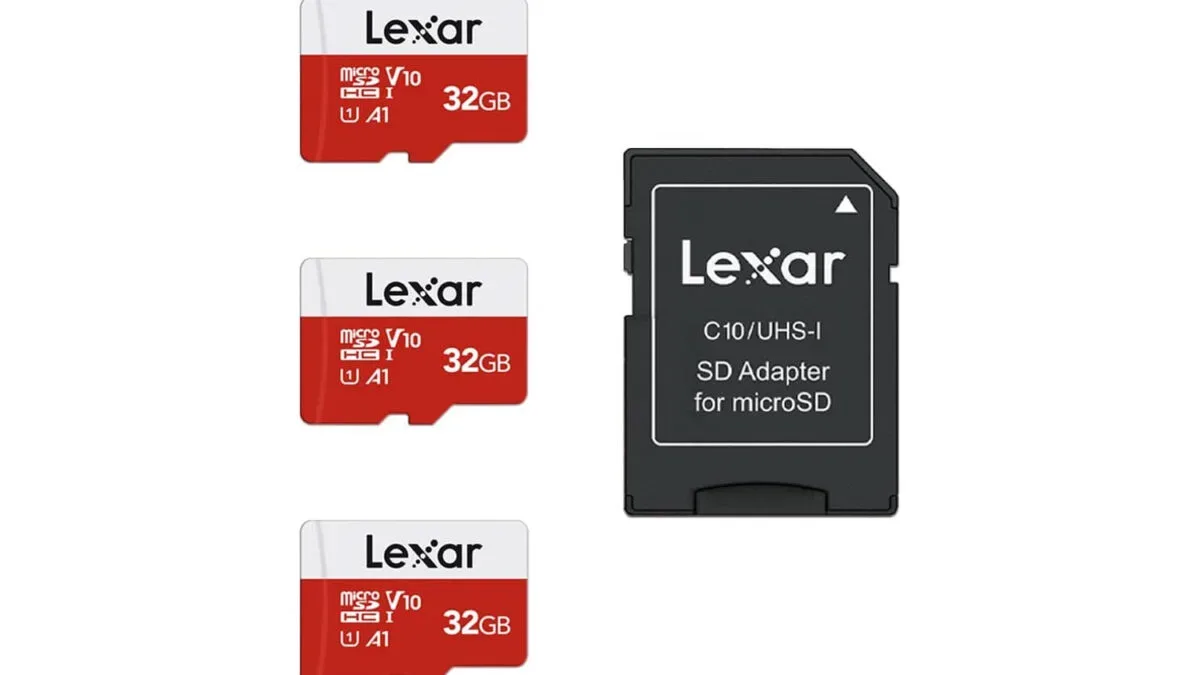
Storage may not be the flashiest addition to a gaming setup, but it is the kind of tiny purchase that can prevent an outsized amount of digital housekeeping. A Labor Day promotion has put a three-pack of Lexar E-Series 32GB microSD cards at $36, down from a listed $43. That is a $7 reduction, or roughly 16 percent, for three separate cards that can be allocated across compatible devices rather than making one card do every job in the house.
The math is the notable part. A single 32GB Lexar E-Series card has been listed at $24, while the three-card bundle works out to $12 per card at the $36 promotional price. For anyone who genuinely needs more than one card—for example, separate storage for a camera, dash cam, portable device, or supported gaming hardware—the bundle costs only modestly more than the listed price of one individual card.
There are smaller purchase options as well. One 32GB card is listed at $20, reduced from $24, and a two-pack is listed at $31, reduced from $36. Those alternatives matter because buying extra storage merely because it is discounted can turn a sensible upgrade into a drawer full of unused plastic. The three-pack makes most sense when three distinct uses are already waiting.
What is included in the $36 bundle
The bundle contains three Lexar E-Series microSD cards, each with 32GB of capacity. Combined, that is 96GB of removable storage, but it should not be treated as a single 96GB volume. Each card remains its own individual piece of media. That division is the point: one card can stay in a compatible device while the others are assigned elsewhere or kept as replacements.
At 32GB apiece, these cards are aimed at relatively modest storage needs. They can hold photos, video, documents, and office files, along with data supported by the device in which they are used. The capacity may be especially practical for devices that write smaller files over time, where a fresh card is more useful than a massive all-purpose archive.
Lexar rates these UHS-I cards for transfer speeds of up to 100MB/s. “Up to” is important. It describes a maximum rated speed rather than a guarantee that every file, reader, host device, or situation will hit that number. The connected device needs UHS-I support to take advantage of the stated performance level. The cards can still function with compatible equipment that does not support UHS-I, but transfers may be slower.
Why UHS-I support is worth checking first
MicroSD purchasing can look deceptively simple: match the tiny card to the tiny slot and carry on. In practice, the device, its storage requirements, and its supported speed standards determine whether a card is a good fit. UHS-I is a bus-interface standard used by many devices, and the advertised up-to-100MB/s transfer figure depends on a UHS-I-capable host and an appropriate workflow.
For gaming, that means the specification should be treated as a compatibility checkpoint rather than a promise of a universal performance boost. A compatible console or handheld may have its own storage limits, formatting requirements, capacity restrictions, and speed behavior. A microSD card can be physically the right shape yet still be a poor match for a particular machine’s documentation or intended use.
Related coverage includes Lexar 32GB microSD Three-Pack Drops to $36 in Labor Day Storage Deal.
This is especially relevant for older hardware and retro-focused setups. Modern microSD media is often used with adapters, flash cartridges, optical-drive replacements, single-board computers, and other accessories, but those configurations can have their own compatibility rules. Before making a purchase for a legacy device, it is best to verify the capacity format it recognizes, any recommended card types, and whether an adapter is required. The card’s 32GB size may be convenient in situations where a device or accessory does not benefit from enormous capacities, but that is not a substitute for checking the hardware’s guidance.
Players building a broader emulation setup may also want to think beyond capacity alone. File organization, backup habits, and a setup that remains understandable months later can matter as much as raw card size. Our look at RetroArch versus standalone emulators explores the value of choosing a configuration that is manageable over the long term—a principle that applies just as easily to removable storage.
Three cards are useful when jobs stay separate
The strongest case for this bundle is not simply “more gigabytes.” It is separation. A person using a compatible security camera, dash cam, digital camera, tablet, or other microSD-equipped device can dedicate each card to a particular role. That reduces the need to constantly remove, erase, and repurpose one card, and it can make it easier to know where particular files belong.
- Camera duty: A card can be reserved for still photos or supported video capture.
- Vehicle or home recording: A compatible dash cam or security camera can use its own dedicated card for footage.
- Portable device storage: A supported smartphone or tablet can receive additional removable space.
- Gaming and accessories: A compatible gaming console or gaming-related accessory can use a separate card, subject to its storage rules.
- Spare media: The third card can remain unused until a device needs fresh storage or another card must be retired.
That flexibility is also why a smaller-capacity multipack can be more appealing than a single larger card for the right buyer. It is not a replacement for high-capacity storage when a device produces large video files or needs a sizable game library. Instead, it is a way to give several compatible devices modest, independent storage at once.
Durability claims add reassurance, not invincibility
The E-Series cards are described as waterproof, temperature-proof, shockproof, and magnetic-proof. Those claims are helpful for a product designed to travel between small electronics, bags, cameras, vehicles, and card readers. Removable media is easy to misplace and easy to subject to everyday bumps, so resilience is a meaningful part of the package.
Still, durability ratings do not eliminate the usual need for care and backups. A microSD card can be physically resilient while the files on it remain vulnerable to accidental deletion, corruption, loss, improper removal, or a device failure. Important recordings, save-related files where supported, and personal photos should not exist in only one place. The convenience of having three individual cards can make a simple backup routine easier, but it does not automatically create one.
The cards are also small enough that organization matters. Labeling a case, noting which device each card belongs to, and avoiding random swaps can save time later. That is less exciting than opening a new package, admittedly, but it is the difference between “camera card,” “dash cam card,” and “mystery rectangle containing something from 2024.”
Who should consider the offer
The $36 three-pack is most compelling for buyers with several confirmed microSD needs and devices that can use 32GB cards. It is a straightforward fit for someone who needs separate media for a camera and a recording device, or who wants one card in use, one in another compatible machine, and one held back as a spare. The bundle’s effective $12-per-card price is substantially below the individual card’s listed $24 retail price and lower than the currently listed $20 single-card option.
It is less clearly suited to anyone whose main goal is one large pool of storage. Three 32GB cards cannot replace the convenience of one larger card in a device that accepts it. Buyers should also avoid assuming that every phone, console, camera, or retro accessory uses microSD directly; some use full-size SD cards, proprietary formats, internal storage, or adapters. Checking the slot type and the manufacturer’s supported specifications remains essential.
Lexar offers capacities beyond 32GB for shoppers whose needs are larger, though those options are separate products with their own pricing. For this specific promotion, the key details are simple: three 32GB Lexar E-Series microSD cards are listed at $36, down from $43; the cards use UHS-I; transfer performance is rated at up to 100MB/s when the host supports it; and the cards are advertised as resistant to water, temperature extremes, shocks, and magnetic exposure.
As with many holiday-adjacent discounts, pricing and stock can change. The sensible move is to decide based on actual device compatibility and a real need for three cards, rather than treating removable storage like a collectible that must be hoarded because it happened to be on sale.
Shop the products
Check current price, model and availability at the retailer.