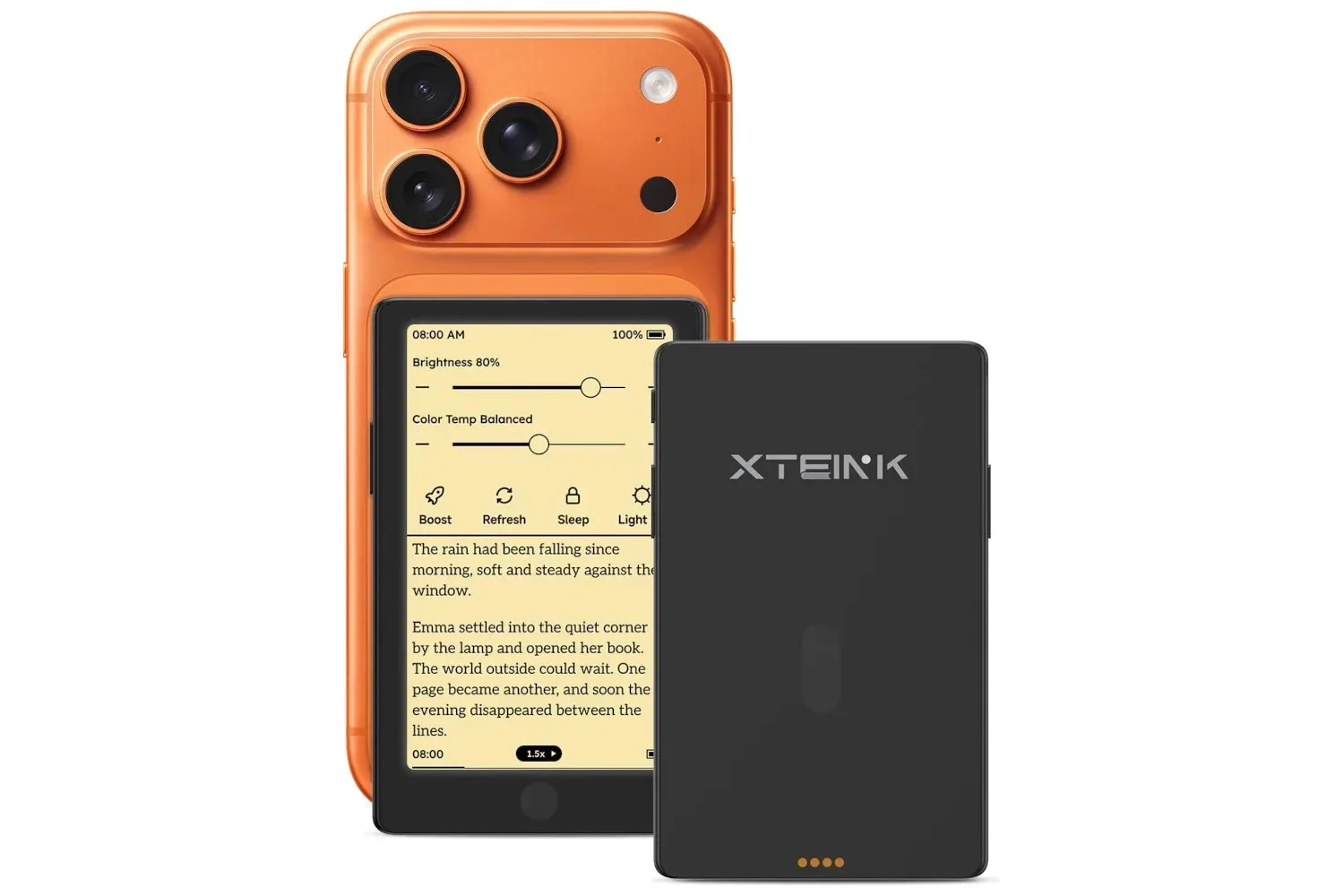
The XTeink X4 Pro Reader was listed at $84 as part of a limited-time 15% discount, positioning the tiny e-reader as a lower-cost alternative for readers who prioritize portability over a large page-sized screen. Its central proposition is straightforward: a 4.3-inch touchscreen, a paper-feel display intended to reduce glare, expandable storage through microSD, and battery life described as lasting for weeks.
That is a notably compact set of specifications for a device intended primarily for books. The small screen will not suit every reader or every document, but it changes the role an e-reader can play. Rather than being another gadget that needs a bag or dedicated pocket, the X4 Pro is presented as a device light and small enough to carry in a pocket. For someone trying to turn short waits, commutes, breaks, or quiet moments into reading time, that may be more important than having a larger display.
A pocket-first approach to reading
Most reading hardware discussions start with display size, library ecosystems, or premium features. The X4 Pro’s 4.3-inch display makes portability the more immediate part of its pitch. A smaller device can be held with one hand and taken along without much planning, which could be useful for readers who move between several books or want a dedicated alternative to scrolling through apps on a phone.
There is a trade-off inherent in that size. A 4.3-inch screen physically shows less text at one time than a larger e-reader display. That can mean more frequent page turns, depending on a reader’s preferred font size and formatting. It may also be less accommodating for layouts that depend heavily on diagrams, tables, illustrations, or large-format pages. Nothing in the available specifications establishes how the device handles those cases, so buyers should treat it principally as a compact reader for ordinary digital books rather than assume it will be ideal for every type of file.
The touchscreen is intended to make the small form factor easier to live with. Touch control gives readers a direct way to move through pages and interact with the device without requiring a large collection of physical buttons. The supplied information does not detail gesture support, interface software, or text-adjustment options, so those are sensible details to verify before making a purchase.
What “paper-feel” means here
The X4 Pro is described as having a paper-feel display that reduces glare. Glare is reflected light on a screen that can make content harder to see, particularly in bright environments. Reducing glare can make a dedicated reading screen more comfortable in places where a reflective display becomes distracting.
That wording should not be stretched beyond what it says. It identifies an anti-glare, reading-oriented aim; it does not, by itself, establish display resolution, lighting features, color capability, refresh behavior, or any other screen metric. Those missing details matter differently to different readers. Someone mainly reading novels may care most about text clarity and comfort, while someone reading comics or image-heavy material would need more specific display information before deciding whether the X4 Pro is a fit.
Storage expansion is a practical advantage
One of the more concrete features is support for a microSD card. MicroSD is a small removable memory card format used to add storage capacity. On an e-reader, that can give an owner room for more files without relying only on the device’s built-in storage.
For readers with a sizable personal library, removable storage can also be a useful organizing tool. It makes it possible to keep more books on hand and potentially move a collection between compatible devices. The X4 Pro is also described as allowing users to convert and transfer digital books they already own, an important detail for people who do not want their reading choices limited to one storefront or one device family.
That flexibility has practical boundaries. “Convert and transfer” does not tell us which file formats are supported, what conversion process is used, or how protected purchases may behave. Digital books can come in many formats, and some are controlled by restrictions that affect where or how they can be read. Readers planning to bring an existing library should confirm compatibility with their own files and the card capacities supported by the device before treating storage expansion as a complete solution.
Battery life matters more on a travel reader
The X4 Pro is said to run for weeks between charges. Exact endurance will naturally depend on how it is used, and no battery capacity or test conditions are provided. Still, the claim speaks to a major appeal of a dedicated e-reader: it is designed around an activity that generally does not need constant charging, notifications, or a stream of background tasks.
For a compact reader, longer intervals between charges can be particularly useful. A device kept in a jacket, bag, or pocket is only convenient if it is ready when there is time to read. The ability to go for extended periods without charging could reduce one more bit of everyday device maintenance, though it should be treated as a claimed use pattern rather than a guaranteed result for every owner.
It also distinguishes the purpose of the product from a general-purpose phone. A phone can certainly display e-books, but it is typically shared with communication, social apps, video, games, and other distractions. The X4 Pro’s value is not that it adds a new way to access every kind of content. Its appeal is a narrower one: keeping a personal book library on a dedicated, compact device.
Who the X4 Pro looks best suited for
At the listed $84 sale price, the XTeink X4 Pro makes the strongest case for readers who value size, a non-reflective reading-oriented screen, removable storage, and a simpler device category. It could make sense for:
- Readers who want a device that can be carried in a pocket.
- People who frequently read novels or other text-led digital books in short bursts.
- Owners of digital books who want the option to convert and transfer their own files.
- Readers who would benefit from adding storage via microSD.
- Anyone looking beyond the most familiar e-reader brands and seeking a lower listed entry price.
Conversely, a buyer whose priority is a large page view, detailed format support, or a particular reading store should seek confirmation of those needs before purchasing. The available information is favorable on the X4 Pro’s physical convenience and storage flexibility, but it does not provide enough detail to make claims about its wider software experience, file-format coverage, or performance with specialized material.
The price is part of the story, but not the whole story
The $84 figure reflected a 15% limited-time reduction at the time it was listed. Temporary discounts can end or change, so it is best understood as a snapshot rather than a permanent price. Even so, the number helps explain the product’s appeal. A compact e-reader does not need to displace a larger, premium device to be useful; it can instead serve readers who want an inexpensive, dedicated way to keep books close by.
That emphasis on a small, specialized display also sits within a broader conversation about screen technologies, including the display supply challenges discussed in recent OLED iPad production developments. The X4 Pro’s supplied details do not identify its underlying panel technology, so no direct comparison should be made. The connection is simply that displays remain central to how portable devices are evaluated: not just by size, but by intended use, reflections, power demands, and readability.
What to check before buying
The available feature list provides a useful starting point, not a complete specification sheet. A careful buyer should confirm a few essentials on the live product listing before checkout:
- The current price and discount: the $84 price was limited-time and may no longer apply.
- Supported book formats: especially for files already owned.
- microSD support details: including supported card capacity, if that affects a planned library size.
- Screen specifications: such as resolution and any lighting options, if reading comfort is the deciding factor.
- Return and support terms: particularly when considering a lesser-known alternative to the biggest e-reader names.
The XTeink X4 Pro’s clearest advantage is not an attempt to be everything. It is the combination of a very small 4.3-inch touchscreen, a paper-feel anti-glare focus, microSD expansion, transferable digital books, and claimed weeks-long battery life. For readers who want a book device that can go almost anywhere without demanding much space, the limited-time $84 listing makes that focused approach worth a closer look.
Shop the products
Check current price, model and availability at the retailer.