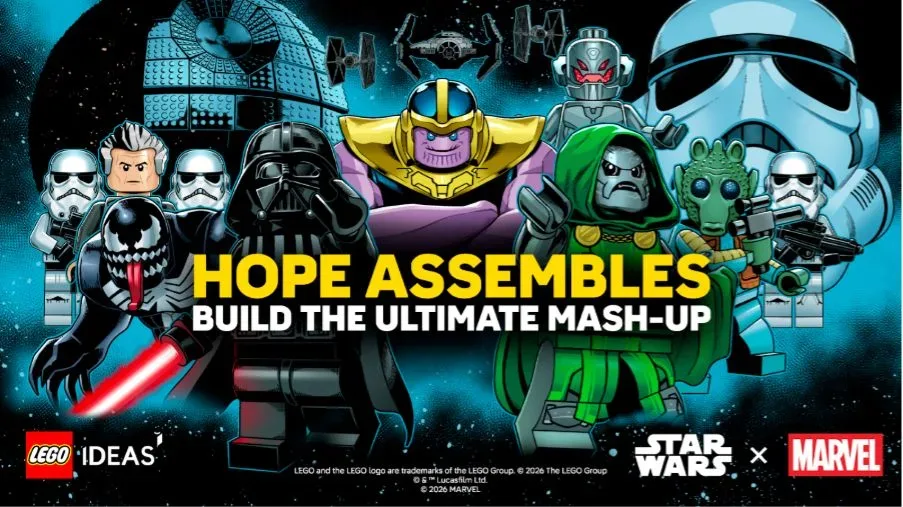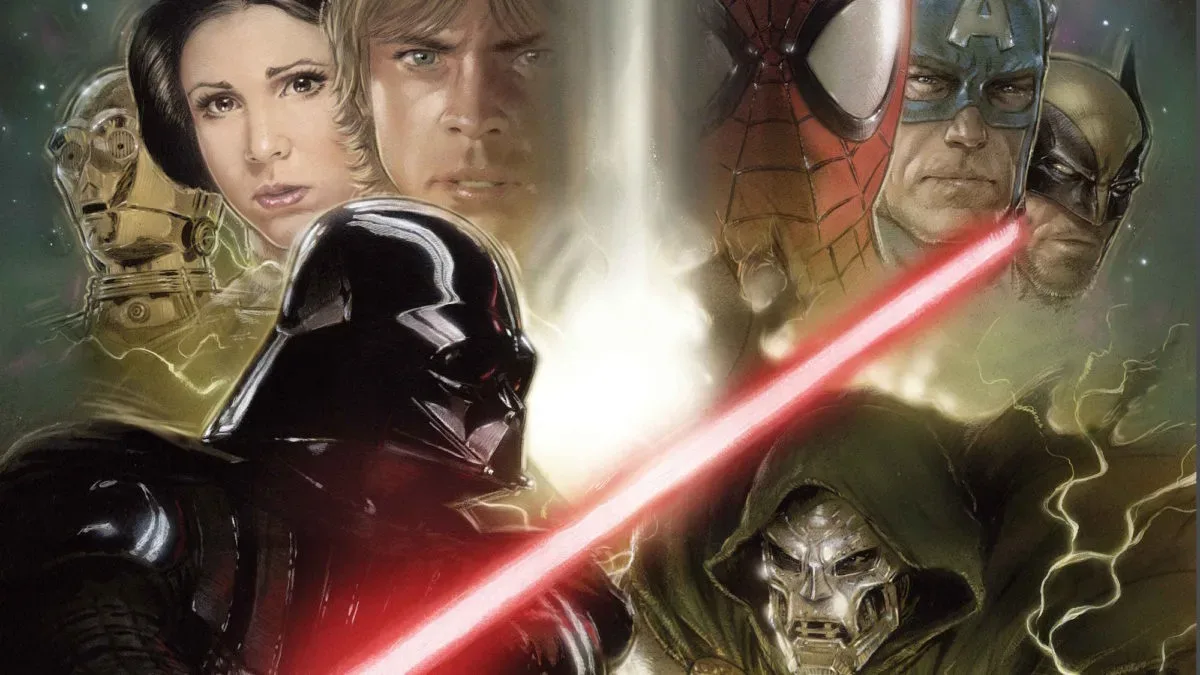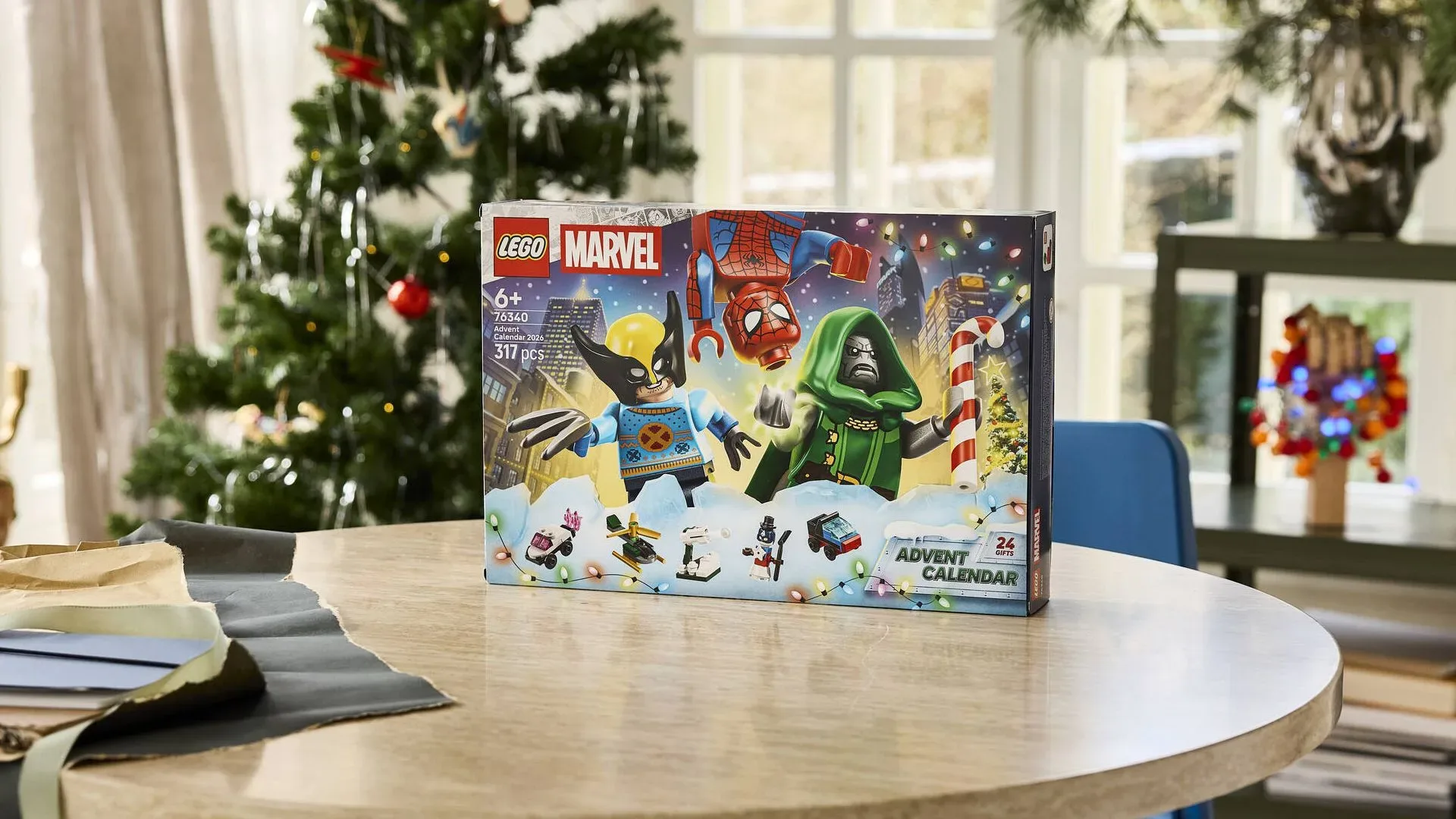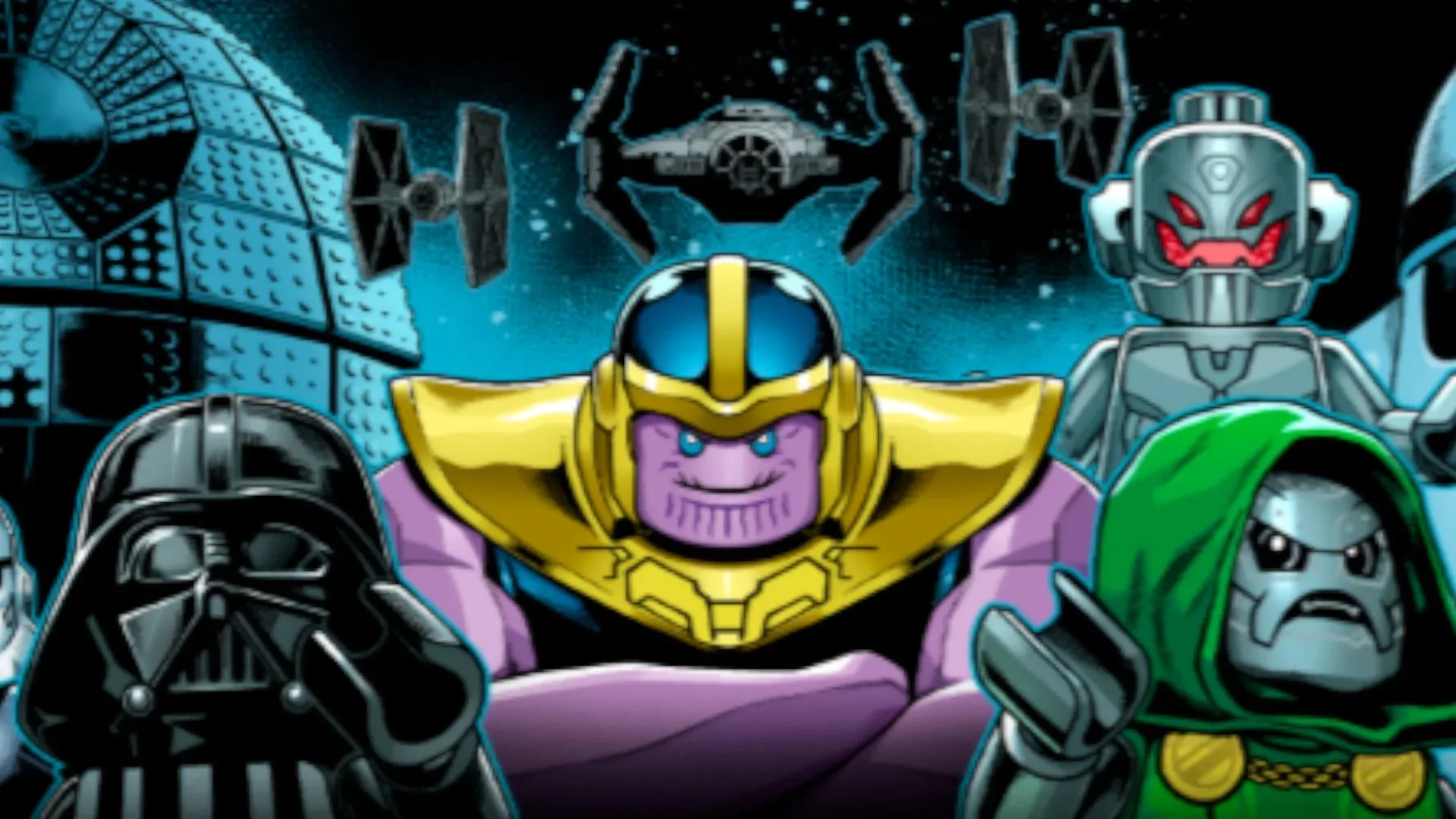
LEGO is opening the toy box between two enormous pop-culture universes. Hope Assembles, revealed at New York Comic Con 2026, is a LEGO Ideas challenge built around Marvel and Star Wars crossovers—and the central twist is that fans, rather than an in-house team alone, can propose the concepts.
The project is described as a first for the two franchises in this format. Participants can submit a family-friendly design that combines Marvel and Star Wars characters, vehicles, settings or visual ideas. Community voting is scheduled to begin on December 8, 2026, with winners due to be announced next year.
That means the most entertaining part of Hope Assembles may happen well before any eventual box reaches a shelf. The challenge gives builders a sanctioned place to answer questions that normally live only in doodles, stop-motion clips and playground arguments: What does a Marvel hero’s ship look like with Star Wars styling? Who belongs in the Emperor’s throne room? Can the strange silhouettes of both universes be combined into a model that is instantly readable from across a room?
Three categories, a very wide creative brief
Hope Assembles is divided into three submission categories:
- Vehicles
- Characters
- Scenes
Those divisions make the challenge broad without making it completely directionless. A vehicle entry could focus on the recognizable shape language that makes a spacecraft, speeder or comic-book machine memorable. A character build can emphasize a minifigure-scale gag, an unusual costume combination or a larger display-focused interpretation. Scenes offer room for storytelling: a famous location from one universe invaded by personalities, props or conflicts from the other.
The examples attached to the premise lean deliberately absurd. Darth Vader wielding the Infinity Gauntlet is the sort of visual punchline that needs almost no explanation. Doctor Doom occupying the Emperor’s throne in the Death Star, attended by “StormDoomtroopers,” takes the same approach: mix symbols of authority from each property until the resulting image is both familiar and gloriously wrong.
That is the useful design lesson in the challenge’s setup. A crossover does not need to bury one franchise under the other. The clearest pitches will likely preserve recognizable parts of both: the silhouette, palette, props, architecture or character pose that allows someone to identify the joke at a glance.
What LEGO Ideas means—and what it does not guarantee
LEGO Ideas is the company’s community design program. Fans create and submit models, the wider community votes, and LEGO reviews designs that advance through the process. A successful submission is therefore not automatically a retail product. It is a fan concept moving through a selection and development path.
Related coverage includes LEGO Hope Assembles Invites Fans to Design Star Wars and Marvel Crossover Sets.
Hope Assembles follows that community-led spirit. The supplied details say popular entries will be considered by both the community and LEGO, with selected concepts turned into purchasable sets. But prospective entrants should keep an important distinction in mind: a polished fan model and a finished retail set are not necessarily identical.
LEGO’s design team may alter a selected project for practical reasons. That can include translating an ambitious digital concept into a stable physical build, adapting parts use, or making other changes needed for the final product. The source material points to prior fan-backed projects where the finished version remained close to its starting idea while still receiving professional revisions.
That is not a downgrade of the original creator’s contribution; it is the practical handoff from concept to mass-produced construction kit. A challenge entry can demonstrate the big idea, the display appeal and the crossover logic. A final official model must also work as an object people can build, handle and enjoy.
Why the category choice matters for entrants
Builders have considerable freedom, but choosing the right category should help an entry communicate its strongest point quickly.
Vehicles: sell the silhouette
Vehicle concepts are likely strongest when the merger can be understood immediately. The aim is not simply putting a Marvel logo on a Star Wars craft, or vice versa. A more persuasive pitch identifies a visual trait from each side and makes them feel intentionally connected. In plain terms, the model should look like a designed object, not two unrelated sets pushed together.
Characters: make the mash-up readable
Character entries can work through costumes, accessories, scale or a carefully selected pose. The central question is simple: can someone recognize the reference without needing a paragraph of explanation? Vader with the Infinity Gauntlet works as an example because each element has a distinct cultural identity. The strongest character concepts will use that same kind of visual shorthand.
Scenes: give the crossover a reason to exist
Scenes have the most room for a miniature story. A throne, a command deck or an intergalactic battlefield can turn a character pairing into a moment. The best use of a scene category may be to let the setting do some of the joke: Doctor Doom in the Emperor’s seat works because the location makes the character’s ambitions feel even more excessive.
Entrants still need to remain within the stated family-friendly guidelines. That broad condition is a meaningful creative boundary. It favors inventive, playful conflicts and visual comedy over material that would be unsuitable for LEGO’s general audience.
The precedent for fan concepts becoming official kits
Hope Assembles is unusual because it crosses Marvel and Star Wars, not because it asks fans to imagine official LEGO products. Community-created designs have already become finished kits, including models based on The Nightmare Before Christmas, Wallace & Gromit and Downton Abbey.
A more specific example is the Yu-Gi-Oh! Exodia design referenced alongside this new challenge. It reached 10,000 fan votes, became one of five finalists and was ultimately selected to become a set. That sequence illustrates why voting matters, while also showing that enthusiasm is only one stage in the process. A model must reach the relevant threshold, contend with other finalists and then be selected for further development.
For fans watching rather than entering, that makes Hope Assembles more than a gallery of crossover jokes. The submissions are early versions of potential products, but they are still proposals. It is sensible to enjoy the creativity without treating every popular model as confirmed merchandise.
A comic connection and a wider moment for Marvel LEGO
Kevin Smith, identified as an actor, director and Marvel comics writer, introduced the project at New York Comic Con. He linked the challenge to the upcoming Star Wars/Marvel: Hope Assembles comic series and described both projects as expressions of creative play across the two universes.
“This challenge gives fans a chance to be part of something never done before and I can’t wait to see all of the creative Marvel and Star Wars mash ups it inspires!”
The timing also puts Hope Assembles alongside a newly revealed LEGO Marvel Skyline that embraces especially offbeat comic-book material, including the Thanos Copter. That appetite for deep cuts matters. Crossovers are most entertaining when they are not confined to the safest possible iconography; a knowing reference can reward longtime readers and viewers while remaining visually funny to everyone else.
Star Wars fans looking for an interactive adventure rather than a brick-building prompt can also see how another corner of the franchise approaches vehicles and competition in this Star Wars: Galactic Racer beginner’s guide.
What to watch between now and the vote
Submissions are indicated as open now through the Hope Assembles page. The key date currently provided is December 8, 2026, when voting begins. After that, the community response will reveal whether fans gravitate toward imposing display scenes, instantly recognizable character gags or vehicles with the cleanest crossover designs.
For would-be designers, the practical opportunity is unusually direct: build a clear concept, put it in the category where it has the best chance to shine, keep it family friendly and let the model itself explain the premise. For everyone else, Hope Assembles promises a public showcase of the kind of playful “what if?” combinations that LEGO has always encouraged—now with Marvel and Star Wars sharing the same bricks.