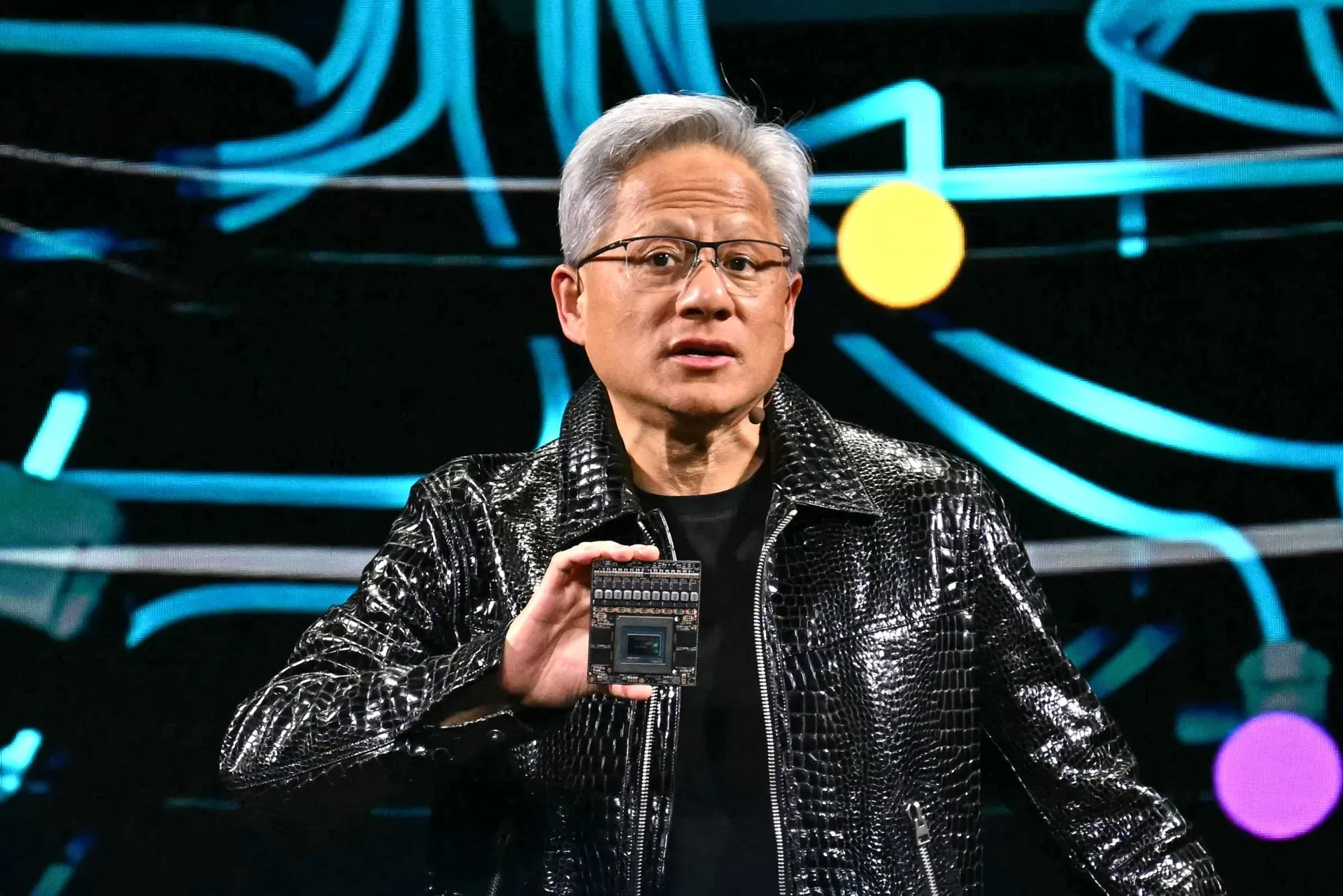
A discussion about putting brakes on the fastest-moving edge of artificial intelligence took an unexpected detour at the All-In Summit in Los Angeles: a live phone call with President Donald Trump. Nvidia chief executive Jensen Huang was handed the phone during an on-stage conversation, and Trump used the moment to dismiss doubts around AI data centers and their expansion.
The exchange arrived shortly after Anthropic co-founder and CEO Dario Amodei published We Must Pace the Frontier, an essay arguing for tighter AI rules, limits on unchecked progress and restrictions on sales of powerful AI chips and semiconductor-manufacturing equipment to China. The position is notable not only because it came from the head of a prominent AI company, but because Elon Musk and OpenAI CEO Sam Altman also endorsed the essay.
That alignment does not settle the policy argument. It does, however, underline the scale of the question now facing the AI sector: whether building ever more powerful systems should proceed as quickly as the market and hardware supply chain can support it, or whether governments and companies should impose deliberate limits.
At the summit, Huang praised Trump’s approach before passing the microphone toward the phone so the audience could hear the president’s response. Trump described concerns about AI as “almost a conspiracy” and repeatedly called them a “hoax.” He argued that data centers are beneficial because they generate wealth for individuals and states, calling them the “oil of the next 20, 25 years.” Trump also said AI was bigger than the internet and suggested opponents of its development could include political figures or China.
“The data centers are great, and they make people wealthy, and they make states wealthy, and it’s the oil of the next 20, 25 years.” — Donald Trump, during the summit phone call
The spectacle matters less as a technical assessment of AI safety than as a clear illustration of the competing incentives around the infrastructure boom. This is not merely a debate over chatbots, generated images, or whether an assistant can write an email. At stake is an enormous buildout of facilities, chips, memory and power-hungry computing capacity—and the investment expectations attached to all of them.
What the argument over “pacing” AI is actually about
In this setting, frontier AI means systems at or near the most capable end of the field. Calls to “pace” development are not necessarily a demand to stop all AI research or remove existing products. They concern the speed at which increasingly capable models are trained, deployed and scaled, especially when their capabilities and potential risks may outstrip safeguards or public policy.
Amodei’s proposal, as described in the summit discussion, contains three practical areas: tighter regulation, constraints on unchecked advancement, and limits on exporting powerful chips or semiconductor equipment to China. Each points to a different pressure point.
- Regulation concerns the rules and oversight that may govern companies developing or deploying advanced systems.
- Pacing concerns the rate of progress: whether the industry’s technical and commercial race should have limits rather than treating faster scaling as an unquestioned good.
- Chip and equipment restrictions concern access to the hardware and manufacturing tools required to develop the most demanding AI systems.
These subjects overlap but are not interchangeable. A company could support rules around exports while opposing domestic constraints on model development. Another could endorse safety testing while disagreeing about what threshold should trigger a delay. The political force of the summit moment came from collapsing those distinctions into a simpler message: data centers create money, so criticism of the boom should be rejected.
That may be effective rhetoric for a room full of technology investors, but it does not answer the underlying questions posed by advocates of a slower approach. Whether data-center construction produces economic activity is separate from whether all future expansion should be treated as risk-free, or whether powerful AI systems and their supply chains need additional safeguards.
Why Nvidia’s role is central
Nvidia sits at the heart of the argument because the company supplies graphics processing units, or GPUs, used for AI workloads. A GPU is a kind of processor designed to handle many calculations in parallel. That makes it useful for the massive mathematical operations associated with training and operating advanced AI models.
The industry often uses compute as shorthand for the hardware resources needed to run those calculations. In the supplied reporting, compute is described both as the physical capacity provided by hardware and as an increasingly valuable economic asset. When AI developers seek larger or more advanced systems, their demand for compute can rise. That can mean more need for the GPUs supplied by Nvidia and for the surrounding components and facilities that let those chips operate at scale.
This is the commercial logic behind the data-center push. A data center is a facility housing computing equipment. In the present AI race, these facilities are not just generic server buildings: they are part of a chain that links investor funding to chip purchases, memory supply, installed computing capacity and the prospect of future AI revenue.
Nvidia’s market capitalization was cited at $5.1 trillion during the episode, demonstrating why a conversation about limits on AI progress carries substantial financial weight. A slower rate of advancement could influence expectations for future GPU demand. That is not the same thing as proving that every safety proposal would damage Nvidia’s business, nor does it establish that stock-market moves were caused by one essay. It does show why company executives, investors and political leaders have reason to view the pace of AI development as an economic issue as well as a technical one.
The money and market backdrop
The reporting places roughly $31.6 trillion of investment behind AI data-center construction. It also says Trump disclosed personal investments of more than $6 million in data-center building during 2026. Those figures provide important context for the president’s enthusiastic language: data centers are being presented not as a peripheral technology project, but as a major investment story with direct political and private financial stakes.
Market anxiety was also part of the timing. Amodei’s essay was published on a Saturday, and the summit podcast was recorded the following Monday. Across the five days mentioned in the reporting, Nvidia shares fell 5.6%. Shares in the three largest RAM suppliers also declined after the essay gained attention.
RAM, or random-access memory, is a type of memory used by computers to hold data that is actively being worked on. Its suppliers are relevant to the broader AI infrastructure story because large-scale computing depends on far more than the processor alone. Still, a shared decline in several stocks does not by itself prove why those declines happened. Markets respond to numerous inputs, including expectations, broader sentiment and company-specific factors. The sequence makes the timing notable; it does not establish a single causal explanation.
That distinction is especially important when public figures frame the debate as an all-or-nothing fight between growth and obstruction. A decline in a stock price is not proof that regulation is misguided. Likewise, enthusiasm for AI infrastructure is not proof that risks are imaginary. The live call instead reveals how rapidly a debate over governance can become entangled with the valuation of companies that sell the infrastructure required to keep scaling.
A political reassurance campaign, not a technical answer
Huang’s appearance with Trump served as a public reassurance exercise at a moment when prominent AI leaders were discussing constraints. Huang told Trump that the audience had been talking about him, praised him for having “saw through” the issue and said attendees were grateful. Trump then supplied the pro-expansion message in unusually direct terms.
Nothing in those remarks offers a detailed framework for assessing AI safety, setting regulatory thresholds or deciding which chips should be subject to export limits. Instead, the argument centered on national competition, wealth creation and resistance to perceived efforts to slow the sector.
For gaming and consumer technology audiences, the bigger implication is that infrastructure debates tend to arrive downstream in products people actually use. When the companies behind major computing platforms prioritize AI capacity, the costs, demand and strategic direction of that capacity can affect the wider hardware ecosystem. The source material does not identify specific effects on gaming devices, game development or GPU prices, so none should be presumed. But it does make clear that AI’s expansion is inseparable from demand for specialized computing hardware and the data centers that deploy it.
It is also a reminder that “AI” is too broad a label for a useful public argument. In the summit exchange, the term covered advanced-model development, the chips that train and run those models, data centers, national competition, financial markets and regulation. Those are connected subjects, but they require different evidence and different policy decisions.
The debate around creator tools offers a narrower example of why the details matter: projects such as creatorAPI’s likeness-licensing marketplace proposal raise questions about how AI-adjacent technology is deployed and governed that cannot be resolved simply by counting new data centers.
What remains unresolved
The call at the All-In Summit did not resolve the core disagreements. Amodei’s case for restraint remains a call for concrete limits and policy action. Trump’s response was a broad defense of continued expansion. Huang’s incentives are closely tied to demand for the GPUs that provide AI compute. Investors, meanwhile, are watching whether expectations for rapid growth remain intact.
Those positions can coexist without producing a clear answer. The useful question is not whether data centers are “great” in the abstract. It is what obligations should apply when companies build and use them to pursue increasingly powerful AI, how the economic gains and risks are evaluated, and who gets to decide when the pace becomes too fast.
For now, the on-stage call is best read as a demonstration of the AI boom’s stakes. In a single exchange, it brought together a major chipmaker, a president who says he has invested in data-center construction, concerns about national competition, a call for AI restraint, and a stock market sensitive to the entire story. That is much more complicated than a hoax—and far more consequential than a rallying cry.