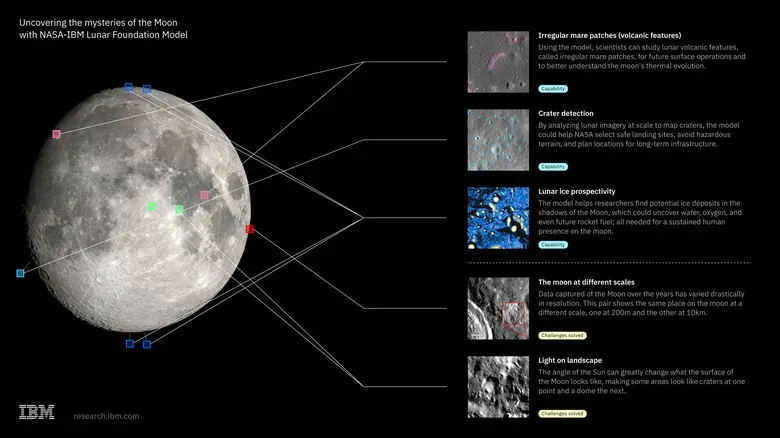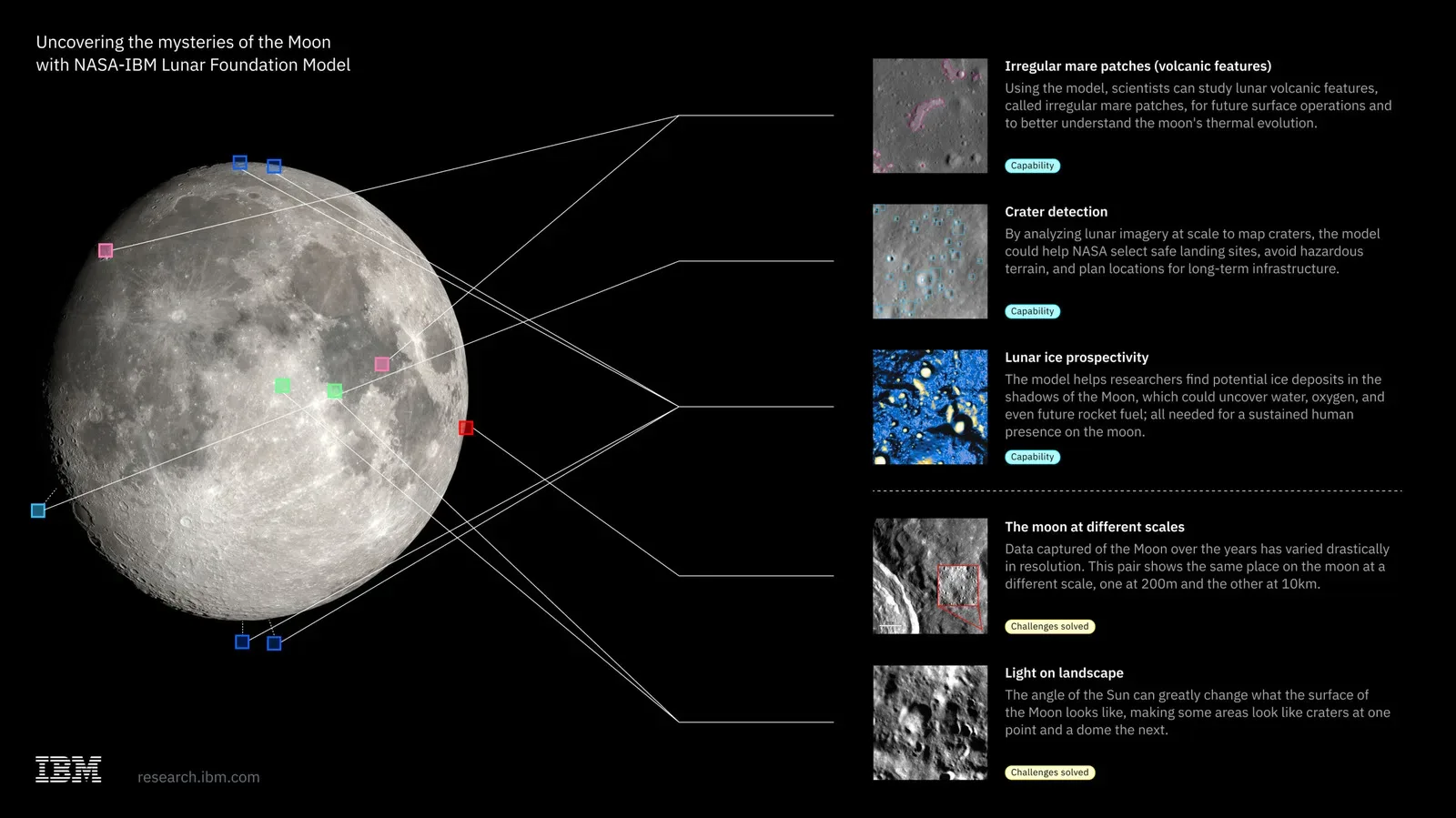
NASA and IBM have released the NASA-IBM Lunar Foundation Model, an open-source artificial intelligence system intended to help researchers interpret the Moon’s complicated surface data. The release is accompanied by an openly available lunar dataset designed for scientists who want to train, adapt, or evaluate models of their own.
The project arrives as lunar exploration receives renewed attention. Artemis II completed a crewed lunar flyby on April 6, becoming the first human flight to the Moon since 1972. Reid Wiseman, Christina Koch, Victor Glover, and Jeremy Hansen traveled farther from Earth than any people had previously gone. While future Artemis missions remain ahead, NASA’s work with IBM focuses on another piece of the lunar puzzle: making the huge volume of orbital observations more useful to researchers.
The model is available through Hugging Face. As a foundation model, it is not positioned as a single-purpose crater counter or ice detector. Rather, it is built to support multiple lunar-analysis tasks, with early evaluations focused on identifying likely surface ice and recognizing craters. That distinction matters. A model with a flexible base can potentially be tuned for specific scientific questions without every team having to begin with an entirely new training process.
What NASA and IBM tested
One test concerned potential lunar ice, a subject with obvious importance for long-term exploration planning. NASA and IBM compared the model’s output with a map created through a published scientific workflow that combines terrain, thermal, and environmental information. Against SwinV2-B, a Microsoft-trained image-processing model commonly used as a baseline in high-resolution vision work, the NASA-IBM model reduced errors by 23 percent.
That result should be read for what it is: a benchmark comparison under the reported evaluation, rather than proof that AI has solved the question of where usable lunar ice exists. Still, it suggests that a model trained around the Moon’s particular conditions can beat a more general image-analysis baseline when asked to find patterns associated with ice.
The second benchmark involved crater identification and classification. In that task, NASA and IBM reported that the Lunar Foundation Model outperformed SwinV2-B by 19 percent, despite being trained with half as much data. Craters are among the Moon’s most familiar features, but they are not a trivial computer-vision problem. Their shapes, visibility, and apparent boundaries can shift dramatically depending on illumination and viewing conditions.
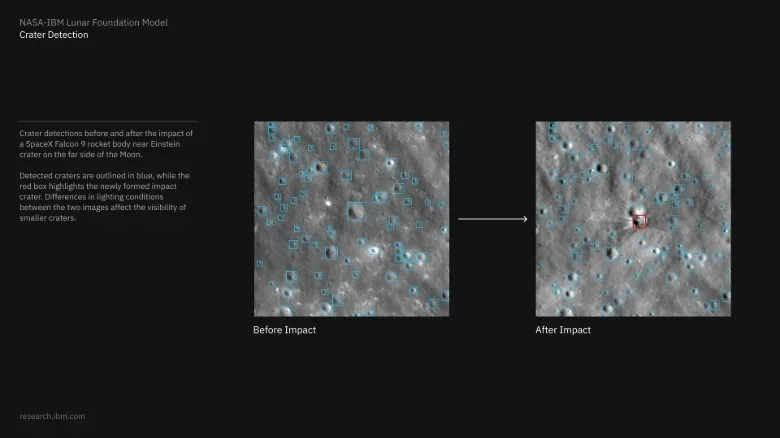
There was also a timely real-world-style check. A SpaceX Falcon 9 rocket crashed into the Moon on August 5, producing a fresh impact feature. When IBM supplied an image from the location to the model, it identified the crash site as a new crater even though it closely overlapped an older crater. It was a useful demonstration of the task the system is meant to assist with, particularly because a new mark on the lunar surface will not always appear in a conveniently blank patch of terrain.
The Moon is a brutal visual environment
Lunar imagery looks clean from a distance, but the training data present problems unlike many familiar Earth-observation datasets. Earth’s atmosphere scatters sunlight, which can soften shadows with ambient illumination. The Moon has no comparable atmospheric cushion. Its shadows can be extremely dark and sharply defined, leaving pixels in shaded areas with little or no usable visual information.
Related coverage includes NASA and IBM Release Open Lunar AI Model and Dataset.
That means the same crater can look substantially different at different times of the lunar day. A rim that is easy to identify under one sun angle might blend into darkness or become visually flattened under another. For a person examining images, that is an expected complication. For a model expected to generalize from examples, it creates a serious risk: the software may learn lighting quirks instead of learning the geological feature it is supposed to detect.
In gaming terms, it is less like recognizing a character model on a well-lit menu screen and more like identifying the same object across levels where the lighting engine keeps changing the scene’s entire silhouette. The analogy only goes so far, of course; lunar science is not a graphics setting. But it captures why a conventional image model can struggle when light and shadow conceal so much of the input.
It also illustrates a broader technology lesson: data arrangement and evaluation rules can be as significant as the architecture that attracts the headlines. That is especially relevant as AI tools increasingly become part of public-facing digital services and platforms. The details of access, data, and design often determine what a tool can genuinely do; even seemingly straightforward feature plans can leave practical questions unresolved, as with Snapchat’s planned group-chat event hubs.
Why standard training was not enough
Many vision systems are trained through masking exercises. Portions of an image are hidden, and the model is asked to infer or rebuild the missing material from patterns learned elsewhere. On a world with many visually repetitive craters, that approach can become unreliable. If a model sees only a small portion of one crater, reconstructing the rest may not prove it has understood that specific feature; it may simply produce a plausible-looking crater based on countless similar examples.
The teams found the usual approach did not produce a workable result for this lunar task. Their answer was geographical separation. They divided the Moon into wedge-shaped sections, then kept the portions used in training distinct from the portions held back for testing. Put simply, the model was not evaluated on nearby examples that could be too similar to what it had already encountered during training.
This strategy is important because it aims to test whether the system can handle genuinely separate areas of the lunar surface rather than merely recognizing familiar local patterns. It does not erase every limitation of machine learning, and reported benchmark gains should not be stretched beyond their specific tasks. But the design addresses a clear problem in a dataset where repetition can easily look like mastery.
The dataset may be the longer-lasting release
The foundation model is the immediate headline, yet the accompanying dataset could become the more durable contribution. It brings together tens of thousands of images and instrument-data records from NASA’s Lunar Reconnaissance Orbiter, the Gravity Recovery and Interior Laboratory mission, and Japan’s Selenological and Engineering Explorer mission, also known as SELENE.
The central achievement is co-registration: imaging data are organized on a grid so that each pixel can correspond with other forms of information that a model may use. Rather than forcing researchers to align disparate inputs from scratch, the dataset provides matched layers of data for the same places on the Moon. It contains more than two million data points.
That organization may sound mundane beside the idea of a Moon-exploring AI, but it is fundamental. A model can be replaced by a stronger successor, retrained for another target, or adapted to a new method. A carefully structured dataset, by contrast, can remain useful across many generations of tools. It gives researchers a common starting point for comparing approaches and avoids making every new project repeat the same difficult preparation work.
For lunar researchers, the open release creates room for independent experimentation with crater studies, ice-related mapping, and other questions supported by the available modalities. For the broader AI field, it is a reminder that specialized models succeed or fail on the quality, coverage, and organization of their underlying material. The Moon may be Earth’s nearest celestial neighbor, but its hard shadows, dense crater history, and fragmented scientific records make it a distinctly demanding place to teach a machine how to see.
NASA and IBM’s reported results are therefore most compelling as a combination: a model that showed measurable gains over SwinV2-B in two named tests, plus a shared data foundation other researchers can use to challenge, refine, or surpass it. The Moon has no shortage of craters. The valuable part of this release is giving more people a better-organized way to study them.