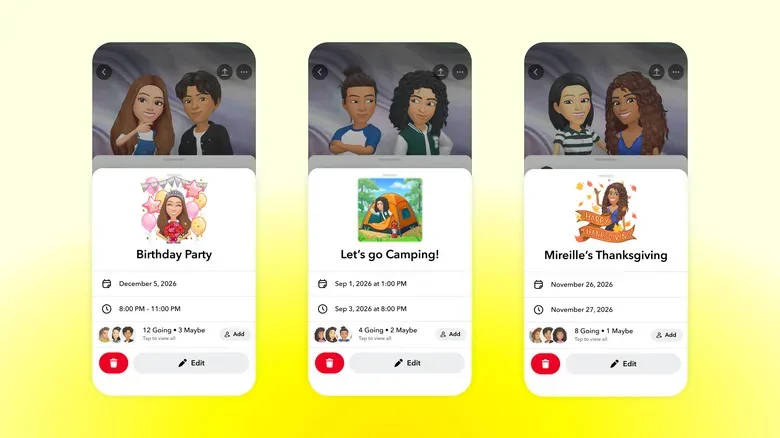
Snapchat is adding a familiar internet staple to an app better known for disappearing messages, camera effects and Bitmoji avatars: a built-in tool for organizing real-world events. The new feature, called Snapchat Plans, lets people create private gatherings, invite friends through direct messages and watch RSVP responses accumulate without moving the whole conversation to a separate service.
There is a particularly modern irony to this development. Planning an in-person hangout used to involve a text thread that became impossible to follow, a calendar entry nobody opened, or an event page filled with people selecting “maybe” until the sun burned out. Snapchat Plans brings that old event-page concept into an environment built around close contacts and quick, casual chat. Yet at launch, one fundamental bit of information is not part of the tool: a location field.
That omission is notable for an app that already has a major mapping component. Snapchat says it is working on adding location information to Plans, though it has not detailed when that addition will arrive or whether it will directly connect to Snap Map.
A dedicated place for making plans
Snapchat Plans is designed for meetups of up to 200 people. Rather than asking users to establish a separate public-facing event, the system is centered on privacy and the app’s existing social structure. Plans are accessible through the My Plans section of a user profile, creating a dedicated spot for upcoming gatherings instead of leaving every detail trapped in an endlessly scrolling group chat.
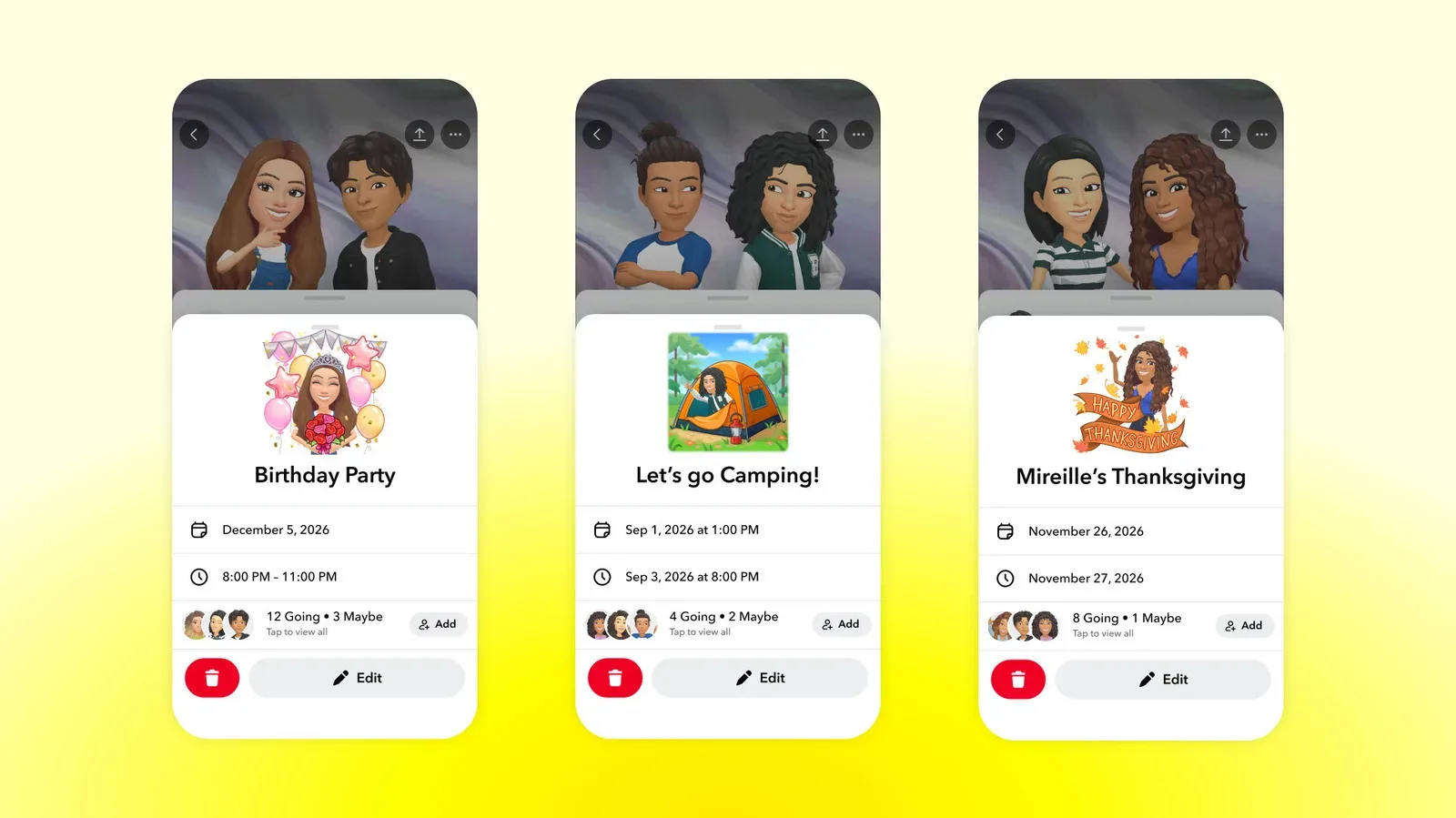
When someone creates an event, invitations are sent through chat DMs. Invitees can respond with the standard set of attendance options: going, can’t go, or maybe. The familiar answers matter because they turn the event chat’s usual guessing game into a visible guest-management system. An organizer can see who has committed, who has declined and who is still keeping their options as mysterious as an unopened Snap.
The presentation also keeps the feature recognizably Snapchat. Events can use Bitmoji-themed cover art, a small but fitting detail for an app where a personalized cartoon stand-in has long been part of everyday communication. It is an aesthetic layer rather than a logistical breakthrough, but it helps Plans look like a native part of Snapchat rather than a borrowed calendar widget awkwardly dropped into the profile menu.
Privacy is central to the feature
Every Snapchat Plan is private. Visibility is limited to the person who created it and the people invited to it. That setup separates Plans from the broad public-event model associated with earlier generations of social platforms, where an event page could function as an announcement board as much as an invitation.
There is one shared organizational view: anyone invited to a Plan can see the guest list. For a birthday dinner, game-night gathering, convention meetup or team get-together, that may be useful context. People can tell whether a friend is attending before they decide, and organizers are not alone in trying to calculate whether the group will be two people or 20. It also means invitees should assume their participation status is visible to the rest of the invited group.
Related coverage includes Snapchat Plans Brings Private Event Organizing to Group Chats.
The private-by-default approach fits Snapchat’s broader emphasis on communication among friends. It may make Plans less suitable for events intended to recruit a large audience beyond an existing circle, but the feature’s 200-person limit and invitation-driven design suggest that mass promotion is not the immediate goal. This is closer to coordination than broadcasting.
Why Snapchat is betting on IRL coordination
Snap says that more than one-third of its core users already rely on group chats in the app to arrange get-togethers. Plans formalizes behavior that is apparently happening already. If a group is discussing a movie, a pickup game, a party or a weekend outing in chat, an organizer can now create a structured event layer around that discussion instead of repeatedly asking who is available.
That is a sensible evolution for messaging platforms. A chat is excellent for spontaneous back-and-forth, but it is a chaotic database. Important information gets buried under memes, reactions and a highly urgent debate over snacks. A Plan gives the group a designated record of the event and a clearer view of attendance while letting invitations arrive in the place friends are already talking.
For gaming communities in particular, the line between online coordination and meeting in person is often thin. Local multiplayer nights, trading-card swaps, tournament watch parties, retro game store visits and convention meetups all begin with a message thread somewhere. A private RSVP tool will not replace every specialized platform, but it could reduce the number of apps needed for small and medium-size groups that already use Snapchat. Organizers weighing how online spaces shape real communities may find useful perspective in this look at how women PC and console players describe gaming culture.
Plans also reflects the continuing shift in what people expect from messaging apps. They are no longer simply places to exchange notes or send a picture that vanishes after a few seconds. Messaging services increasingly act as social infrastructure: they host groups, coordinate schedules, distribute invitations and preserve a lightweight record of what a circle of friends intends to do next.
The missing detail: where is everybody going?
The central limitation of Snapchat Plans at this stage is straightforward: it does not appear to offer the ability to add location details. A tool meant to help organize an in-person event can track who is coming, but not yet tell invited people where to show up within the event itself.
That does not make Plans unusable. Organizers can still send an address in chat, share details elsewhere in a conversation or direct friends toward a previously agreed-upon venue. But it creates extra work and removes a detail that users may reasonably expect to live next to the date, invite list and RSVP controls. The limitation becomes even more conspicuous because Snapchat already operates Snap Map, a widely used map feature in the app.
Snap has said it is actively developing location support for Plans. What remains unknown is the shape that support will take. It could be a simple address field, a more direct use of Snap Map, or something else entirely. Until the company provides more specifics, users should not assume that a map integration is confirmed.
There are also practical privacy questions that any future location feature would need to handle carefully. A private invite-only event is different from publishing a venue to a broad audience, and a map tool can reveal more than an organizer intended if its controls are unclear. The current absence of a location option is inconvenient, but it also means Snapchat has time to determine how a useful location workflow can coexist with its private-event model.
An old feature with a Snapchat-shaped identity
Event creation is hardly new. The web has cycled through numerous tools for invitations, calendars, attendance tracking and venue coordination. Snapchat Plans is less about inventing a new category than packaging those basics around the company’s existing chat habits, private friend networks and visual identity.
That may be the point. The strongest tools are often the ones that remove a few annoying steps from something people already do. If Snapchat users are already assembling real-life gatherings through group chats, a private event panel with invite tracking can make those conversations easier to manage without demanding that everyone create an account elsewhere or learn a more complicated platform.
For now, Snapchat Plans has a clearly defined role: a private, in-app organizer for events of up to 200 invitees, complete with chat-delivered invitations, attendance responses, visible guest lists for invitees and Bitmoji styling. It also has an obvious work in progress. Before it can serve as a complete home for arranging an IRL meetup, it needs to answer the most practical question of all: where should everyone meet?