Google has introduced Gemini 4 Carbon, a new frontier AI model positioned around coding, cybersecurity and broader agent-style computer tasks. The company’s headline claim is not merely that Carbon writes better code, but that it can do more useful security work around that code: identify weaknesses, rank them by importance and help address underlying causes rather than simply papering over visible symptoms.
That is a substantial ambition, and it is worth keeping the language precise. The reported results are Google’s own benchmark claims, not independent confirmation that Carbon is universally better than competing models in everyday development or security operations. Still, the combination of reported results and the company’s guarded launch plan makes the model notable. Google is initially limiting Carbon to selected cybersecurity defense companies for pre-release testing, with a later expansion planned through its Fairwind Program before wider access.
What Google says Gemini 4 Carbon achieved
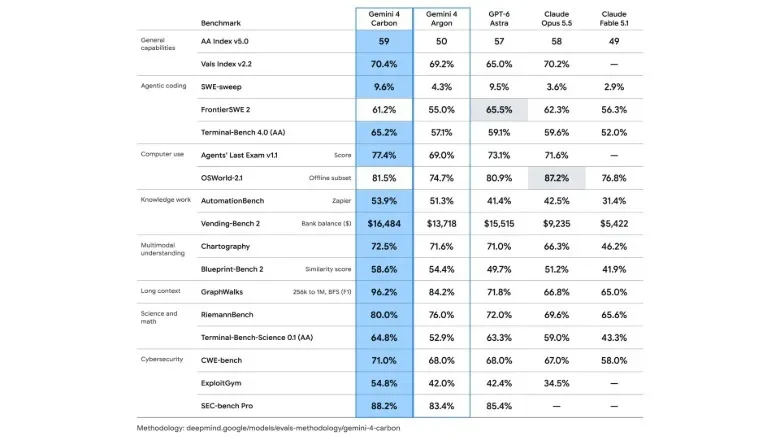
On the AA Index v5.0, described as a general AI benchmark, Google reports a score of 59 for Gemini 4 Carbon. That places it narrowly ahead of Claude Opus 5.5 and GPT-6 Astra in the company’s comparison. Google also says Carbon leads or nearly leads across several categories, including agentic coding, computer use, knowledge work, science and mathematics.
Those category names matter because they describe different forms of AI capability. Agentic coding generally means more than producing a function after being given a prompt. It refers to a model working through a multi-step software task: interpreting an objective, examining relevant material, making changes and carrying the task forward. Computer use similarly points to tasks that involve navigating or operating through a computing environment rather than delivering a single isolated answer.
Google is putting particular emphasis on cybersecurity, saying Carbon outperformed other models by wide margins in that area. Its stated strengths include finding vulnerabilities, prioritizing them and patching root causes. It also says Carbon is twice as likely as Gemini 4 Argon to generate secure code.
The comparison to Argon is especially relevant because Gemini 4 Argon arrived only two weeks earlier. Carbon is therefore being presented as a rapid follow-up rather than a distant next-generation release. Argon is already available through the Gemini app and AI search mode, while Carbon is taking a much more limited path at first.
Why vulnerability prioritization may be as important as detection
Finding a possible flaw is not the same as helping a defender make a sound decision. Security teams can face large numbers of alerts and potential issues, and a system that merely produces more possible problems may add to the workload. Google’s focus on prioritizing vulnerabilities suggests Carbon is intended to distinguish between findings in a way that helps security professionals decide what deserves attention first.
The company also says Carbon can patch vulnerabilities at their root cause. In plain terms, a root-cause fix aims to correct the underlying condition that produced a security problem, rather than applying a narrow workaround that leaves the basic issue intact. That distinction is useful in theory, but it also raises the stakes for validation. A proposed change can look plausible while affecting a larger codebase in unexpected ways. Security-sensitive code changes need review and testing, especially when the work is generated by an AI system.
For game studios and other software teams, the practical appeal is easy to see. Modern projects involve substantial codebases, toolchains and online services. A model that can help make code more secure could be valuable, but the safe use case is assistance within an accountable process—not treating model output as automatically trustworthy. Carbon’s initial focus on cybersecurity defense companies reflects that caution.
AI’s place in development remains a live industry debate. The discussion is not solely about how quickly a model can output code; it also concerns judgment, institutional experience and who remains responsible for the final result. That wider tension is reflected in the concern that AI cannot simply replace the experience lost when studios close. A more capable coding model may change workflows, but it does not erase the need for knowledgeable people to set goals, assess risks and verify work.
Security claims include model behavior, not only software flaws
Google’s description of Carbon goes beyond conventional code security. It says the model reduces shortcut-taking and loophole exploitation, is more transparent and honest, better resists prompt injection, collaborates more effectively and follows through without overstepping.
Several of those qualities describe behavior rather than raw problem-solving ability. Prompt injection is an attempt to manipulate an AI system through untrusted instructions embedded in material it processes, potentially steering it away from its intended task or safeguards. Resistance to such attacks is important for models that may inspect files, work with external information or carry out multi-step computer tasks.
The reference to “unsupported claims” is also significant. In this context, an unsupported claim is a statement presented by the model without adequate basis in the information or evidence it has. A system can sound confident and still be wrong, so a test aimed at unsupported claims is trying to measure whether the model appropriately grounds what it says.
Google’s phrase “following through without overstepping” captures a difficult balance for agentic systems. A model that gives up too early is not very useful for complex work. One that acts too aggressively, makes unnecessary changes or moves beyond the user’s intended scope can create new problems. The desirable behavior is sustained progress with clear limits: pursue the task, explain important decisions and avoid unauthorized or unwarranted action.
Benchmarks are useful signals, not a blanket verdict
Benchmark tables are a major part of frontier-model competition because they offer a compact way to compare systems. A high score can indicate real progress, particularly when the evaluation aligns with a task an organization cares about. But scores do not automatically answer every practical question a developer or security team will have.
A benchmark typically measures performance under defined conditions. Real deployments involve a team’s own code, processes, access controls and review practices. They may also require an AI tool to handle ambiguity, incomplete documentation and constraints that are not fully represented in a standardized test. For that reason, Google’s score of 59 on AA Index v5.0 and its claimed leads across other areas should be read as meaningful reported indicators—not proof that Carbon will be the best fit for every job.
The same applies to the assertion that Carbon is twice as likely as Argon to produce secure code. The comparison gives a directional picture of the company’s testing, yet it does not mean every Carbon-generated snippet is secure or that teams can drop normal review. Secure development remains a process involving architecture, testing and oversight, not a property guaranteed by the model used to draft a change.
A deliberately narrow first release
Carbon will initially be available only to select cybersecurity defense companies for pre-release model testing. Google then plans to offer access to additional trusted partners through the Fairwind Program before making it widely available. This staged model follows the route used for Gemini 4 Argon, which subsequently reached the Gemini app and AI search mode.
That rollout strategy fits the capabilities being claimed. A model that assists with cybersecurity and coding can be highly useful, but those are also areas where misuse, poor judgment or unreviewed actions can carry serious consequences. Limiting early access gives specialized defensive organizations an opportunity to assess the model before a broad release. It also means that, for now, Carbon should not be treated as a tool ordinary Gemini users can assume is already available to them.
The competitive context is clear. OpenAI and Anthropic have both been associated with competing frontier systems, and Google is using Carbon’s benchmark performance to argue that it has regained or strengthened ground in pivotal technical categories. Yet the most consequential part of this release may not be a single leaderboard position. It is the attempt to combine coding ability, cybersecurity assistance and safer agent behavior in a model whose public availability is being held back until more targeted testing occurs.
For developers, security professionals and studios watching AI tooling, the useful takeaway is measured rather than magical: Google is claiming meaningful progress in a model designed to work on complex technical tasks, especially secure code and vulnerability remediation. The eventual value will depend on whether those benchmark gains hold up in controlled, real-world workflows—and on whether users retain the review practices needed to turn assistance into dependable results.