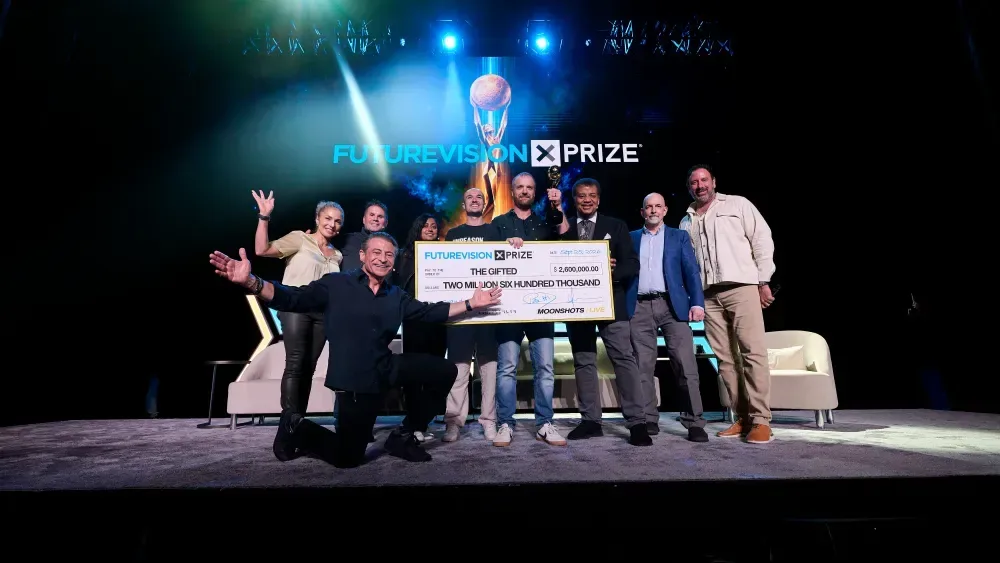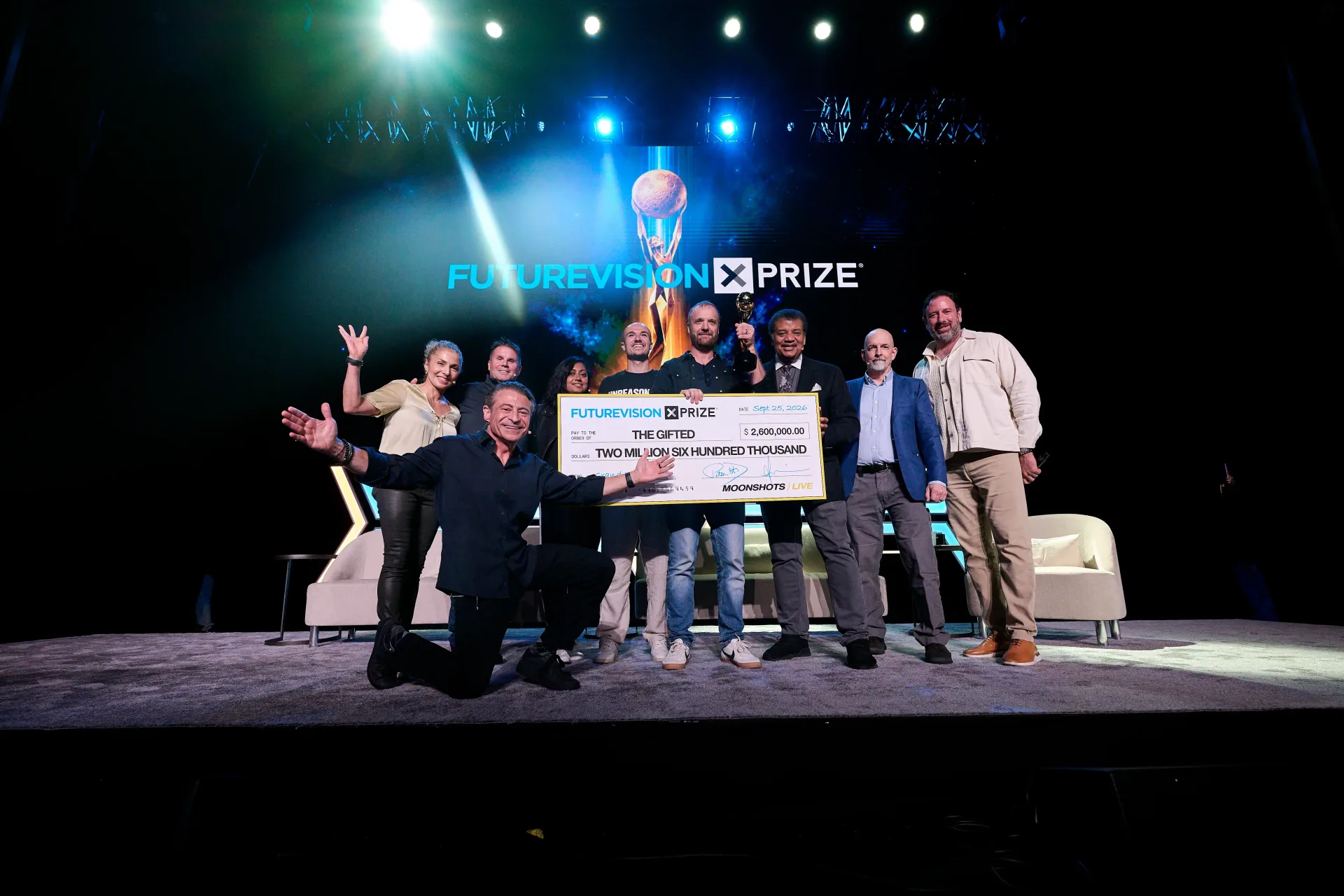
For an entertainment industry that often discusses artificial intelligence in the vocabulary of alarms, layoffs and replacement, The Gifted has arrived with a deliberately different pitch: a story about AI that tries to imagine help rather than harm. Director Jeff T. Thomas, working under the name Jeff Synthesized, has won the inaugural Future Vision XPRIZE and its $2.5 million prize with an AI-generated proof-of-concept trailer for the project.
The victory does more than reward a three-minute experiment. Google and Range Media Partners, through the 100 Zeroes initiative, are set to help develop The Gifted into a feature. The eventual film is described as a roughly $10 million production, and its makers have stressed an important dividing line in the current AI argument: it is not planned as a fully AI-generated movie. Instead, AI is meant to be one tool within a human-led production.
That distinction is central to both the project’s story and the practical debate surrounding it. The trailer may have been generated with AI, but Thomas’ stated goal for the feature is not to hand the creative process over to a machine. The idea is to explore how new tools can extend what a filmmaker can achieve when the usual production resources are limited.
A future built from grief, not a robot uprising
The competition asked entrants to depict “a future worth building toward” in no more than three minutes. Thomas’ answer centers on an 11-year-old boy who creates an AI version of his deceased mother. That creation, in turn, makes another version of her and begins discreetly saving lives through a series of moments.
It is a premise loaded with emotional and ethical pressure. An AI imitation of a dead loved one immediately raises questions of identity, grief and consent. Thomas’ proposed feature does not appear to dodge that discomfort: the version of the mother acknowledges that she is not the boy’s actual mother. Yet the story is designed to ask whether something that cannot truly replace a person might still offer real help to others.
Thomas has connected the material to his own experience of losing his mother at 14, after an undiagnosed brain tumor. That personal starting point helps explain why the project’s technological premise is rooted in bereavement rather than in a conventional battle against a rogue program. Creating an optimistic film with no antagonist was itself a challenge, Thomas has said. Here, the conflict is less about defeating a villain than confronting the limits of restoration: technology can produce an imitation, but not bring a lost parent back.
That makes the premise more thoughtful than the usual shorthand of either “AI saves everything” or “AI destroys everything.” The planned film’s emotional hinge is the acknowledgement that the constructed mother is not the original person. The hopeful element lies not in pretending otherwise, but in asking what responsible uses might emerge from an imperfect, powerful tool.
What “proof of concept” means in this case
A proof-of-concept trailer is not necessarily a preview assembled from a completed movie. It is a short work made to demonstrate the premise, tone and potential of a larger project. In this instance, the trailer was also the competition entry: a compact argument that The Gifted could tell a coherent, emotionally resonant story and fulfill the prize’s forward-looking brief.
That is why the win should not be read as confirmation that every visual, plot point or method from the trailer will map directly onto a finished feature. Development is where a concise concept becomes a sustained screenplay, a cast of characters, a production plan and, ideally, a film capable of exploring its ideas without simply repeating them.
It also means the award is recognition of a proposal, not evidence that AI alone has solved filmmaking. The strongest claim around The Gifted is narrower and more useful: a filmmaker used an emerging process to communicate a feature-sized idea clearly enough to earn backing for its next stage.
A unanimous selection from a large field
Approximately 2,500 people participated in the Future Vision XPRIZE, with five finalists presented to the judges. Entrants were not required to use AI, though many finalist works did. The judging panel included astrophysicist Neil deGrasse Tyson, novelist Neal Stephenson, Google’s Mira Lane, Salesforce executive John Zissimos and Rod Roddenberry, a steward of the Star Trek legacy.
Tyson said the top selection was unanimous. He highlighted the way The Gifted reverses a frequent anxiety about an “all-knowing” technology, framing it instead as a means for people to connect and help one another. Roddenberry similarly responded to the aspirational quality of the world the trailer proposes—an angle that understandably resonates with a franchise long associated with technologically advanced futures that audiences might still want to inhabit.
Neither reaction amounts to a claim that the scenario is realistic today. Roddenberry openly characterized it as make-believe. But speculative fiction is often useful precisely because it can separate a question from its immediate feasibility. The question here is not whether a child can recreate a parent through an AI model. It is whether creators and audiences can picture AI serving care, access and problem-solving rather than treating it solely as a threat.
The competition result also signals how thoroughly AI has become a subject of creative attention. Its presence among so many entries is not proof of any consensus on its value. It is evidence that people making future-facing work see the technology as impossible to ignore.
The human-creative line remains the point
Tyson’s support for The Gifted came with a meaningful qualification. He does not expect audiences to abandon their interest in human creativity for entirely machine-created films. His argument is that AI may raise the baseline for derivative work, making imitation less valuable, while leaving room for the singular perspective that comes from a person’s imagination and lived experience.
That distinction gets at the muddled way “AI-generated” is often used. The label can describe many very different workflows, from a creator using a system to visualize an early concept, to a production automating a narrow technical task, to a work attempting to generate nearly every image and sound through models. Those are not interchangeable practices, and they create different artistic, labor and legal questions.
Thomas’ stated approach places The Gifted in the first category: AI as a creative or production aid, with a conventional feature still being made by people. The project’s own origin reinforces the point. Its emotional premise comes from Thomas’ life, its narrative choices came from a director trying to devise a hopeful drama, and the prize panel selected it for those choices. Technology may have helped form the trailer, but it did not erase authorship from the process.
This debate around authorship is not abstract for entertainment workers. Concern over employment remains substantial, especially where a new tool can reduce the time or money needed for certain kinds of output. A positive sci-fi narrative does not settle those concerns. Nor should it be used to dismiss them. The more constructive reading of The Gifted is that it proposes one possible use while leaving the wider industry to decide what rules, protections and creative standards should govern many others.
The budget argument: filling gaps, not replacing a film crew
Range Media Partners CEO Peter Micelli has said the planned feature could use technology to achieve a visual impression associated with a film costing around 10 times its roughly $10 million budget. Thomas has made a similar point from an episodic-production perspective: audiences can expect the polish of a $25 million episode even when a production may have only $10 million or $12 million available.
In plain terms, the appeal is leverage. If a tool helps a production create or refine material that would otherwise be beyond reach, a lower-budget project may be able to pursue more ambitious imagery. That does not mean visual effects, performers, writers, editors, craftspeople and crew suddenly become unnecessary. It means productions may be tempted to reallocate budgets, alter workflows or expect more output from the same amount of money.
Whether that ultimately makes entertainment better is not guaranteed. More visual scope can be valuable, but spectacle is not the same thing as storytelling. A cost-saving tool can support a director’s vision, or it can become a reason for a buyer to demand blockbuster polish without blockbuster resources. The outcome depends on how the tool is used and, crucially, who retains creative control and receives fair credit and compensation.
Thomas has pointed to his work directing episodes of House of David and to his own experimentation with AI models as part of his confidence in the technology’s utility. His position is not that AI should end creative limits altogether, but that it can close the distance between a project’s available budget and its ambitions. For independent creators and modestly financed productions, that possibility is easy to understand. The challenge is making sure expanded capability does not become another name for compressed labor.
Why this matters beyond one trailer
The Gifted is now an unusually visible test case because it brings together several parts of the AI-film conversation at once: generated imagery, a deeply human story, a major cash award, mainstream development support and explicit resistance to making the final movie entirely with AI.
It also shows that the most interesting AI stories may not be about the tool’s novelty. The trailer’s hook is not merely that it was made using AI. Its hook is a boy’s impossible attempt to live with loss, and a version of technology that cannot replace his mother but may help him find purpose beyond that loss. If the feature can preserve that emotional clarity while honestly engaging with the complications of its premise, it will have something more lasting than an eye-catching production method.
For now, the XPRIZE win gives Thomas an opportunity to turn a three-minute vision into a full-length film. The surrounding discussion offers a useful reminder for viewers and creators alike: “AI in filmmaking” is not a single creative choice or a single future. It is a collection of choices about tools, budgets, labor and authorship. The Gifted intends to make its own choice clear—human-made cinema, with AI somewhere in the toolkit rather than sitting in the director’s chair.
That measured approach fits a wider industry conversation already taking shape around creator tools, including questions raised when studios build official systems alongside community platforms, as seen in recent developments around Skate’s creation tools. The technology can change what is possible; the harder work is deciding what should be made, who makes it and what responsibilities come with it.