Tesla has begun offering rides involving its Cybercab robotaxi, moving the purpose-built autonomous vehicle from an unveiled concept into a limited passenger service. The company says its Robotaxi app is available on iOS and Android, and people can request autonomous trips in Austin, Dallas, Houston, Miami, Orlando and Tampa.
There is an important asterisk the size of a compact car: the Cybercab itself appears to be operating only in Austin at the outset. Requesting a Robotaxi ride does not mean a passenger can specifically summon Tesla’s distinctive two-seat, no-driver-controls vehicle. In Austin, the vehicle assigned depends on party size and availability, so riders cannot currently select Cybercab as though it were a character skin in a racing game.
That makes this a launch with both real significance and deliberately narrow boundaries. Tesla is putting a vehicle designed around full autonomy into a ride service, but the initial operational footprint is constrained, the Cybercab fleet is comparatively small, and the practical experience for a rider may still involve a more familiar Tesla model.
For a transportation project long associated with big ambitions, the rollout is less “every street becomes a sci-fi boulevard overnight” and more “the matchmaking queue is live, but the rare drop rate is low.”
Robotaxi app access spans six cities, but Cybercab access does not
Tesla’s Robotaxi app supports ride hailing in six cities: Austin, Dallas and Houston in Texas, plus Miami, Orlando and Tampa in Florida. The company describes the service as usable for errands, commuting and similar everyday trips.
However, the service area and the Cybercab deployment should not be treated as identical things. The app may be accessible across those locations, yet the Cybercab option itself initially appears confined to Austin. Even there, riders are not being offered a direct vehicle-choice menu. A larger group, for example, may require a different vehicle than the compact Cybercab can accommodate. Availability also determines what arrives.
That distinction matters because Tesla’s standard vehicles and the Cybercab represent very different ideas of autonomous transport. A Model Y is a consumer vehicle that is recognizable in ordinary traffic. Cybercab is a dedicated robotaxi built without the traditional controls expected in a passenger car. The former can be part of a broad fleet while the latter remains an early, limited deployment.
It is a useful reminder that a service launch can include several layers: where an app works, where driverless vehicles are authorized, which models are in the pool, and which model a given rider actually receives. Those layers do not necessarily line up neatly, particularly at the beginning.
A 314-vehicle Texas authorization, with 45 Cybercabs
Tesla is authorized to operate 314 vehicles without drivers in Texas. Most of that total consists of Model Ys, while 45 vehicles are Cybercabs. The count underscores why an Austin rider should not assume every Robotaxi request will produce the low-slung vehicle seen in Cybercab promotional imagery.
It is also unclear how Tesla is allocating those authorized vehicles between passenger taxi activity and testing. The authorization figure is therefore not a direct tally of cars actively carrying paying riders at any particular moment, nor does it reveal how many Cybercabs are circulating on Austin streets versus supporting the company’s development work.
That uncertainty is central to understanding the scale of the move. Forty-five Cybercabs is enough to establish a meaningful real-world fleet presence, but it is not a citywide blanket of identical autonomous pods. Fleet composition, dispatch decisions, operational conditions and demand can all shape what the service looks like day to day.
For anyone watching autonomous transportation through a gaming lens, it is the difference between a public beta opening and a full worldwide release. The underlying system has crossed an important threshold, but access can still be controlled, supply can still be limited, and the exact experience can vary with circumstances.
What makes the Cybercab different
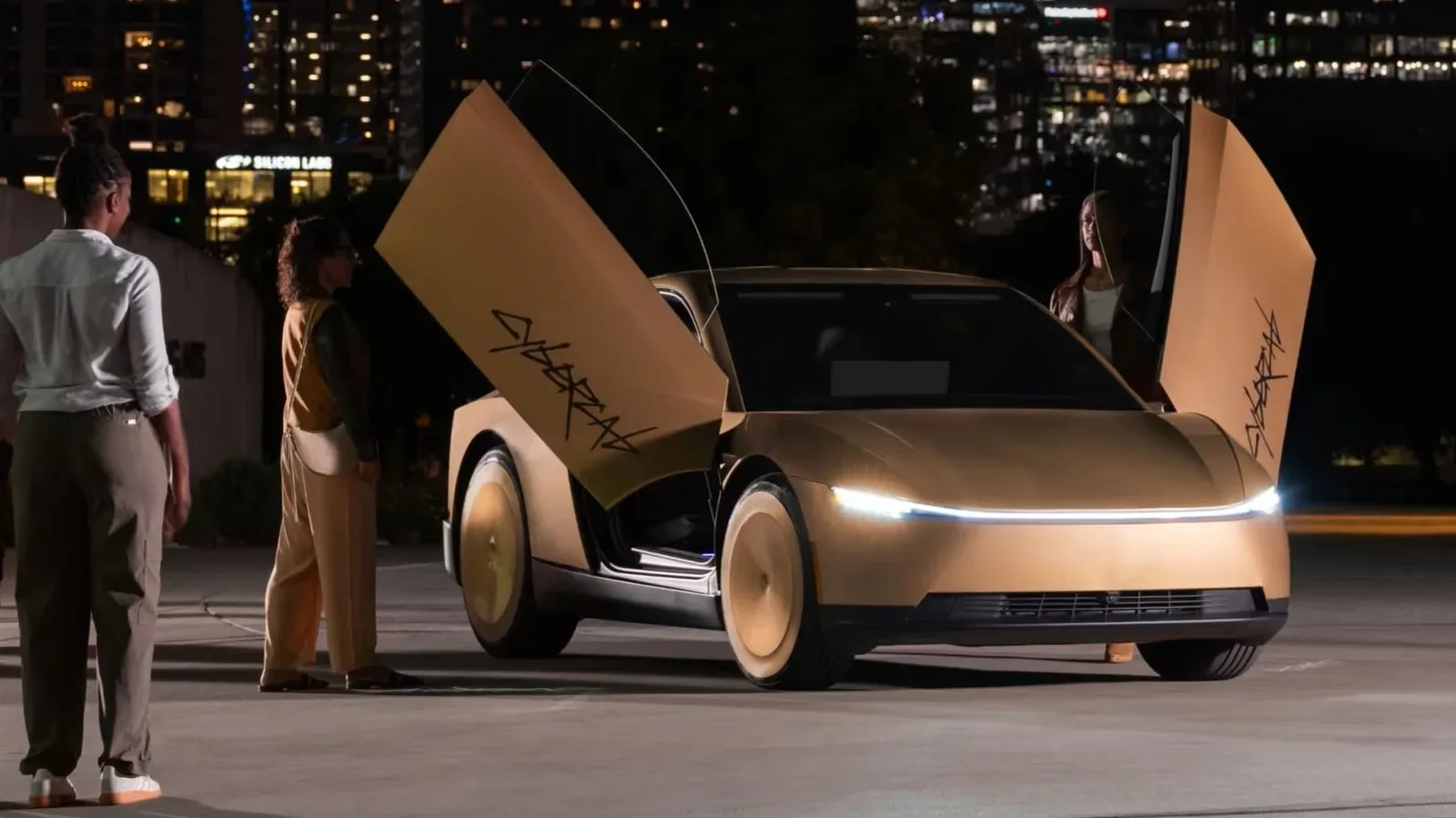
The Cybercab was conceived for complete autonomy rather than as a conventional car adapted for occasional driverless operation. It has no steering wheel or pedals, leaving no designated human driver position to take over control. That is the core of its identity: passengers are riders, not backup pilots asked to keep their hands near an emergency wheel.
Inside, the layout centers on a bench-style seat for up to two passengers and a large central touchscreen on the dashboard. The two-person seating limit helps explain why vehicle assignment is dependent on group size. A party that exceeds that capacity will plainly need something else from the Robotaxi fleet.
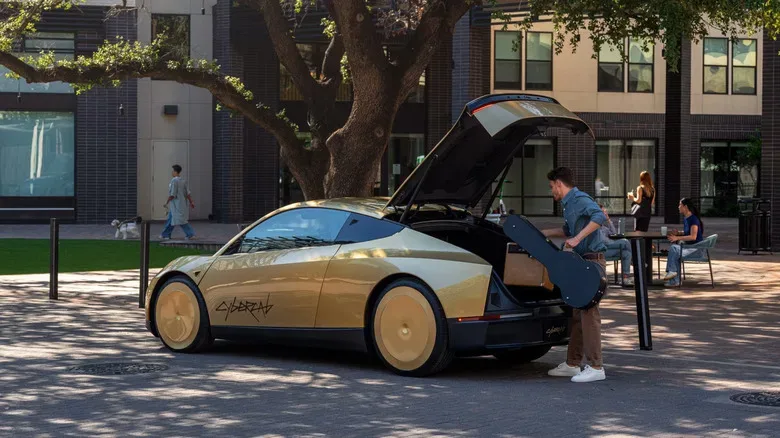
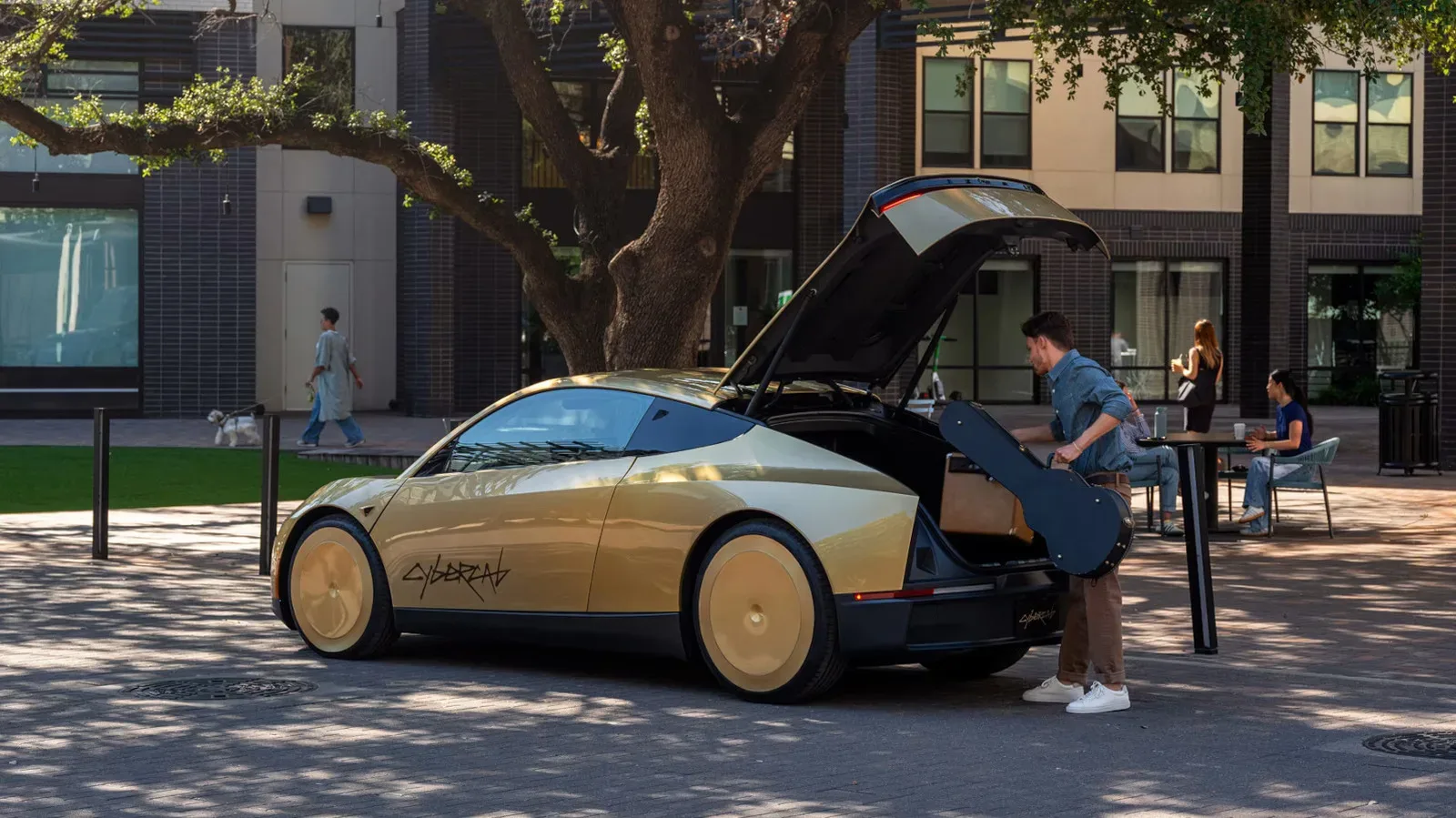
Tesla also emphasizes the available cargo space. While the cabin is small, the vehicle has room intended for luggage, scooters and other larger items. That balance suggests a vehicle meant not only for a short solo commute but for practical point-to-point journeys where riders bring belongings along. A two-seat robotaxi might not be the answer for every airport group, but cargo capacity could matter substantially for the trips it is suited to handle.
The design is therefore unusually specific. Rather than trying to be a flexible family car, a personal vehicle and a driverless taxi all at once, Cybercab is built around a focused job: move one or two people autonomously, with room for their stuff. Whether that narrower mission becomes a strength at scale will depend on how reliably and widely the network can operate.
It also makes the early inability to choose one especially notable. Tesla is now placing a vehicle with a highly distinct passenger format into service, while asking riders to accept that dispatch—not preference—will determine whether they encounter it. For early adopters, that could turn a routine trip request into a small lottery. The app may provide transportation either way; the Cybercab remains the uncommon unlock.
Tesla owns the first Austin Cybercabs
The Cybercabs currently operating in Austin are Tesla-owned. They are not yet on sale to consumers or businesses, even though Tesla has presented a longer-term vision in which ownership of these vehicles extends beyond the company itself.
When Cybercab was first unveiled, Elon Musk described a future where people could own multiple vehicles and run a fleet that generates income through a ridesharing network. That concept would shift Cybercab from being solely a Tesla-operated transport tool into an asset that outside owners could deploy commercially.
For now, that remains a future-facing plan rather than a retail reality. Tesla is accepting inquiries from parties interested in helping build its robotaxi network, which indicates its initial sales approach may be directed toward companies capable of acquiring whole fleets. There is no stated availability for individual retail buyers in this rollout.
That prospective business model makes the Austin service more than a test of the vehicle’s passenger appeal. It is also an early proof point for a potential network structure: Tesla-owned cars first, followed eventually by fleet customers if and when sales begin. The distinction is substantial. A company-operated fleet can be managed under a unified structure, while a network supplied by multiple owners introduces different questions around maintenance, deployment and operational consistency.
For the moment, the plainest takeaway is also the most grounded one: Cybercab rides have entered Tesla’s Robotaxi service in Austin, but on limited terms. The app covers more cities than the Cybercab itself. Tesla has many more authorized driverless Model Ys than Cybercabs in Texas. Riders cannot explicitly request the Cybercab, and the company has not begun selling the vehicle.
That cautious reading does not make the moment uninteresting. A no-steering-wheel, no-pedals passenger vehicle is now part of a real ride-hailing operation, not merely a future-looking display piece. It is another sign that transportation technology is increasingly borrowing the language of platforms, fleets and software access—territory that will feel familiar to anyone following how digital ecosystems expand. For a related look at technology pushing toward shared digital spaces and new hardware formats, see this report on immersive technology’s shift toward shared spaces and smart glasses.
The big unknown is not whether Cybercab has technically joined the service. It has. The questions are how quickly the Austin fleet grows, when the vehicle appears beyond that market, how much of the authorized fleet is dedicated to passenger trips, and whether Tesla’s eventual sales plan brings fleet operators into the network. Until then, Austin is the place where the robotaxi experiment is most concrete—and where a ride request might just roll the rarest vehicle in the lobby.