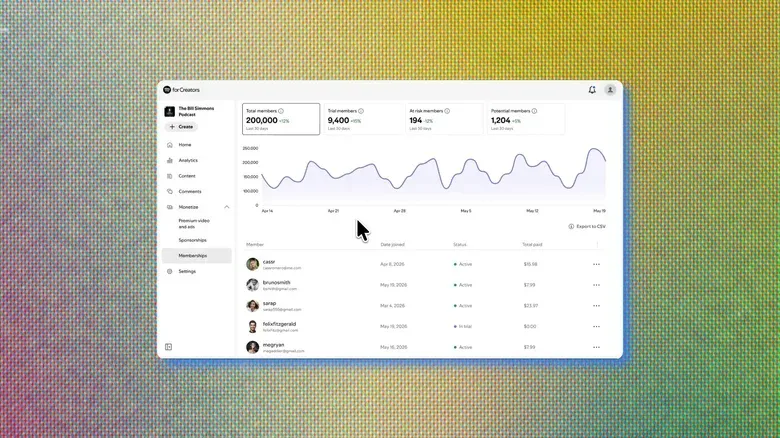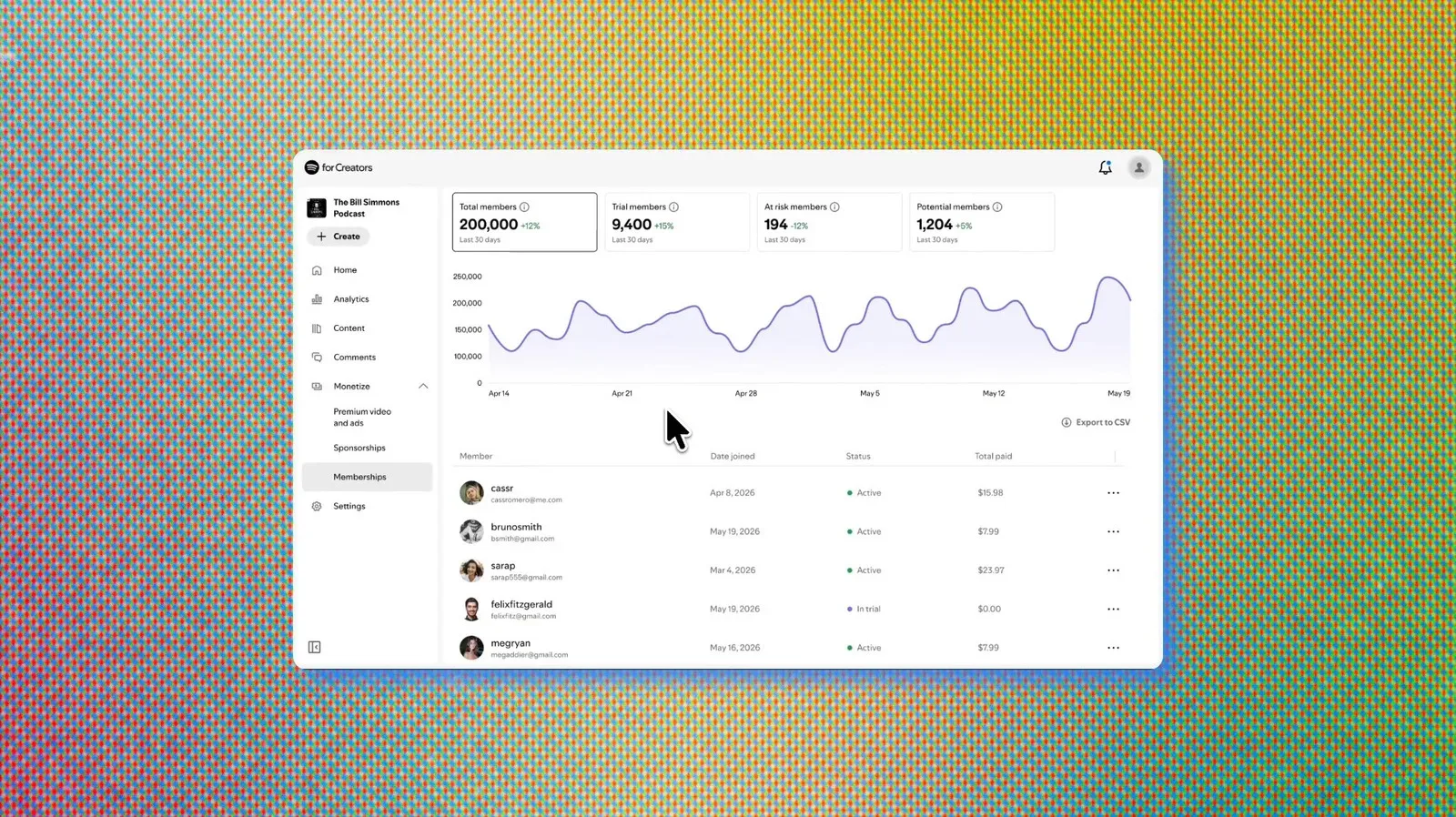
Spotify is expanding its creator-monetization toolkit with Memberships, a tiered subscription program intended to let podcast creators offer exclusive material directly to their most dedicated listeners. The basic proposition is familiar to anyone who has encountered fan-supported creator platforms: audiences pay recurring fees for access to benefits, while creators receive a share of that recurring revenue.
The notable number is the split. Spotify says creators will keep 90% of revenue earned from Memberships. The program is set to launch in 34 markets, though not every show will qualify immediately. A show hosted through Spotify for Creators or Megaphone must have at least three published episodes, 100 listeners or viewers, and 100 consumption hours.
For podcasts—including shows that cover games, game development, hardware, speedrunning, collecting, or wider entertainment—Memberships creates a potentially simpler way to place a supporter option where audiences already listen. It does not change the essential challenge of making a subscription worthwhile, but it gives eligible creators a built-in system for packaging that value.
What Spotify Memberships does
Memberships allows creators to construct tiers at different price points and attach particular benefits to each tier. A tier is simply a subscription level: someone paying at one level can receive a defined set of perks, while a higher-paying member can receive a broader set. The supplied details do not specify the available prices, the precise kinds of benefits, or what tools will be offered for delivering exclusive material. The important confirmed point is that creators can bundle benefits into separate membership levels.
That model resembles approaches established by Patreon and YouTube channel memberships. Patreon’s platform fee is described as 10%, and YouTube offers six channel membership levels. Spotify’s 90% revenue figure places its stated share in comparable territory to a model where the platform retains 10%, although creators should not treat two services as automatically identical just because the headline percentage matches. Revenue share is only one part of a membership business; eligibility, audience habits, tier design, distribution and the workload of fulfilling perks all matter.
Memberships was first outlined in May at Spotify’s Investor Day, where it was framed as a route to recurring revenue from a creator’s most engaged fans. Recurring revenue means income that returns on an ongoing schedule, typically monthly subscriptions, rather than a one-time purchase or an advertising payment that varies with each campaign. For independent audio creators, that predictability can be meaningful even when the audience is smaller than a mass-market show’s.
The eligibility thresholds, explained
The launch requirements are modest enough to establish a baseline audience, but they are still real gates for a new show. To qualify, a show on Spotify for Creators or Megaphone needs:
- At least 100 consumption hours;
- At least 100 listeners or viewers; and
- At least three published episodes.
Consumption hours refers to the combined amount of time people spend consuming a show. It is not the same as a listener count. One hundred people who sample a few minutes each may meet the listener measure without adding up to 100 total hours, while a smaller group listening through longer episodes could contribute a substantial amount of total time. Requiring both metrics suggests the program is looking for evidence of reach and actual engagement, not solely an episode upload count.
The three-episode requirement also matters. It is a low publishing threshold, but it ensures a show has more than a single pilot before pursuing paid tiers. That is sensible in practical terms: a membership pitch asks listeners to place continuing trust in a creator’s output, and a small catalogue gives potential supporters at least some indication of the format and cadence they are being asked to support.
For gaming-focused podcasts, the numerical gates may be reachable through a tightly focused format as well as a broad one. A show covering a particular competitive scene, game series, retro platform or development discipline can build meaningful engagement without needing to be a giant general-entertainment production. But qualification is not a verdict on whether a paid community will work. The threshold measures initial activity; it does not answer whether listeners want extra content badly enough to subscribe.
Why tier design matters more than the button
A membership system can make it technically easy to charge, but it cannot decide what a creator should charge for. The strongest use of tiers is usually clarity. Supporters should be able to understand what is included, how often it arrives, and what distinguishes one level from another. Vague promises of “more content” can create expectations a small team struggles to meet, particularly for a show already producing regular public episodes.
Exclusive content is the confirmed core of Spotify’s offering. Beyond that, creators will need to set boundaries based on the work they can sustain. A podcast may choose a simple model in which paid members receive additional episodes or bonus discussions, while its main show remains accessible to everyone. Another may make membership about deeper analysis around a subject that does not fit the public feed. The right approach will differ by audience, but the principle is the same: benefits should be feasible over time.
That distinction is especially useful for games media. Fast-moving news and release coverage may be most effective in a public feed, where they can reach the widest audience. Longer conversations, focused discussions, or community-oriented material may be a better fit for a paid layer. This is analysis rather than a stated Spotify rule, and success will depend on individual creators and their communities. Still, it highlights why membership offerings are not merely an advertising substitute. They ask creators to shape a second, reliable product for paying fans.
Creators also need to avoid turning their public work into an advertisement for the paid work. Memberships are most durable when the free show remains worthwhile in its own right. A listener who feels that every public episode is incomplete without payment may simply leave; a listener who already values the public show has a clearer reason to consider supporting it.
Where Memberships fits in Spotify’s existing creator strategy
Memberships is not Spotify’s first attempt to help creators earn from audiences. In 2021, the service introduced a paid-subscription platform for exclusive content. In 2024, it followed with the Partner Program, which offers a share of advertising revenue as well as additional earnings through paid subscriptions.
The newer Memberships program therefore looks like a further refinement of a broader strategy rather than a sudden move into creator payments. Advertising revenue, paid subscriptions and fan memberships operate differently. Advertising income is generally linked to monetized listening and advertiser demand. Paid subscriptions place value on access. Memberships add the concept of distinct supporter tiers, enabling creators to make the relationship more granular than a single paid-or-free divide.
That broader set of options can matter because no single revenue source suits every show. An established program with a large audience may benefit from advertising, while a specialist show with a smaller but highly engaged community may see greater potential in supporter payments. Some creators may use multiple models at once. The supplied information does not explain whether or how Memberships interacts with other Spotify monetization programs, so creators should not assume every feature or revenue route stacks in the same way until they can review the applicable program details.
For the audience, this is another sign that listening platforms are becoming more than distribution pipes. They are increasingly attempting to handle discovery, playback, advertising and direct audience support in one place. Convenience is the attraction: a listener may not need to leave the app they already use to support a show. The trade-off, in general, is that creators are relying more heavily on the rules, eligibility standards and product decisions of a single platform.
What the 90% share does—and does not—tell creators
Keeping 90% of Memberships revenue is a straightforward and potentially attractive headline. It means Spotify’s stated platform portion is 10% of revenue earned through the program. But a percentage should be interpreted carefully. It tells creators how the stated Memberships revenue is divided; it does not by itself reveal a show’s eventual take-home income, how many listeners will convert into paid members, or how much work it will take to retain them.
Conversion is the key practical unknown. In membership terms, conversion means a listener moving from the free audience into a paying tier. A show can have plenty of listeners and still have only a small number of members. Conversely, a concentrated audience with a strong affinity for the host or subject can support a tiered offering more effectively than raw download or listener figures might suggest.
That is why the eligibility criteria should be viewed as an entry point, not a forecast. One hundred listeners or viewers and 100 consumption hours demonstrate a base level of activity. They do not create an obligation for that audience to subscribe. The most realistic expectation is that Memberships supplies an option: a way to test whether a portion of an existing audience wants exclusive material and is willing to pay for it.
What this could mean for game-focused creators
Podcasting has long sat alongside game culture, from developer interviews and lore deep-dives to tournament analysis and game-industry discussion. Memberships may be useful to creators who want to build a closer supporter relationship without directing listeners to a separate service. It may also appeal to fans who prefer a consolidated experience in the app where they already follow shows.
However, the presence of another monetization tool does not remove the need for a distinctive point of view. The same lesson applies across creative work: audience attention is earned through material people cannot easily get elsewhere. A recent discussion of game development’s need for fresh ideas makes the adjacent point that differentiation remains important even as the business tools change. Original ideas remain a central concern across the games industry; for a podcast, that can mean a compelling format, expertise, perspective, or a community that sees real value in continued support.
Spotify Memberships offers the mechanism, while creators still need to supply the reason to join. With a 34-market launch, defined access requirements and a stated 90% creator revenue share, the program gives qualifying shows another route beyond advertising and traditional paid subscriptions. Its impact will depend less on the existence of tiers than on whether creators can make those tiers clear, sustainable and meaningfully valuable to the listeners who already choose to spend time with them.