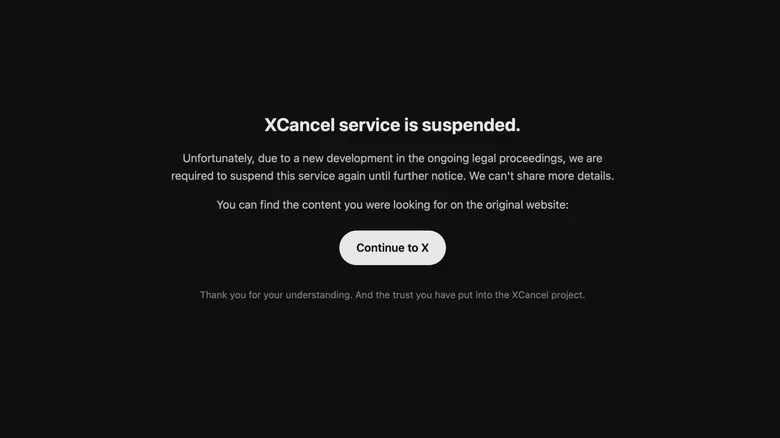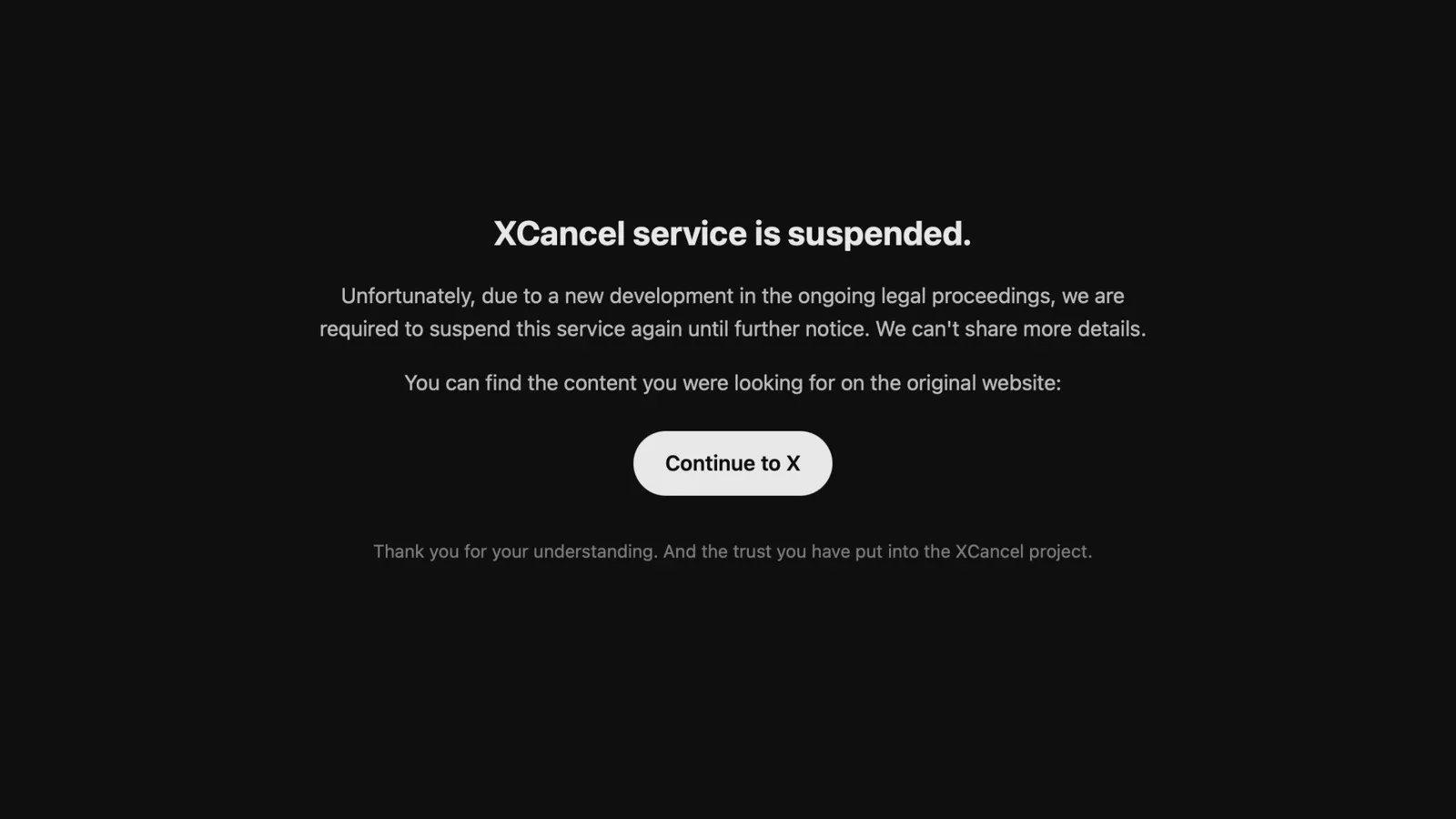
Two tools that let people read X posts without entering X’s own website or app have gone offline again amid an unresolved legal dispute. Nitter’s GitHub repository was archived and switched to read-only status on September 11, while XCancel has posted that its service is suspended because of a new development in ongoing legal proceedings.
The pair’s status follows a cease-and-desist sent by X in August. The platform alleged that Nitter was making unlawful use of, and circumventing, X’s application programming interface and associated data. XCancel relied on Nitter to provide its own indirect access to posts, placing both services at the center of the same conflict.
The latest shutdown does not establish a final outcome. XCancel has not provided details of the reported legal development, saying it cannot share more information. But the archived Nitter repository and the suspension notice mean that, for now, people who used either service no longer have their usual route to view public X posts outside the Elon Musk-owned platform’s official experience.
What Nitter and XCancel were designed to do
Nitter was an open-source service built to display content from X without requiring a person to log in or create an X account. It also underpinned related services, including XCancel. Their core appeal was not a new social network or an alternative place to publish posts. Instead, they acted as an intermediary viewing layer for material posted to X.
That distinction matters. A visitor could use such a service to check a post or follow information being shared on X while avoiding the ads and tracking cookies associated with using the main service. It also meant viewers were not contributing to the platform’s user counts in the ordinary way.
For users, the practical draw was straightforward: a less account-dependent, potentially more private way to read information that had been posted to a major social platform. For X, that same setup raised questions about access to platform data and compliance with its rules.
A quick explanation of the technical terms
API stands for application programming interface. In broad terms, it is a set of defined ways that software can request information or interact with a service. Platforms can use APIs to control which outside tools gain access, what they can request, and under what conditions.
Scraping generally describes the automated collection of information from a website or service. The cease-and-desist alleged that the services violated X rules by scraping its data. The available information does not resolve the merits of that allegation or describe the specific technical methods at issue.
Tracking cookies are browser-stored data that can help websites recognize visits and support functions including measurement or advertising-related activity. Nitter and related services were used by people seeking to read posts without those cookies from X’s own site.
A stop-start timeline
- August: X sent Nitter a cease-and-desist alleging unlawful API use and circumvention involving associated data.
- After the notice: Nitter and XCancel briefly became unavailable.
- Earlier in September: Both services resumed operation.
- September 11: Nitter’s GitHub repository was archived and made read-only.
- Most recently: XCancel said it had suspended its service following a new development in ongoing legal proceedings.
The sequence is important because it shows that the first interruption was not the end of the matter. The services returned after the August notice, then disappeared again as the legal situation apparently changed. There is no public detail here establishing whether the current suspension is temporary, voluntary, compelled by a legal demand, or connected to any eventual court ruling.
Why the shutdown matters beyond two websites
At stake is a familiar tension around public posts on a privately operated platform. A post may be publicly viewable, but that does not necessarily mean the platform permits every method of accessing, collecting, republishing, or presenting it. Services such as Nitter make that tension especially visible because they separate viewing public posts from participation in the official platform environment.
That separation can be meaningful to people who do not want an account, prefer to limit tracking, or simply need to monitor statements and links shared on X. It can also affect how much control the platform has over the presentation of its content, the advertising around it, and the technical paths through which users retrieve it.
For readers, the immediate implication is narrower but real: links that previously pointed to Nitter or XCancel may no longer work, and the services should not be treated as dependable at present. Anyone attempting to follow information that is posted only on X may now have fewer ways to do so without visiting X directly.
There is a broader digital-privacy lesson, too. Tools that minimize account use, advertising exposure, and tracking can depend on technical access that the underlying platform may restrict. Privacy-friendly access is not solely a browser setting or a personal preference; it can also rest on whether an independent service is allowed to continue operating. That is a separate question from what data a platform chooses to request in the first place, an issue also relevant to digital credentials that limit the information initially shared.
What remains unknown
The public record described so far leaves major questions unanswered. XCancel’s statement refers to a new development but does not identify it. Nitter’s repository being archived makes future development and changes difficult through that project space, but it does not by itself explain the legal status of the software, its operators, or related instances.
It is also not clear whether either service will return, whether legal action will result in a permanent closure, or whether the dispute will produce a more detailed public account of the claims. X’s August accusations are allegations, and the suspension notices do not independently settle them.
For now, the most certain facts are operational: Nitter’s repository has been placed in read-only mode, and XCancel says its service is suspended. The tools that once offered a route to read X posts outside X’s official site and app are unavailable again, with their longer-term future unresolved.