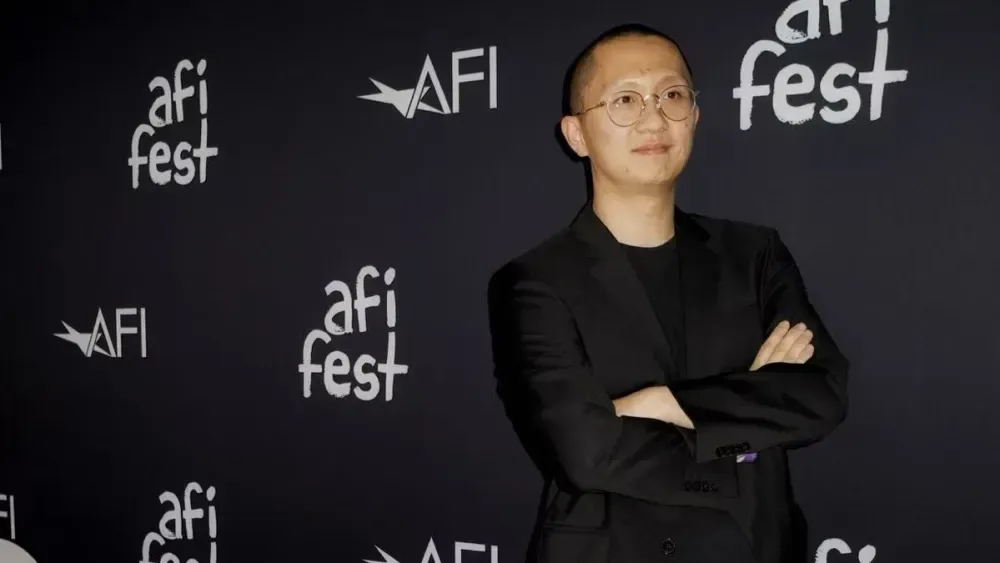
A production company is often measured in credits, awards and deal announcements. Narval Films’ story has those markers: more than 50 commercial videos, 52 vertical short-form projects, a television series and 15 films. But its stated ambition is more structural than simply adding titles to a slate. Co-founders Aaron Linjun Yu and Jera Wang want to reduce the distance between an artist having an idea and being able to make it, particularly for filmmakers navigating multiple cultures, languages and industries.
Yu arrived in Los Angeles in 2014 without the industry network that frequently determines who gets a first meeting, a first job or a first project financed. Four years later, he and Wang co-founded Narval Films. Their early business was practical rather than glamorous: local advertising campaigns and music videos for Chinese artists in their existing circle helped keep a small, windowless office operating. The founders set themselves a long runway, agreeing that abandoning the company would not even be on the table unless it failed to sustain itself after 10 years.
That decision matters because it reframed a bad outcome. A difficult project, a missed opportunity or a financial problem did not automatically become evidence that the venture had failed. It became a problem to solve within a longer commitment. Wang describes a partnership in which she is oriented toward execution while Yu approaches complications analytically, breaking distant goals into smaller attainable ones. The company’s output suggests that blend of persistence and pragmatism has become central to its operating model.
From assimilation to authorship
Yu studied video art and theater before finding advertising work in Shanghai, a career path that brought professional success but not creative fulfillment. He has described his move to Los Angeles, after the deaths of both his parents, as necessary to avoid becoming increasingly detached from himself. His first year in the United States also involved a highly disciplined attempt to overcome a language barrier: memorizing articles and recording recitations every day to improve his fluency.
That background informs Narval’s view of what support for culturally diverse artists should mean. The company’s focus includes Asian communities, LGBTQ communities and other minority groups, but its approach is not to treat identity as a broad branding category. Instead, Yu and Wang emphasize precision in the individual filmmaker’s perspective. This is an important distinction in conversations about representation.
Representation can mean that people or communities are visible on screen or behind the camera. Authorship concerns who controls the perspective: who decides what a character’s life, language, contradictions and emotional stakes look like. For Narval partner Yun Xie, the difference is tangible. She characterizes the company’s development conversations as an effort to identify the emotional source of an idea and to ask whether the story has gone far enough, rather than sanding down its specificity for a generalized idea of what an Asian or Asian American story ought to be.
That approach also resists a common industry shortcut: treating a huge range of Asian, Asian American and Pacific Islander experiences as one uniform audience category. A filmmaker’s position between countries, languages or cultural expectations can create tensions that are difficult to package neatly. Narval’s stated position is that such tension may be the reason a project has something distinctive to say, not a flaw that must be simplified before it can move ahead.
It is a philosophy that connects with a broader issue in screen production. Development is not just the stage where budgets and schedules are discussed; it is where a project’s point of view can either sharpen or be diluted. A producer who asks what a filmmaker needs to say may be performing a different role from one who only asks whether a concept resembles a familiar commercial category. Neither question eliminates financial realities, but Narval’s work suggests that the former is central to the company’s identity.
Why a 17-minute film became a meaningful bet
That tension between artistic conviction and financial caution is clearest in Man Made Lake, directed by Annie Ning. The 17-minute short follows cultural friction between a French expatriate and neighboring residents of a gated community in China. It was selected as one of 13 titles worldwide for the Orizzonti Short Films International Competition at the Venice Film Festival.
Ning is an American-born Chinese filmmaker returning to China for a story about how foreigners locate themselves in a society that is not fully theirs. Yu was drawn to that in-between vantage point. The producers did not treat Ning’s cross-cultural position as a contradiction requiring a cleaner answer; they considered it the core of the film’s perspective.
Backing it was still not an automatic decision. Yu and Wang debated the project for a week because short films have little conventional revenue model while still requiring meaningful resources. That phrase deserves some unpacking. A revenue model is the expected route by which a work returns money: theatrical ticket sales, licensing, advertising, subscriptions, sales or another established commercial mechanism. A short can build a filmmaker’s profile, earn festival recognition and demonstrate a director’s craft, but those outcomes do not guarantee direct income that covers production costs. Financing one is therefore often a calculated creative risk rather than a conventional business case.
For Narval, the deciding factor was the strength of Ning’s screenplay and the certainty that the voice on the page was genuinely hers. Wang pointed to three elements: Ning’s prior work demonstrated a visual and cinematic language; the script contained an unusual idea; and meeting her confirmed the writing came from an authentic artistic perspective.
The production later exceeded its budget. Yu contributed personal funds so crew members could receive their promised rates on time. That is not a sustainable substitute for a properly financed production, nor should it be romanticized as a standard expectation for independent producers. It does, however, illustrate the meaning Narval places on responsibility to collaborators once a project is underway. Crew payment is not an incidental production detail; it is a basic commitment that affects the people doing the work.
Man Made Lake is therefore more than a festival-selection headline. It is a concrete example of the company’s larger claim: creative freedom has material requirements. A director needs more than permission to tell a particular story. They need producers willing to navigate financing, staffing, schedules and the risks that can arise when an unusual project does not fit an easy formula.
A slate that moves between formats
Narval’s activity is not confined to festival shorts. Its 15-film list includes Only the Moon Stands Still, Why We Dance and Under the Burning Sun. Only the Moon Stands Still won the AFI Fest Audience Award, while Under the Burning Sun received the Slamdance Audience Award. Alongside film and television production, the company has built short-form work through its subsidiary, NVert.
Since 2024, NVert has produced 58 short-form dramas. Two titles have registered notable platform results: The Mafia Boss’s Regret has passed 13 million plays on DramaWave, and I Forgot I Married Him reached No. 1 trending on Kalos TV. The titles point to a format with its own conventions and audience behavior, rather than merely being abbreviated versions of conventional film or television.
Vertical short-form drama generally refers to narrative video designed for phone-first viewing in a portrait orientation, frequently delivered in brief episodes. Its production demands can differ from those of a feature or traditional series: pacing must establish stakes quickly, framing has to work on a narrow screen, and stories are made to be consumed through mobile platforms. Narval’s investment in that field signals a willingness to treat format as an artistic and distribution question, not as a hierarchy in which feature films are automatically the only serious destination.
Yu’s goal for the coming five years is for creators to move more freely among formats. That does not mean every story belongs everywhere. A 17-minute festival short, a commercial video, a television series and a vertical drama have different lengths, viewing contexts and commercial assumptions. The practical implication is that producers must help identify the form that carries the idea best, then build an appropriate path around it.
For readers following changes in media production, that is also part of the wider conversation around how stories travel between sectors. Our look at games, books and creators feeding Hollywood’s adaptation push explores another side of the same broad shift: ideas increasingly develop across formats rather than following a single traditional pipeline.
Community as production infrastructure
Narval’s name comes from narwhals, the social whales that travel together. Yu uses that image to describe the company’s evolution, while Xie says collaborators began referring to a “Narval family.” The language is warm, but it also points to a serious operational reality for immigrant creatives and artists far from their original support systems.
Networks are often discussed in entertainment as though they are inherently transactional: introductions, contacts and access. Narval frames them instead as an ecosystem of people sharing resources, taking risks and making connections that may not deliver an immediate result. Wang’s point is not that Narval grants legitimacy to talented Asian filmmakers. Rather, the company can help people find one another and make the journey from idea to production shorter and less solitary.
That distinction avoids the familiar “individual success story” narrative. Yu’s personal path—from a 90-square-foot attic in Shanghai, through advertising work and a difficult relocation, to a Los Angeles production company—is significant. But Narval’s stated legacy is not meant to be a story of one person climbing higher than everyone else. It is meant to be a place where more people can make work without waiting for someone above them to grant permission.
Xie’s image captures the contrast: the conventional entertainment ladder measures how far a single person can ascend, while a room is only meaningful when others are inside it. Narval Films’ achievements so far provide evidence that the room can produce work across commercials, film, series and phone-first drama. Its more demanding test will be maintaining that care and specificity as the company expands. For Yu and Wang, however, growth is not presented as an end in itself. The objective is a creative home where distinct voices can remain distinct—and where collaboration makes the next project more possible.