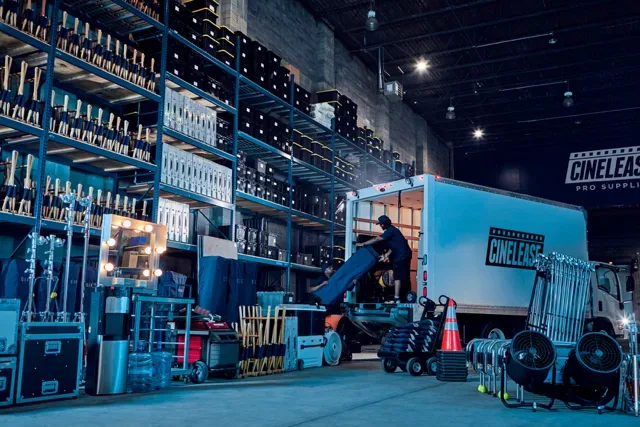
Cinelease is acquiring Quixote’s grip and lighting equipment, along with its production-supply assets, portable restrooms and communications gear. The transaction gives Cinelease a substantially wider set of production-support capabilities while Quixote continues to reduce its operations following a difficult period for film and television production.
The immediate human cost is significant: about 60 Quixote employees, mostly in Los Angeles, are expected to be laid off. Quixote had already announced in April that it was winding down its soundstage business, and this latest move takes it out of ancillary equipment services as well.
For Cinelease, the acquisition is part of a broader plan to grow beyond its established film and TV rental business. Its stated ambition is to serve live events, sports and other large-scale projects alongside screen productions. The new production-supply operation will be called Cinelease Pro Supplies.
What is changing hands
The deal covers several practical layers of a working production. Grip and lighting equipment are core on-set departments, but they do distinct jobs.
- Lighting refers to the fixtures and associated gear used to illuminate performers, locations and sets.
- Grip broadly covers the hardware that supports, shapes, positions and safely moves equipment, including the tools used to control light and rig cameras or other production components.
- Production supplies are the operational necessities that help a shoot function day to day. Cinelease’s acquired inventory will operate as Cinelease Pro Supplies.
- Portable restrooms and communications gear address the logistical side of a production, especially where crews are working on location or at a large event site.
That combination matters because it brings related rental and support categories under a single company. A project may need creative tools such as lighting equipment, physical infrastructure such as restrooms, and practical coordination equipment at the same time. Cinelease’s strategy is built around supplying more of that combined package.
This does not mean every former Quixote service is becoming a Cinelease service. Quixote’s ongoing business is being concentrated around transportation, including its Star Waggons trailers. Cinelease has said it expects to continue partnering with Quixote, so the companies can remain connected even as their core offerings become more separate.
Quixote’s retrenchment has been extensive
The equipment sale is another stage in a larger restructuring. Hudson Pacific Properties acquired Quixote Studios for $360 million in 2022, a point described as the peak of domestic film and television production. Hudson Pacific has since written off the entire investment.
Earlier this year, Quixote laid off 70 people and moved away from the soundstage business. One facility in Atwater Village, near Griffith Park, remains in operation under lease. The company also closed production-services businesses in Atlanta, New Orleans and Albuquerque while focusing its remaining service operations in Los Angeles and New York.
In business terms, this is a shift from a broad production-services model toward a narrower transportation-focused operation. Transportation can encompass trailers that support casts and crews, and Star Waggons remains the recognizable name within that remaining part of the company.
“Film and television will remain our foundation as we expand across live events, sports and large-scale projects,” Cinelease chairman Louis Dargenzio said in a statement.
That distinction is important. Cinelease is not presenting film and television as an abandoned market; it is treating them as the base from which it wants to reach adjacent industries. Quixote, by contrast, is exiting multiple adjacent service categories to concentrate on a smaller portion of its former footprint.
Cinelease is assembling a wider infrastructure business
The Quixote asset purchase follows other recent additions at Cinelease. The company entered rigging through C&C Studio Services, now operating as Cinelease Rigging, and also acquired barricades and fencing from West Coast Fencing.
Rigging generally means the specialized work and hardware used to suspend, secure or position production equipment safely. It is a field closely connected to the practical demands of soundstages, venues and large outdoor operations. Barricades and fencing similarly extend the company’s reach into site management and crowd or perimeter control.
Viewed together, the acquisitions point to a company building an entertainment-infrastructure platform rather than simply enlarging a single equipment catalog. That phrase can sound abstract, but the underlying idea is concrete: offer more of the physical services required before cameras roll, while crews work, or when a major event opens to attendees.
The sports and live-events angle also helps explain why communications equipment, temporary facilities, rigging, fencing and lighting may fit together commercially. They are different products and services, yet each is part of making a complex temporary workplace or event space operational. Cinelease’s stated rationale is that complementary capabilities can make customers’ jobs easier and allow the company to serve larger projects at greater scale.
What the deal means for productions and events
The clearest likely implication is a change in who supplies the gear and services, rather than a newly announced change to the fundamental work of a film set. Existing and prospective customers will see the acquired production-supply business under the Cinelease Pro Supplies name. Grip and lighting assets will also sit within Cinelease rather than Quixote.
For productions, consolidating related needs with one provider can potentially simplify planning and coordination. But the available details do not establish pricing, inventory levels, service coverage, contract terms, staffing arrangements at Cinelease, or the timing of operational integration. Those are the details that would determine how the change is felt on individual productions.
The broader context is a production slump that has forced changes across companies serving film and television. Equipment rentals, stages, transport, supplies and on-location services are all connected to the volume and scale of productions being made. When that activity weakens, companies built to support it may have to shrink, sell assets, specialize or seek work in neighboring markets.
In this case, the responses diverge. Quixote is retaining transportation and Star Waggons as its center of gravity. Cinelease is using acquired assets to widen its offering across film, TV, sports, live events and large-scale projects.
Audiences seldom see this infrastructure directly, despite its role in the finished entertainment experience. Lighting affects the images ultimately seen on a cinema screen or at home; for a useful primer on how presentation formats can affect viewing, see our explanation of IMAX Enhanced at home. The transaction here is about the less visible, earlier stage: the equipment and logistics that enable productions and events to happen in the first place.
A deal defined by both expansion and contraction
The headline is an acquisition, but it represents two very different business stories at once. Cinelease is expanding its scope, adding lighting, grip, supplies, portable restrooms and communications assets to a growing portfolio that already includes rigging plus barricades and fencing. Quixote is reducing its scope after withdrawing from soundstages and ancillary equipment services, while keeping its transportation operation.
The result is a redistribution of production-support assets during a softer period for the industry. Cinelease is betting that a larger, more diversified service platform can support screen work while opening doors in sports and live events. Quixote is betting that a more concentrated transportation business, led by Star Waggons, is the appropriate foundation for its next phase.