IMAX Enhanced sounds like the sort of home-cinema badge designed to trigger an immediate upgrade itch: a special label on a movie, a certification on a television or speaker, and the familiar IMAX name carrying all the implied scale of a huge theater screen. But the practical meaning is both simpler and more limited. For most viewers, its clearest benefit is not an exclusive TV mode or a dramatic boost in raw video quality. It is more of the movie image on screen.
That distinction matters when the label appears beside films on Disney+. An IMAX Enhanced presentation can use a taller frame than the ordinary widescreen version, revealing visual information that would otherwise be outside the home release’s picture. On a standard 16:9 television, that can be much more immediately noticeable than a subtle improvement in compression or fine detail. It is also a benefit that does not demand an IMAX Enhanced television.
There is a separate audio component involving DTS:X spatial audio, and there are certified TVs and sound systems from companies including Sony and TCL. Yet consumers should treat those as distinct pieces of the puzzle rather than proof that every IMAX Enhanced logo delivers a complete, superior experience. A streaming service, the version of a film, the display, the audio equipment, and personal preferences all shape the result.
The useful question, then, is not whether IMAX Enhanced is inherently “better.” It is: which part of the presentation matters most for the film and the setup in front of you?
The key feature is an expanded aspect ratio
An aspect ratio describes the shape of an image: its width compared with its height. Many films are presented in 2.39:1, a very wide format built around the proportions of conventional cinema screens. Modern televisions, phones, and many computer displays are comparatively taller at 16:9, or 1.78:1. Put a 2.39:1 film on a 16:9 TV without cropping it, and black bars appear above and below the picture.
That is not a defect. Those bars preserve the intended wide composition. The important wrinkle is that films made with IMAX photography may have taller imagery available for at least some scenes. An IMAX Enhanced home version can use that additional vertical image instead of sticking entirely to the regular widescreen presentation.
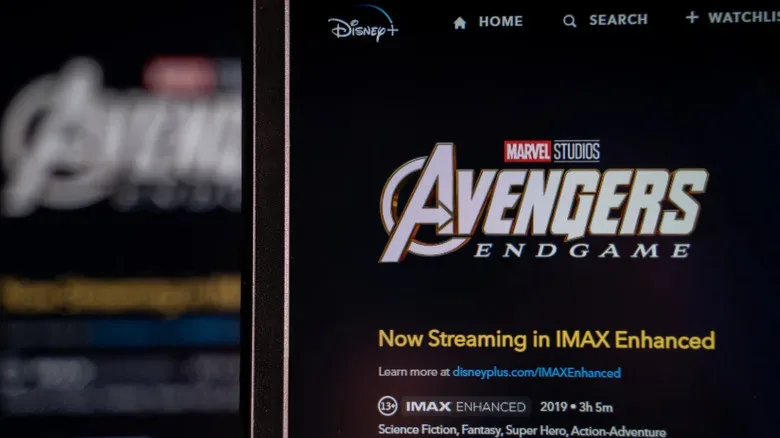
Disney+ IMAX Enhanced titles are presented at 1.90:1. That is still wider than a 16:9 television, so small black bars can remain. However, it is appreciably taller than 2.39:1. The effect is not merely that the image looks larger. Viewers can see more at the top and bottom of the frame: more environment, architecture, action, or character placement, depending on the shot.
That is why the feature can be meaningful even in a household that does not care about technical specifications. A viewer may not identify a streaming bitrate difference from across the room, but may instantly notice that a scene occupies more of the television. In this case, “IMAX Enhanced” is most usefully understood as a version of a film with an expanded image area, not a universal shortcut to maximum home-video quality.
A taller frame is not necessarily a full-screen frame
It is tempting to equate any screen-filling image with IMAX, but the labels and ratios need a little care. Some 4K Blu-ray releases use 1.78:1 for IMAX-shot footage, matching the shape of a typical television and eliminating black bars. The Dune films, Interstellar, and the forthcoming physical release of The Odyssey are identified as examples using that TV-filling ratio.
Packaging can communicate this inconsistently. The Dark Knight explicitly calls out “1.78:1 (IMAX sequences)” on some 4K Blu-ray packaging, while Interstellar can acknowledge 16:9 without prominently using the IMAX wording. For anyone buying a disc specifically for its expanded scenes, checking the listed aspect ratio is more informative than assuming every IMAX-associated title handles the format in the same way.
Likewise, IMAX Enhanced on Disney+ at 1.90:1 is not identical to a 1.78:1 disc presentation. Both can reveal more than a 2.39:1 version, but they do not necessarily display precisely the same amount of picture or fill a TV in exactly the same fashion.
IMAX Enhanced and picture quality are not the same promise
The certification also encompasses Digital Media Remastering intended to improve image quality, and its presentations can include high dynamic range, or HDR. HDR expands the range of brightness, contrast, and color a compatible display can reproduce. In straightforward terms, it can allow deeper-looking dark areas, brighter highlights, and a broader, more convincing range of colors than a standard dynamic range image.
But HDR is not exclusive to IMAX Enhanced. HDR10 and HDR10+ are established HDR formats supported by many modern TVs. A movie can have HDR without being IMAX Enhanced, and an IMAX Enhanced label alone should not be treated as a guarantee that a particular stream will outrank every other edition in every visual category.
The major constraint is bitrate: the amount of data delivered each second. Streaming platforms limit bitrate to make playback reliable over varied internet connections and to reduce buffering. Even a 4K stream has less data available than a 4K Ultra HD Blu-ray, which has the advantage of a substantially higher bitrate. More data can preserve fine detail and reduce the compromises that come with video compression.
This produces a genuinely useful trade-off rather than a simple hierarchy. A disc can be the best choice for someone prioritizing the strongest possible detail and image integrity. Yet that disc may not carry the expanded IMAX framing available on a streaming version. Disney’s physical releases are a notable case: they typically do not include the expanded aspect ratio.
Avengers: Endgame makes the contrast especially clear. Its 4K Blu-ray is described as the highest-quality version available in raw image terms, but it uses a 2.39:1 image and does not carry an IMAX label. Its IMAX Enhanced Disney+ stream offers the taller framing. A viewer choosing between them may be choosing more image composition versus the benefits of the higher-bitrate disc—not deciding between “real quality” and a gimmick.
Neither preference needs defending as objectively correct. In a shared living room, the bigger visible frame may make the streaming presentation the more satisfying option for everyone watching. In a carefully tuned setup where the owner values compression-free detail, the disc can remain preferable. The right selection comes from recognizing that each version emphasizes a different strength.
Audio requires a different kind of compatibility
The words “IMAX Enhanced” may appear as one neat package, but the audio path is separate from the expanded image. The audio feature is tied to DTS:X, a spatial-audio format. Spatial audio is designed to create a more dimensional sense of sound placement than basic stereo, potentially making effects and ambience feel positioned around the listener rather than simply pushed from left and right speakers.
To turn on IMAX Enhanced sound, a setup needs DTS:X support. That requirement can involve an appropriate sound system, and the eventual result depends heavily on the equipment in use. A capable speaker arrangement can make sound placement more persuasive; a setup without DTS:X cannot access that particular part of the feature.
This should not be confused with a requirement for IMAX Enhanced-certified hardware. The certification exists for TVs and speakers, and the logo indicates that a product meets IMAX’s performance standards. It does not mean that uncertified gear cannot show the taller IMAX Enhanced image. Nor does a certified television by itself ensure that every component in an audio chain supports DTS:X.
For viewers who do not own, or do not want to buy, a DTS:X-capable sound system, Disney+ treats IMAX Enhanced sound as a separate setting that can be turned off. That makes the decision refreshingly practical: use the expanded aspect ratio if it appeals, and only pursue the audio option if the existing system supports it and the benefit is worth it.
You probably do not need certified hardware
This is the most important shopping advice attached to the format. Modern TVs supporting HDR standards such as HDR10 and HDR10+ can play IMAX Enhanced movies on Disney+ as intended. The expanded aspect ratio is also available on supported devices without IMAX Enhanced certification, including an iPhone.
In other words, an IMAX Enhanced badge on a TV is not an admission ticket to the taller image. It may be relevant if a buyer is evaluating a whole home-theater package and values the standards behind the certification, but it should not override foundational display considerations.
Display technology has broader consequences across everything a person watches. OLED screens are noted for excellent black levels, while mini LED is another display technology shoppers can weigh. Those characteristics affect movies and television regardless of whether a title bears the IMAX Enhanced logo. A buyer comparing televisions should therefore begin with picture performance, the HDR support they need, screen size, and the environment where the set will be used—not treat the IMAX badge as a stand-alone measure of quality.
The same common-sense separation applies to speakers. Do not spend heavily on a sound system solely to chase the IMAX Enhanced wording. Decide whether DTS:X spatial audio is a capability you actually want, then verify that the rest of the setup can use it. The image benefit costs nothing extra if the title and playback device already support the format.
Where the format is available
Disney+ currently gathers the largest catalog of IMAX Enhanced films in one service. That makes it the most direct destination for viewers who want to compare expanded-frame streaming versions with conventional releases. Sony Pictures Core also has some IMAX Enhanced content, but access is limited to a PS5, an Xperia phone, or a Sony smart TV.
That PS5 requirement is a reminder that format access is often platform-specific, even when the underlying goal—seeing a film with its intended scale—is easy to describe. The broader entertainment question is also familiar to games: presentation choices can either preserve or dilute the feeling a work is aiming for, a point explored in this look at how a crossover protects its fantasy.
Physical media remains worth checking on a title-by-title basis. Some 4K Blu-rays offer expanded IMAX footage and the higher bitrate that discs provide. Others preserve only the wider theatrical framing. The absence of an IMAX Enhanced logo on a case is not enough information to settle the question; the listed aspect ratio and wording around IMAX sequences are the better clues.
A practical way to choose your version
For a movie with both an IMAX Enhanced stream and a 4K disc, start with the outcome you will actually notice most:
- Choose the IMAX Enhanced stream if seeing more of the frame is the priority, especially for films whose IMAX photography gives scenes a taller scale.
- Choose the 4K Ultra HD Blu-ray if the highest available bitrate and the resulting detail are the priority, while accepting that some releases use only the 2.39:1 image.
- Check the disc’s aspect ratio before assuming it lacks expanded sequences. A 1.78:1 listing can be the meaningful indicator even if packaging language varies.
- Keep using a non-certified TV if it already supports the relevant HDR playback and your device supports Disney+ IMAX Enhanced.
- Consider DTS:X only for audio, rather than assuming it is needed for the visual presentation. Disable the separate sound option if the equipment does not support it or it is not wanted.
IMAX Enhanced is therefore neither an empty badge nor a blanket verdict on home-video quality. It can offer a conspicuous, valuable change: a taller image that restores more of the filmed frame. It can also add an audio option for compatible DTS:X systems. What it cannot do is remove streaming’s bitrate limits, make every physical edition equivalent, or justify replacing a good television simply because it lacks another logo.