Fortnite collaborations have always lived in a strange, energetic space between tribute and disruption. The appeal is obvious: a character that once belonged to a particular world, genre and emotional register suddenly becomes part of a vast playable pop-culture collision. But that same process can flatten what made the character distinctive. A hero arrives, receives the standard Fortnite treatment, and the question becomes less “does this feel like them?” than “can they hold the usual equipment?”
The new Kingdom Hearts x Fortnite trailer appears to understand that this is precisely the wrong question for Sora, Riku and Kairi.
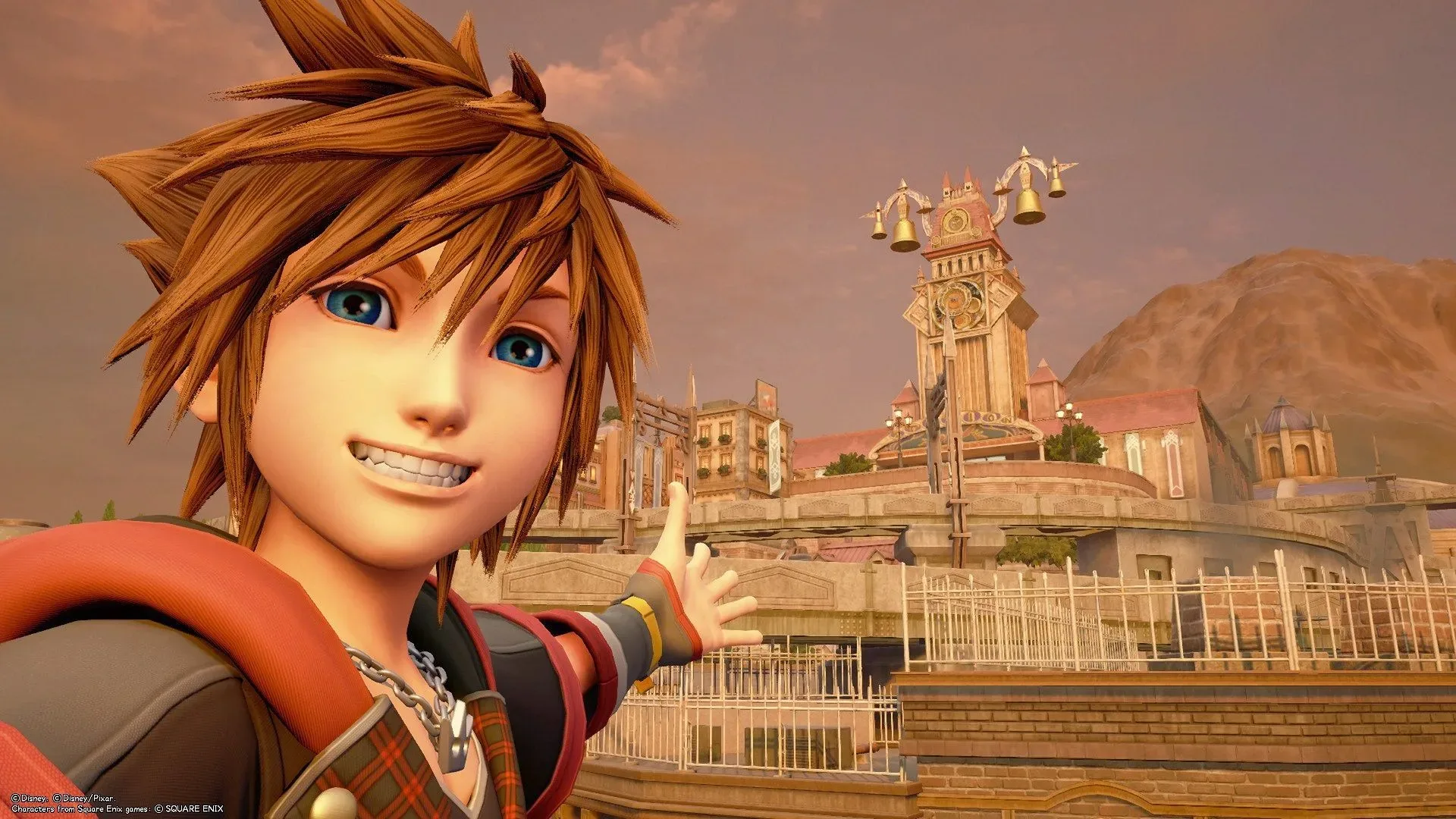
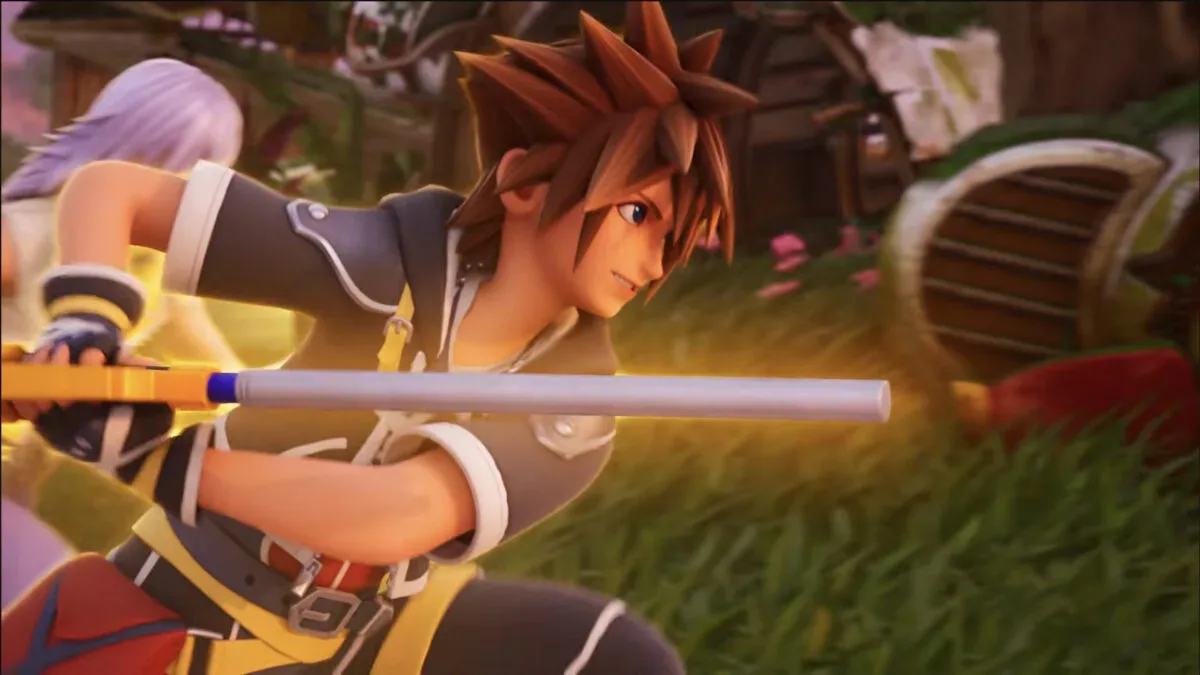
Its central trick is not merely recognizing that Kingdom Hearts has fans with fond memories. It is recognizing which memories carry the emotional charge. The trailer closely recreates the opening moments of Kingdom Hearts 2, set to the opening guitar notes of Hikaru Utada’s “Sanctuary,” and it follows several of the original cutscene’s action and emotional beats. Even the timing of Sora hitting the ground is coordinated with a familiar musical sting. That is a very particular kind of nostalgia: not a checklist of recognizable objects, but an attempt to restore a feeling through rhythm, framing and sound.
Why the Kingdom Hearts 2 callback matters
A crossover trailer does not have much time to establish its terms. It needs to introduce the collaboration, sell its imagery, and persuade players that this meeting of brands has a reason to exist. Referencing Kingdom Hearts 2’s opening gives the trailer a ready-made emotional language for longtime fans. The point is not simply that viewers can identify Sora. It is that they can recognize the momentum of an opening they already associate with anticipation, mystery and movement.
That distinction matters because nostalgia is often treated as a visual commodity. Put the old costume on screen. Play a few seconds of an old song. Show the logo. Those gestures can work, but they can also feel like a company is pointing at a memory from the outside. This trailer’s more thoughtful move is to recreate a sequence of relationships between image and sound. Sora’s landing has weight because the music tells fans when that impact should arrive. The keyblades matter because they sit inside a visual vocabulary that already belongs to these characters.
In film and game trailers, that kind of deliberate recreation is often called an homage: a new work openly echoes a known earlier work. An homage can be shallow if it only copies a famous pose or line. Here, the apparent aim is more focused. The trailer draws on a scene whose music, editing and action are deeply linked for Kingdom Hearts players, then translates those cues to the Fortnite collaboration.
That may be why the trailer has drawn praise from viewers who read the edit as fan-minded rather than merely brand-minded. The response is not just to the existence of a Kingdom Hearts collaboration. It is to the sense that the people building its introduction understood the series’ emotional shorthand.
The keyblade is more than an accessory
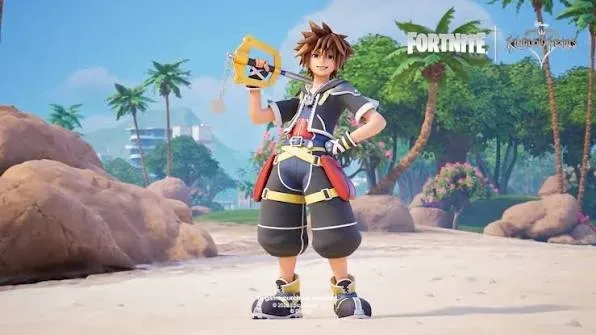
The trailer’s other smart decision is what it avoids. It does not foreground familiar Fortnite gunplay. Instead, Sora, Riku and Kairi are shown with their keyblades, while Sora moves through the air and performs combo-driven attacks associated with Kingdom Hearts action.
Related coverage includes Kingdom Hearts Meets Fortnite in a Trailer Built on Kingdom Hearts 2 Nostalgia.
That sounds like a minor presentation choice, but it changes the entire pitch. A keyblade is not simply a weapon model that can be swapped for another one. Within Kingdom Hearts imagery, it is inseparable from the characters and the series’ style. It immediately signals the kind of action fans expect: aerial movement, swinging attacks and chained combinations rather than a conventional shooter pose.
A combo, in action-game terms, is a sequence of attacks connected in quick succession. Combos are mechanically useful in many games, but they are also expressive. They communicate speed, flow and a particular combat identity. Showing Sora dancing through the air in such a sequence says “Kingdom Hearts” more effectively than placing him in a generic battle stance ever could.
This is the delicate problem crossovers must solve. A guest character has to be adapted enough to function in the host game’s world, but not adapted so completely that the guest becomes unrecognizable. The visual language of the trailer suggests that Fortnite is trying to meet Kingdom Hearts on Kingdom Hearts’ terms, at least in the way it presents the collaboration. The trio retain their bespoke weapons and their signature style rather than being introduced through the most standardized part of Fortnite’s identity.
There is a broader lesson here for licensed game appearances. The strongest crossover material often identifies a character’s irreducible core. For some characters, that might be a voice, silhouette, fighting stance, vehicle or musical motif. For this trio, the trailer makes a persuasive case that the core includes keyblades, soaring motion and melodramatic grandeur. Remove those ingredients and the collaboration risks becoming a costume rack with an expensive logo attached.
Music does the heaviest emotional lifting
“Sanctuary” is doing important work before a single keyblade hits the screen. Music can compress years of player memory into seconds, especially when it is tied to the beginning of a game. An opening theme is heard at a moment of heightened attention: the game is new, the player is eager, and the narrative promise has not yet been resolved. Returning to it later can reactivate not only scenes but the expectation of entering that world for the first time.
That is why the trailer’s choice lands as more than a borrowed needle drop. The song and the reconstructed opening beats work together. One establishes the emotional cue; the other confirms that the cue is intentional. Without the visual commitment, the music could read as a loose reference. Without the music, the action could be any fantasy-flavored character showcase. Together, they frame the trailer as an invitation to revisit a specific piece of Kingdom Hearts memory.
It is also telling that the trailer seems content to let implication do some of the selling. There is no need to force the audience through a barrage of conventional Fortnite combat imagery when the franchise being invoked already has an action grammar of its own. That restraint preserves the dream for a little longer: Sora is still Sora, Riku is still Riku, and Kairi is still Kairi, even after crossing into an ecosystem built around unexpected guests.
A trailer can preserve the fantasy without promising more than it shows
It is important to separate the trailer’s presentation from claims about the collaboration’s complete gameplay details. A cinematic or promotional trailer can communicate tone, character identity and intent without explaining every practical aspect of how a crossover works. The material shown strongly emphasizes keyblades and Kingdom Hearts-style aerial action; it does not, by itself, establish every feature, mode or mechanical rule players may encounter.
That is not a criticism. It is a reminder that trailers and gameplay are different kinds of communication. The trailer’s job here is unusually clear: make Kingdom Hearts fans feel seen. It accomplishes that by making careful aesthetic choices rather than trying to explain an entire event in a short runtime.
For players who care about character authenticity in crossover games, the useful takeaway is straightforward. Watch what the marketing chooses to center. Does it give a visiting character their own recognizable movement, symbols and emotional texture? Or does it immediately make them indistinguishable from everyone else? In this case, the keyblades and the recreated Kingdom Hearts 2 cadence are the evidence that the collaboration’s first impression was designed around identity rather than novelty alone.
That concern also surfaces in other discussions of how action games communicate combat and character perspective, including an examination of Marvel’s Wolverine and its combat idea. The particulars are different, but the principle travels: mechanics and presentation mean more when they are rooted in what makes the character themselves.
Fortnite’s biggest advantage may be its ability to change the frame
There is an irony in a Fortnite trailer succeeding by temporarily making people forget Fortnite’s usual frame. The game is commonly understood as a place where disparate properties coexist, a format built for collision. That is its strength, but it can create a risk of sameness: every guest eventually looks like another piece on the same board.
The Kingdom Hearts trailer instead creates a short pocket of space for the guest series. It uses Fortnite as a destination, but it lets Kingdom Hearts define the mood. The first impression is not “look how strange it is to see these characters here.” It is “remember why these characters mattered.”
That is a far more generous approach to fan memory than simply disassembling familiar icons into transferable cosmetics and poses. It acknowledges that people are attached to scenes, songs and motion—not only names and character models. And by avoiding a prominent gun-focused reveal for Sora, Riku and Kairi, the trailer sidesteps an image that could have immediately punctured the illusion it is trying to build.
Whether a crossover ultimately satisfies players depends on more than one striking trailer. But as an introduction, this one makes a compelling case that someone involved knew where the emotional fault lines were. They knew that a few guitar notes from “Sanctuary,” a precisely timed fall, a keyblade, and Sora suspended in the sky could say more to Kingdom Hearts fans than a dozen winking references.
For a collaboration designed to bring a beloved series into Fortnite’s enormous cultural blender, that is the right instinct. The trailer does not ask fans to pretend the blender is not there. It simply gives Kingdom Hearts enough room to arrive with its heart still intact.