Meta has made Muse Spark Open available to download, presenting an 800-billion-parameter AI model built to run locally on Apple Silicon. The catch is not subtle: a full local setup needs as much as 1TB of memory.
That requirement turns the launch into two stories at once. Muse Spark Open is an ambitious open-weight release aimed at developers and organizations that want direct control over a very large model. It is also a sharp reminder that “run it on your own computer” can mean “assemble a small workstation fleet,” rather than download a file to the Mac already sitting on a desk.
Meta calls Muse Spark Open the most capable open-weight model from the US to date. Its published benchmarks indicate that it exceeds GLM 5.3 and Kimi K3 on agentic-task and visual-reasoning evaluations. Those results are meaningful claims, but they should be read as company-released benchmark results rather than a universal verdict on every workload. A model can perform strongly on selected tests while producing different results in a particular codebase, toolchain, prompt format, or creative pipeline.
For game developers, technically inclined studios, and the growing number of people experimenting with AI-assisted production, the release is therefore less about a one-click consumer tool than a signpost. Large local models are becoming more plausible on desktop-class hardware, but the economics, system design, and operational expertise still decide who can realistically use them.
What “open-weight” means—and what it does not
An AI model’s weights are the learned numerical values created during training. They are the core data that lets a model turn an input into a response. An open-weight release makes those trained weights available for others to download and run, subject to its applicable terms.
That differs from using an AI system only through a hosted interface or an application programming interface (API). With a hosted model, the provider operates the infrastructure and a user sends requests over a network. With local deployment, the organization running the model supplies the hardware and manages the environment itself.
The distinction matters in practical terms. A locally run model can potentially fit workflows where a team prefers to keep inputs inside its own infrastructure, wants to experiment with a customized deployment, or expects sustained usage that makes recurring token charges unattractive. But self-hosting also transfers the difficult parts: acquiring compatible systems, maintaining them, configuring the model, managing capacity, and evaluating whether outputs are dependable for the task at hand.
Open weights do not automatically mean every part of an AI project is open, nor do they erase licensing and deployment responsibilities. The relevant point here is narrower: Muse Spark Open is downloadable and designed for local operation, rather than being restricted to a remote service.
Why an 800-billion-parameter model needs extraordinary memory
A parameter is one of the values a model uses to represent patterns learned in training. Saying that Muse Spark Open has 800 billion parameters describes its immense scale. It does not, by itself, tell someone whether the model will be the best fit for a given writing, coding, planning, or image-understanding task. It does explain why the memory requirement is so imposing.
To run a model, a system has to hold the model’s weights in accessible memory. Memory is not the same thing as storage: a drive may hold files while memory is the high-speed working area needed when software is active. A downloadable model can therefore be available to anyone while remaining impractical to execute on ordinary hardware.
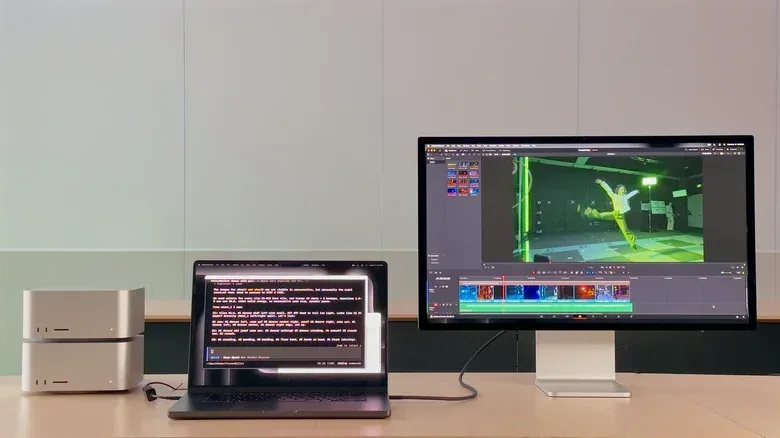
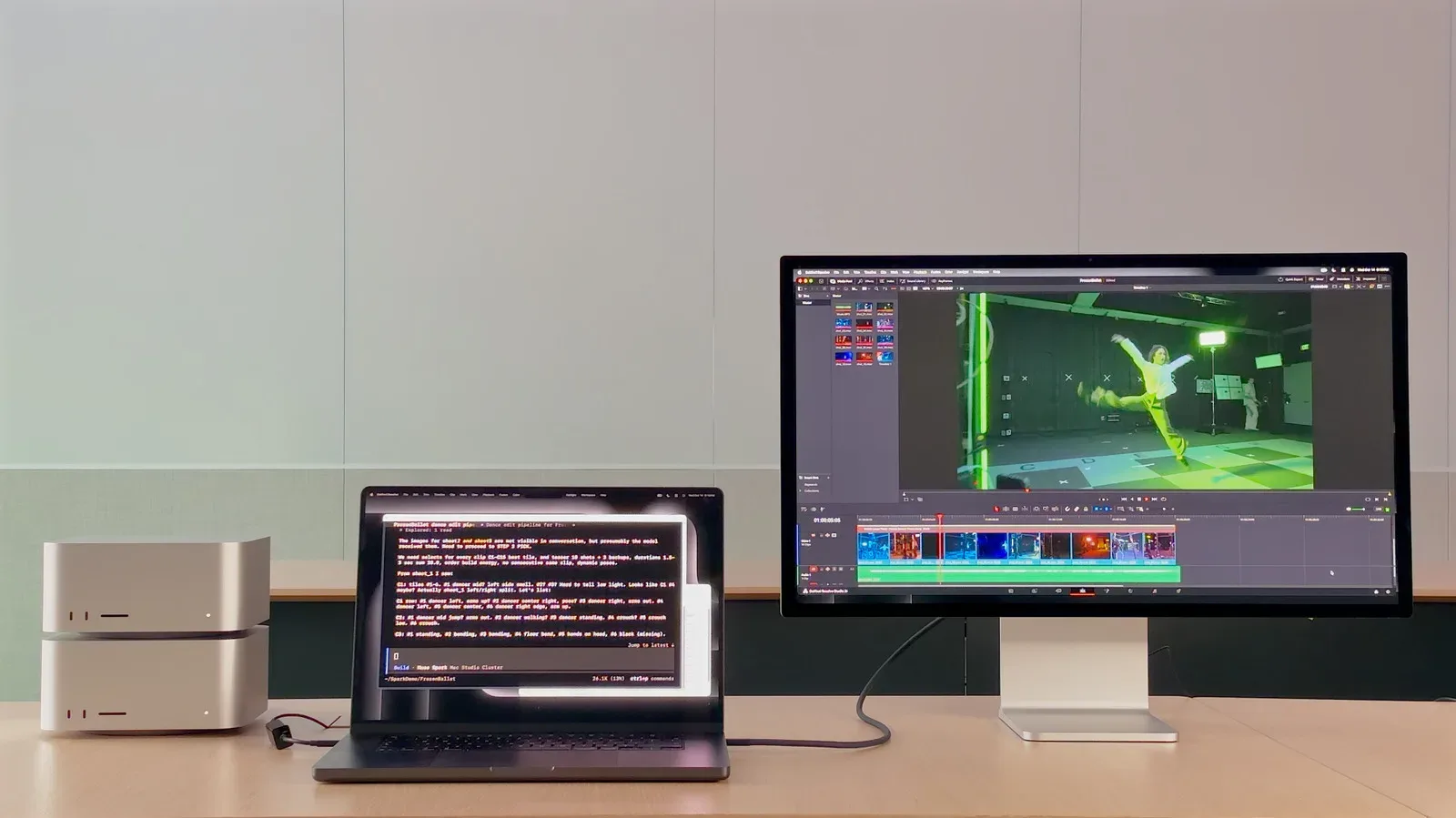
Meta says the model can be held across two M5 Ultra Mac Studio machines with 512GB each. It attributes that possibility to Apple’s unified-memory architecture, where the integrated GPU can use up to 512GB in a single Mac Studio. With two systems, Meta says the arrangement behaves like one supercomputer with a terabyte of unified memory.
Unified memory is Apple’s approach in which CPU and GPU components draw from the same memory pool. For AI inference—the process of using a trained model to produce an answer—that can be important because the compute hardware needs quick access to large volumes of model data. The stated design goal is clear: use Apple Silicon machines at an unusually high memory capacity to make a model of this size runnable outside a conventional data-center setup.
“Runnable” should not be confused with “cheap,” “simple,” or necessarily “fast enough for every use.” The supplied information identifies the capacity needed to accommodate the model, not a guaranteed speed, number of concurrent users, latency, output quality in a specific project, or a turnkey setup process. Those are the questions organizations will need answered before treating local deployment as an operational alternative to hosted AI.
The Mac Studio configuration is the real barrier
Muse Spark Open is described as the first model optimized to run locally on M5 Ultra-equipped Mac Studio hardware. Apple had said the 512GB Mac Studio would arrive in late October, but specific pricing and a firm ship date had not been announced in the available information.
Meta also says the model can run on four 256GB M5 Ultra Mac Studios. That configuration is estimated at roughly $38,000. Even before considering setup, space, power, networking, and the people required to operate a deployment, that figure places a full local instance far beyond the typical solo developer or hobbyist.
That does not make the release irrelevant to smaller teams. Open-weight launches can matter as reference points for tools, research, hosted services, and future hardware targets. But the immediate audience for a 1TB configuration is more likely to be a larger organization with a concrete reason to own the computing capacity.
One potential rationale is usage economics. Teams that repeatedly pay for hosted-model requests often track their token budget. Tokens are chunks of text processed by a model; providers commonly meter AI usage in token-based units. Heavy use can turn that metered spending into a meaningful operating cost. A company with sustained demand may decide that a substantial upfront hardware purchase is worthwhile, provided the model is genuinely capable for its work and the organization can support the deployment.
That calculation is not automatic. A hardware purchase is a fixed investment, while hosted usage can rise and fall with demand. The right answer depends on utilization, model performance, internal technical capacity, and the value of local control—not simply the size of a model’s parameter count.
What Meta’s benchmark claims say
Meta’s released results position Muse Spark Open ahead of GLM 5.3 and Kimi K3 on agentic tasks and visual reasoning. Agentic tasks generally involve a model taking multi-step action toward a goal, often by planning, choosing tools, using intermediate results, and adjusting its next step. In a software-production context, that might mean working through a sequence rather than returning a single standalone response.
Visual reasoning describes tasks in which a model is expected to interpret and reason from visual information. That can be relevant to any workflow dealing with images, interfaces, reference material, or other visual inputs. It does not establish that the model is best at every visual job, nor does it tell developers how well it will work with a particular game engine, asset pipeline, or internal data set.
Benchmarks are useful because they create a shared measurement framework, but they are not substitutes for task-specific evaluation. A studio considering AI for documentation, prototype support, production planning, or internal tools should care about failure modes, consistency, deployment complexity, and review processes alongside headline scores. The supplied benchmark comparisons show where Meta believes the model is competitive; they do not eliminate the need for that closer testing.
Why the release may still matter to game development
The game industry has plenty of reasons to watch local AI even if few teams are shopping for four top-end Mac Studios. Studios handle confidential materials, complex production pipelines, and workflows that can generate large numbers of AI requests. A capable locally operated model could be appealing where control over inputs and predictable high-volume usage are priorities.
At the same time, an 800-billion-parameter local model should not be mistaken for a universal production solution. A game team would still have to determine what tasks are appropriate, what human review is necessary, and whether the systems cost makes sense. The practical lesson is not that every developer needs a terabyte of memory; it is that the upper edge of local-model capability is increasingly tied to workstation-scale infrastructure.
Smaller creators can also follow the broader development without treating it as a shopping list. The ability to run a model locally is a spectrum, not a binary. Muse Spark Open occupies an extreme end of that spectrum, one designed around a multi-machine Apple Silicon configuration. Its existence may influence future tooling and expectations, but its stated memory footprint makes clear that it is not aimed at a typical desktop setup.
Developers interested in the broader relationship between creative production and technology can also follow projects that put game-making tools in more hands, such as thatgamejam #02’s audio-led game-development challenge. Muse Spark Open represents a much more infrastructure-heavy side of the same broad conversation: what new tools enable, and who can practically access them.
A major release with a deliberately narrow first audience
Muse Spark Open is available now through Hugging Face, but availability is only the first gate. The hardware threshold means the model is most immediately relevant to organizations prepared to operate an exceptionally large local AI deployment. For them, the pitch is straightforward: a downloadable 800-billion-parameter model, optimized for Apple Silicon, with company-published results claiming strong agentic and visual-reasoning performance.
For everyone else, the most important detail is the 1TB requirement. It captures both the promise and the constraint of this moment in local AI. Very large models are moving closer to locally controlled hardware, but “local” at this scale means specialized, expensive equipment—not an ordinary Mac, and not a casual weekend install.