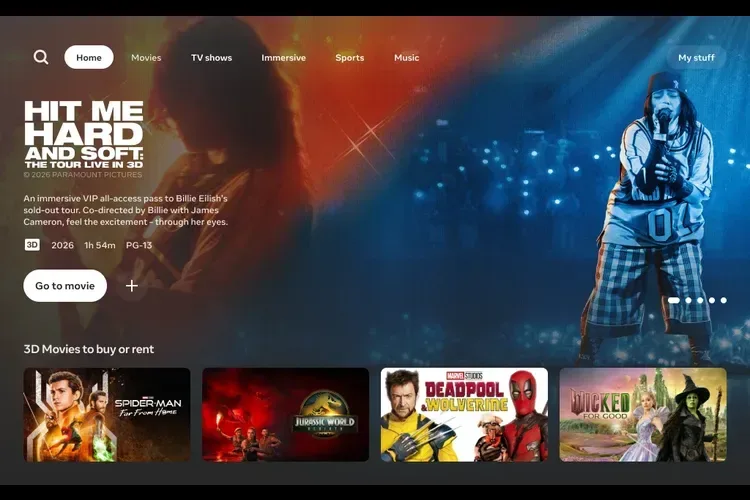
Meta has opened a new storefront lane for virtual-reality movie nights: more than 150 3D movies are now available to rent or buy through the TV app on Meta Quest 3 and Meta Quest 3S headsets. The launch is initially limited to the U.S., and it puts paid 3D film rentals and purchases directly alongside the streaming options Quest users could already access.
The immediate library includes major studio films such as Deadpool & Wolverine, James Cameron’s Avatar, Spider-Man: Far From Home, Jurassic World Rebirth and Wicked: For Good. It also includes Hit Me Hard and Soft: The Tour, the Billie Eilish concert film co-directed by Eilish and Cameron. That title has a specific exclusivity window: it is available to rent or buy in 3D on Meta Quest through December 31.
Most titles cost $6.99 to rent or $16.99 to purchase, though Meta says pricing can vary. That makes this a transactional-video offering, not an all-you-can-watch subscription catalog. For a Quest owner, the important practical distinction is simple: access to the headset does not itself include these movies, and a purchase price is separate from a rental price.
What has changed for Quest movie watching
Quest headsets were already capable of functioning as private streaming screens. Native apps provide access to services including YouTube, Amazon Prime Video and Disney+, with Disney+ offering select 3D films. Users can also reach services such as Netflix and Apple TV through Quest’s built-in browser. The new addition is a dedicated selection of 3D titles for individual rental or purchase within Meta’s own TV app.
That distinction matters because convenience is a meaningful part of any living-room alternative. A person may already have a subscription app installed, but a film’s availability in 3D, the ability to rent it without changing devices, and whether it is offered as a buy-or-rent transaction are separate questions. The TV app expansion is specifically about the latter two, with a catalog built around 3D viewing.
Meta is also positioning the headset more strongly as a personal home-theater device. Its latest Quest software update includes a Theater mode that presents a large virtual screen while dimming the viewer’s surrounding environment. In ordinary terms, that is designed to reduce visual distraction and make a film feel less like a floating window in a mixed digital space and more like a focused cinema session.
There is an obvious trade-off in the “personal” part of that pitch. A virtual screen can create a movie-focused space without relying on a physical television or projector, but it is not a shared couch-and-TV setup in the normal sense. The product direction here is tailored to an individual viewer wearing a headset, rather than a room full of people watching one panel. Buyers weighing broader home-entertainment upgrades can also compare the conventional audio side of the equation in this look at Sonos discounts on headphones, soundbars and speakers.
3D movie playback is not automatically the same as a 360-degree experience
The terms around headset video can blur together, so it is useful to separate them. A conventional 3D movie uses separate image perspectives for each eye to produce depth. The viewer still watches a framed film, just one with the perception of foreground and background distance. The key selling point of the new library is that stereoscopic depth effect.
A 360-degree video, by contrast, is captured around the viewer and can allow them to look in different directions. The supplied details about the Billie Eilish concert suggest that its production goes beyond simply applying 3D to a standard stage recording. Eilish performs on a 360-degree stage surrounded by the crowd, and Cameron’s Lightstorm Vision team developed a system for long-range 3D filming intended to capture close action without placing cameras between the performer and fans. A separate 3D camera was positioned on stage.
Meta’s description of the result emphasizes a feeling of standing near Eilish, looking toward the audience and feeling present at the show. That is a creative aspiration, not a guarantee that every concert viewer will have the same reaction. What can be stated from the production information is that the shoot was designed to solve a real staging problem: getting close views of a performer on a circular, audience-surrounded stage while avoiding intrusive camera placement.
It is also worth not treating this one concert film as a technical specification for the full catalog. The newly available collection contains more than 150 movies, but the supplied information only describes the specialized long-range and on-stage 3D camera work for Hit Me Hard and Soft: The Tour. Different films may have different production histories and visual approaches. The shared point is their availability in 3D through the Quest TV app, not proof that every title uses the same kind of immersive concert capture.
How the pricing and availability work
- Eligible headsets: Meta Quest 3 and Meta Quest 3S.
- Initial territory: the U.S. only.
- Catalog size at launch: more than 150 3D movies.
- Typical stated pricing: $6.99 for a rental and $16.99 to buy, with prices varying by title.
- Featured limited window: Hit Me Hard and Soft: The Tour is exclusively available to buy or rent in 3D through Meta Quest until December 31.
For prospective customers, the territory limitation is the first thing to check. “Initially” signals that the U.S. is the starting point rather than a permanent promise of exclusivity, but it does not establish a date for other regions. Meta has said international availability is planned as part of a broader expansion, so viewers outside the U.S. should avoid assuming that the current launch applies to them.
Likewise, the listed prices are best read as a baseline rather than a fixed store-wide rule. “Most” titles being $16.99 to buy and $6.99 to rent means an individual movie can depart from that pattern. Anyone deciding between renting and purchasing should check the title’s store page at the time of transaction instead of treating either amount as universal.
A larger catalog is planned, but it is tied to a future product launch
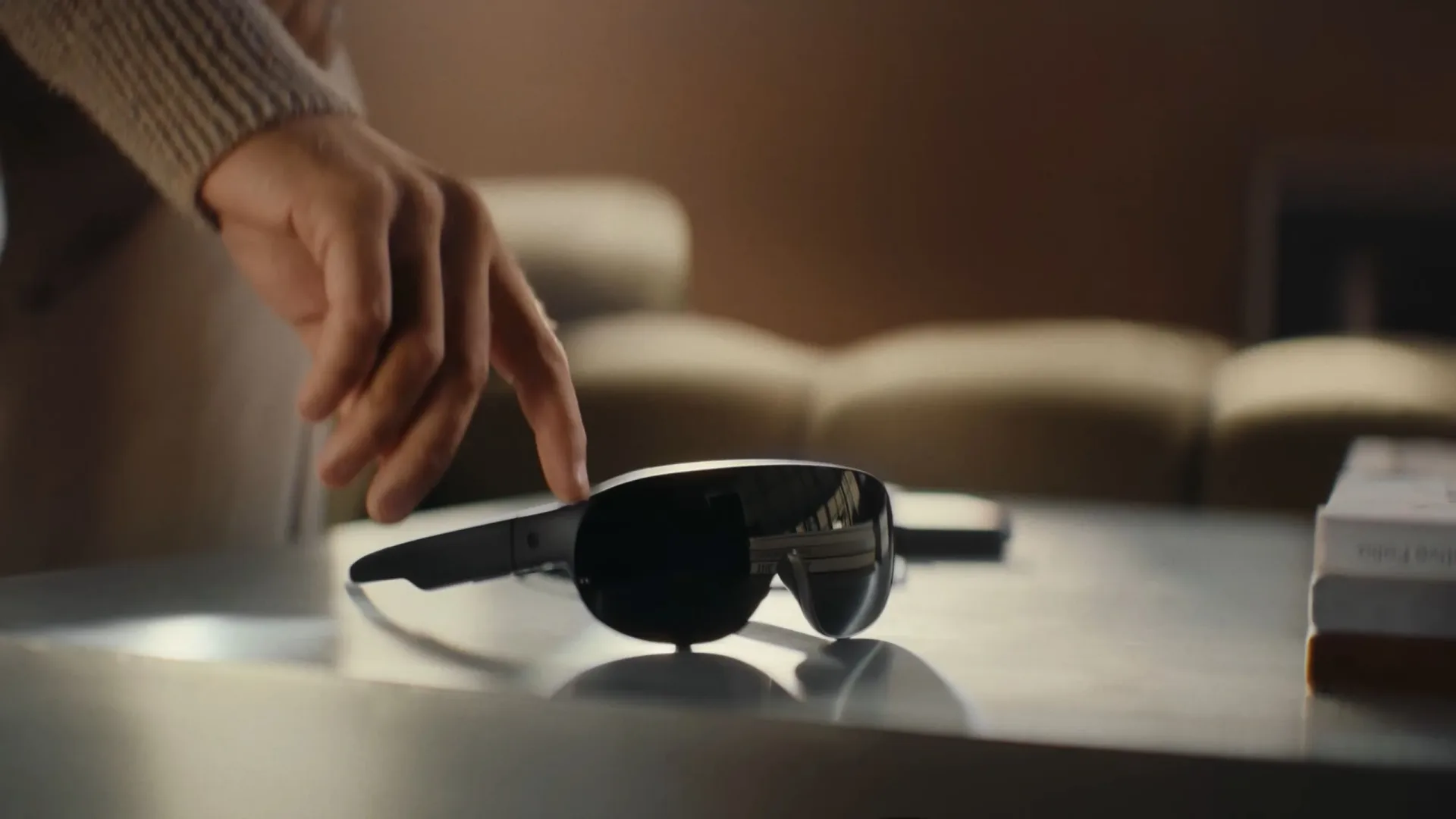
Meta says it has further movie agreements in progress and expects the TV app’s library to grow to thousands of titles alongside international availability. The company connects that expansion to the spring 2027 launch of Meta VR Glasses, which it says will cost $1,299.
That roadmap provides scale, but it should be understood as a future plan rather than a description of today’s Quest store. The present-day fact is a U.S. catalog of 150-plus titles for Quest 3 and Quest 3S. Thousands of titles, broader regional access and the Meta VR Glasses rollout are all described as coming with the 2027 launch.
The $1,299 figure applies to the planned Meta VR Glasses product, not the 3D movie rentals or purchases now offered on Quest. Keeping those costs separate helps prevent a confusing comparison. There are three different financial layers in the announcement: ownership of compatible hardware, the per-title charge for rental or purchase, and the future listed price of a separate glasses product.
Why this is a notable content push
VR hardware has long faced a content question that extends beyond games: what reason does someone have to put on the headset when they are not playing? Movie and television apps provide one answer, and 3D movies are especially suited to a device that can display a dedicated image for each eye. Meta’s move is therefore not merely a catalog refresh; it is an attempt to make video viewing a more central use case for Quest.
The company’s Theater mode reinforces that strategy. A large virtual screen and dimmed surroundings are software choices aimed at reproducing some of the concentration associated with a cinema. The 3D store complements that environment with paid titles intended to benefit from stereoscopic viewing. Neither part depends on the other in a strict sense, but together they form a clearer home-theater pitch than browser streaming alone.
For viewers, the best reason to care will vary by title. A blockbuster made for 3D may be appealing because of depth and scale; a concert film may be appealing because camera placement can create a sense of proximity to the performer. The Billie Eilish release is the clearest example of the latter, given its custom filming system and on-stage camera. Meanwhile, the presence of familiar films such as Avatar, Spider-Man: Far From Home and Deadpool & Wolverine gives the storefront recognizable starting points.
The limitation is just as clear: this is a paid, headset-specific experience at launch and is currently U.S.-only. It will not replace every streaming subscription, and the announcement does not say that every existing service or title gains a new 3D option. Instead, it gives Quest 3 and 3S owners a new storefront for a defined set of 3D rentals and purchases, while setting out a considerably bigger—but future-facing—plan for 2027.