The cancellation of Mass Effect 5 has left a particularly frustrating kind of vacuum: fans know the project existed, know it was teased several times, and now know they will not see the finished result. Comments from two writers who worked on it, Catherynne M. Valente and Derek Künsken, add an important human detail to that loss. Their descriptions do not reveal a plot, a release plan, or a list of gameplay systems. They do, however, push back on the assumption that a cancelled game must have been creatively lifeless or chaotic.
Valente said she had worked as a writer on the project for three years. In posts following the shutdown of BioWare and the game’s cancellation, she described the assignment as both a major privilege and an intense challenge, saying she put sustained effort into it for Mass Effect fans. Her reaction was unequivocally mournful: this was work she valued, and its end hit hard.
Künsken separately confirmed that he had contributed on and off for five years. He said his character and lore work with Valente had been the most energizing, “in-the-zone” collaboration of his career. Künsken also asked for support for the roughly 50 people he said deserved recognition and new employment, while noting that he was still seeking clarity about what he could publicly discuss. Additional reporting on the writers’ comments similarly reflects the limited but meaningful picture now emerging.
What the writers’ remarks do—and do not—tell us
There is a temptation, especially after a cancellation, to treat staff testimony as a definitive verdict on a game’s quality or commercial prospects. That would go too far. A highly motivated writing team is not proof that an unreleased game was ready, that every department was aligned, or that the project would necessarily have succeeded. No playable build, script, production schedule, budget, or formal explanation for the cancellation is established by these comments.
For more context, explore Pokémon Card Collection Kept in a Loft Sells for £1.56 Million at UK Auction.
But the inverse assumption is equally unsupported. Cancellation is not evidence that employees were disengaged or that nothing promising was being made. Valente specifically responded to claims suggesting the industry could not make a worthy sequel, saying the team had been making good progress. Künsken’s account supplies a second perspective from within the writing effort: he recalls active, creatively rewarding work on characters and lore.
That distinction matters because online postmortems often compress an enormous production into a simple story: a beloved franchise, a difficult development, then an obvious failure. The available testimony points to a more complicated reality. A game can contain committed people doing work they believe in and still never reach players. The loss is not abstract to the people who built that work, particularly writers whose characters, dialogue, histories, and narrative connections may now remain unseen.
Why character and lore collaboration is central to Mass Effect
In this context, lore means the accumulated fictional framework of a series: its species, worlds, political relationships, technologies, historic events, terminology, and the rules that make its setting feel internally connected. In a Mass Effect game, lore is not merely background encyclopedia material. It informs why a character reacts to another species in a particular way, what an apparent distress call means, what a returning location represents, and which prior events can credibly affect a new story.
Related coverage includes Mass Effect 5 Writers Recall an Energized Collaboration After Cancellation.
Character work, meanwhile, is the process of developing the people at the center of that setting: their motives, voices, relationships, conflicts, and roles in the story. Künsken’s description of collaborating with Valente on both areas suggests that the project’s narrative work was concerned with the link between personal stories and the broader universe, rather than treating them as separate tasks.
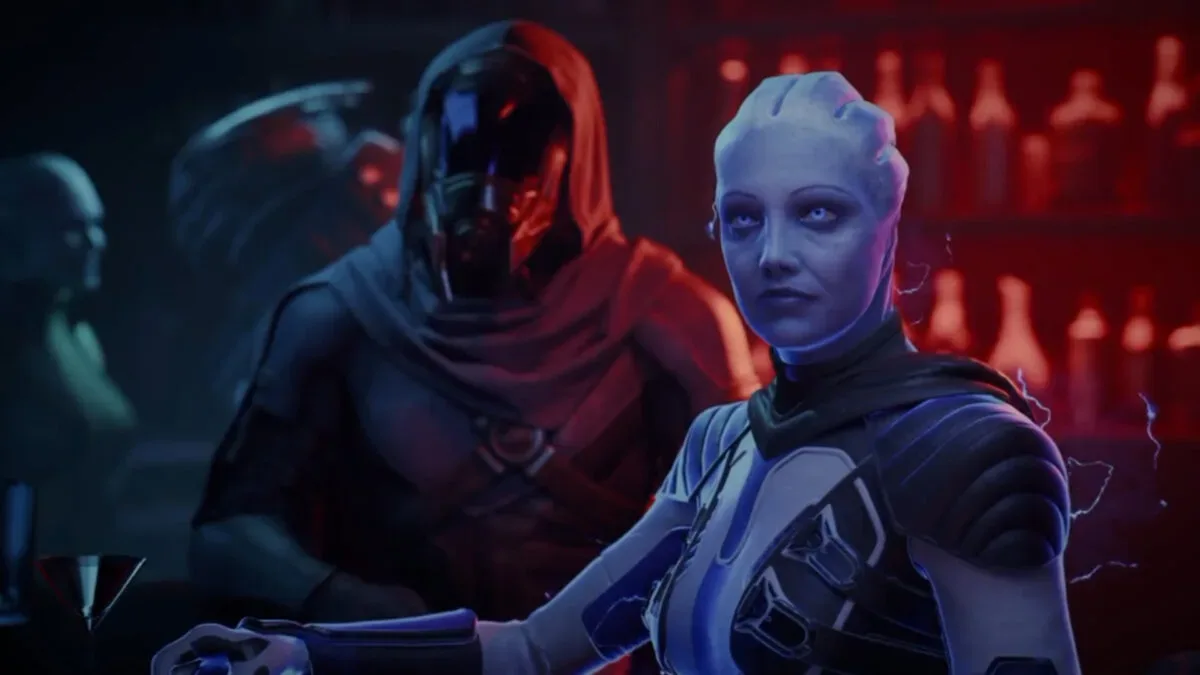
That is especially relevant to the few official teases that existed. The next Mass Effect was announced in 2020 and only shown in a limited number of subsequent glimpses. Liara T’Soni, a party member from the original trilogy, appeared in the first trailer. Later material implied that a team in the Milky Way could be responding to a distress call from Andromeda. The Angara, a people introduced in Mass Effect: Andromeda, were also shown alongside Milky Way species.
Those pieces strongly suggested a project attempting to connect the series’ two major galactic settings. They were never a full confirmation of story structure, player perspective, or the exact mechanics of such a connection. Still, they frame why lore work would be unusually consequential. Bridging the Milky Way and Andromeda would require narrative answers about distance, contact, communities, and the cultural consequences of peoples from those settings meeting.
A bridge between galaxies was implied, not fully explained
The distinction between implication and confirmation is crucial with cancelled games. Fans can reasonably observe that Liara’s appearance, the apparent Andromeda distress call, and the Angara’s presence near Milky Way species all point in the same broad direction. It is reasonable to call that an apparent bridge between the galaxies. It is not reasonable, based on the material available, to present any particular theory about how that bridge would work as settled fact.
There is likewise no basis here to state that the game would have centered on a specific returning protagonist, that it would have resolved every outstanding question from prior entries, or that it had chosen a final ending. Those are precisely the kinds of details Künsken indicated may be constrained by what former contributors are allowed to share. The writers’ public comments are valuable because they clarify the feeling and scope of their involvement; they are not a license to fill the remaining blank spaces with fan speculation.
Valente’s previous connection to the franchise helps explain why her participation has attracted attention. She wrote Mass Effect: Andromeda Annihilation, a tie-in novel set in the wider Mass Effect universe. That experience is relevant background, but it should not be mistaken for evidence that the cancelled game followed the novel’s story or adopted its particular concepts. Her stated role on Mass Effect 5 was as a writer, and the disclosed details stop there.
The response also exposes a familiar problem in public blame
Valente had to clarify that she was not involved in Mass Effect: Andromeda, Anthem, or Dragon Age: The Veilguard after being told she should have made a great game instead. Her response underscored a basic but routinely ignored point: a studio is not a single person, and a franchise’s history cannot be assigned wholesale to an individual whose name is absent from the credits of the games being invoked.
For players, credits are more than a ceremonial list after finishing a game. They are one of the clearest ways to understand who actually worked on a given project. They cannot tell the entire story of every individual contribution, but they are far more reliable than treating anyone newly visible after a cancellation as responsible for every past studio decision.
That is also why Künsken’s request to support the displaced team deserves attention separate from debates over which previous Mass Effect or BioWare game a player prefers. His estimate of 50 people refers to colleagues he believes should be recognized and able to land safely in new roles. The immediate practical issue is employment and professional uncertainty for people who had been building an unreleased game, not only the community’s disappointment at losing a sequel.
What remains of Mass Effect 5
For now, the public record is thin but not empty. Mass Effect 5 was announced in 2020. Its teasers connected Liara, the Milky Way, Andromeda, and the Angara in ways that implied an ambitious cross-galaxy premise. It has now been cancelled following BioWare’s shutdown. And at least two writers have described their work on it as deeply meaningful, collaborative, and creatively alive.
That does not transform the cancelled game into a finished work fans can judge. It does challenge the reflex to recast an unseen project as automatically doomed because it will never launch. Valente and Künsken’s accounts preserve something more modest, but still important: a record that people were invested in the characters and world they were making, even if audiences will never get the chance to meet them.