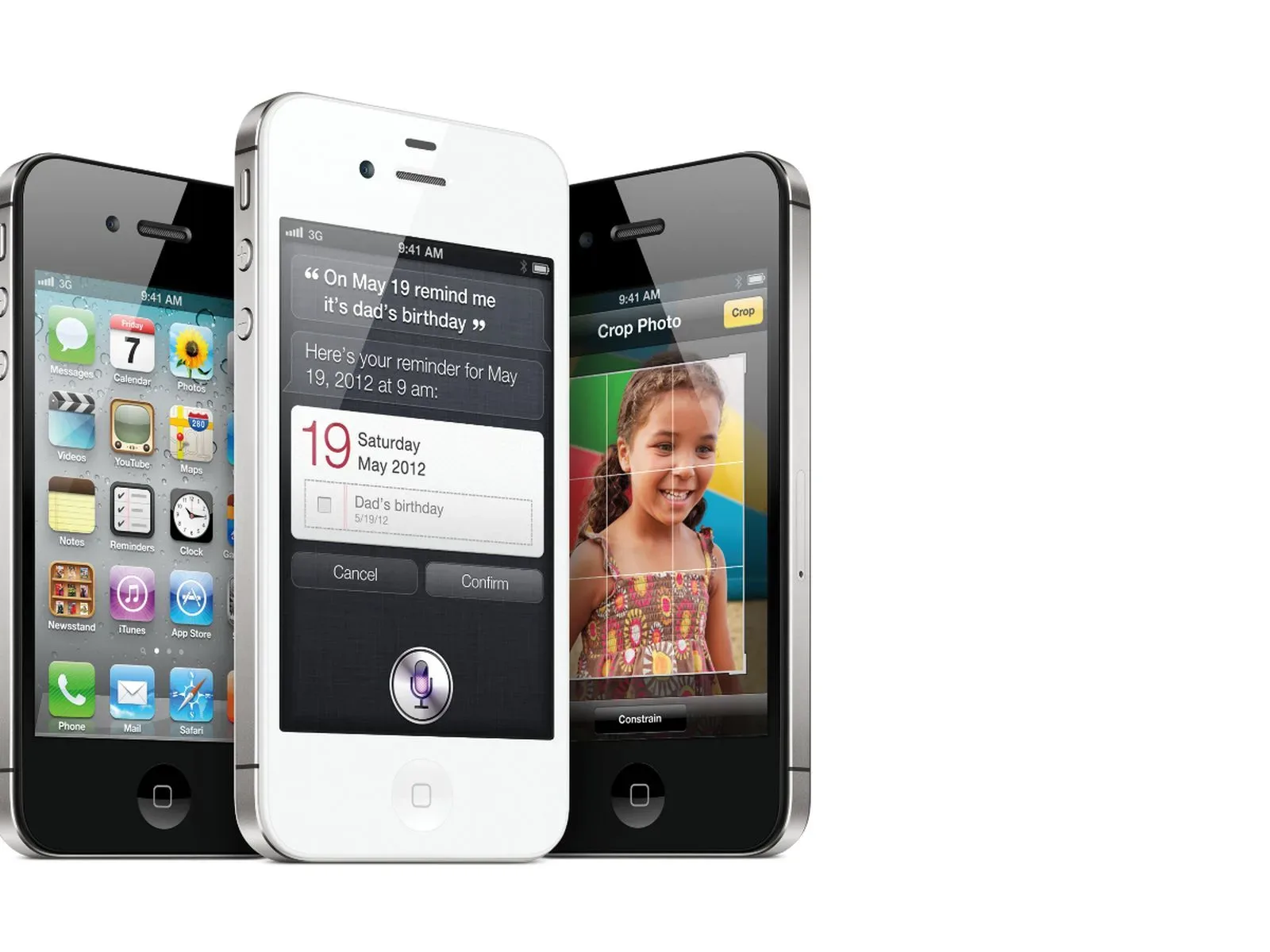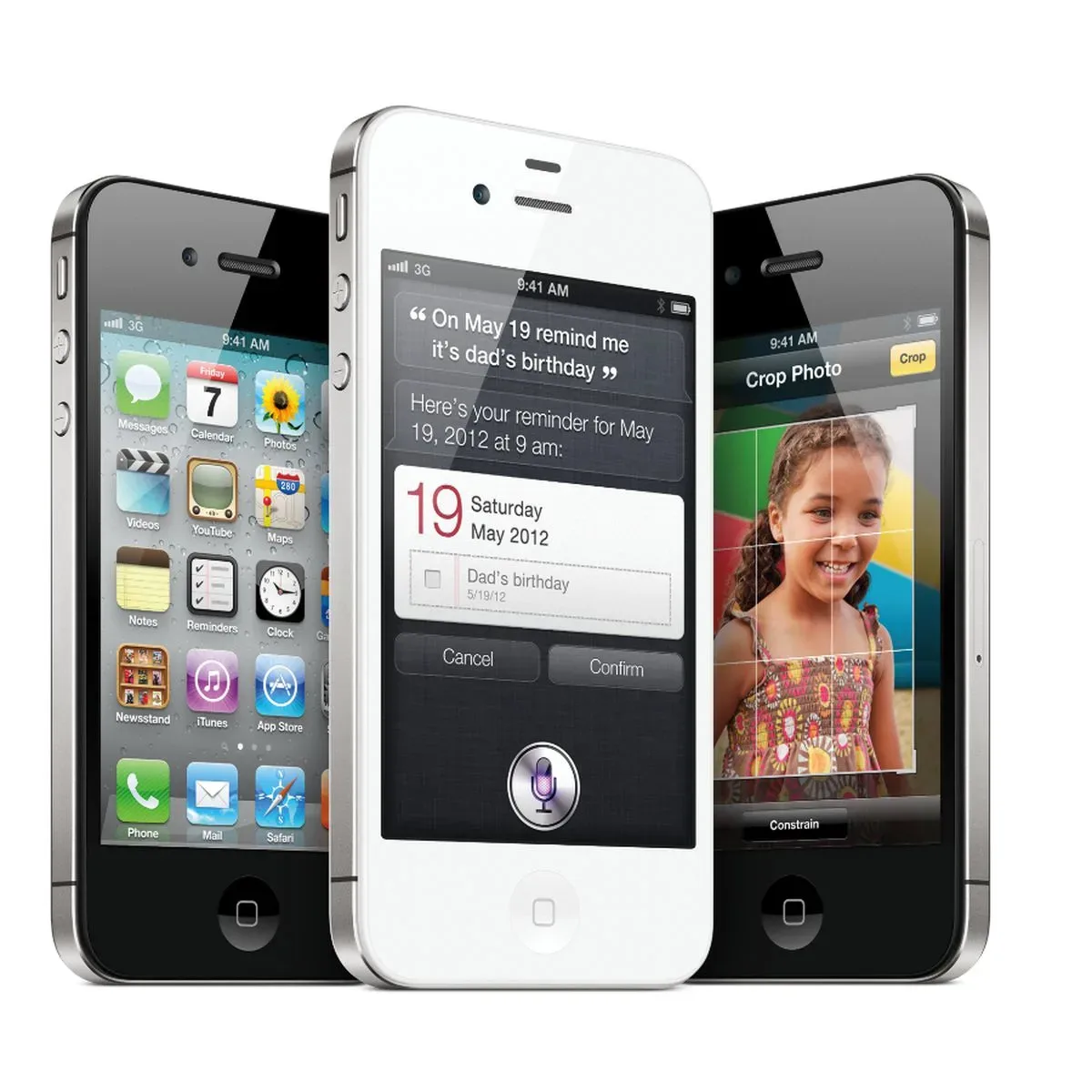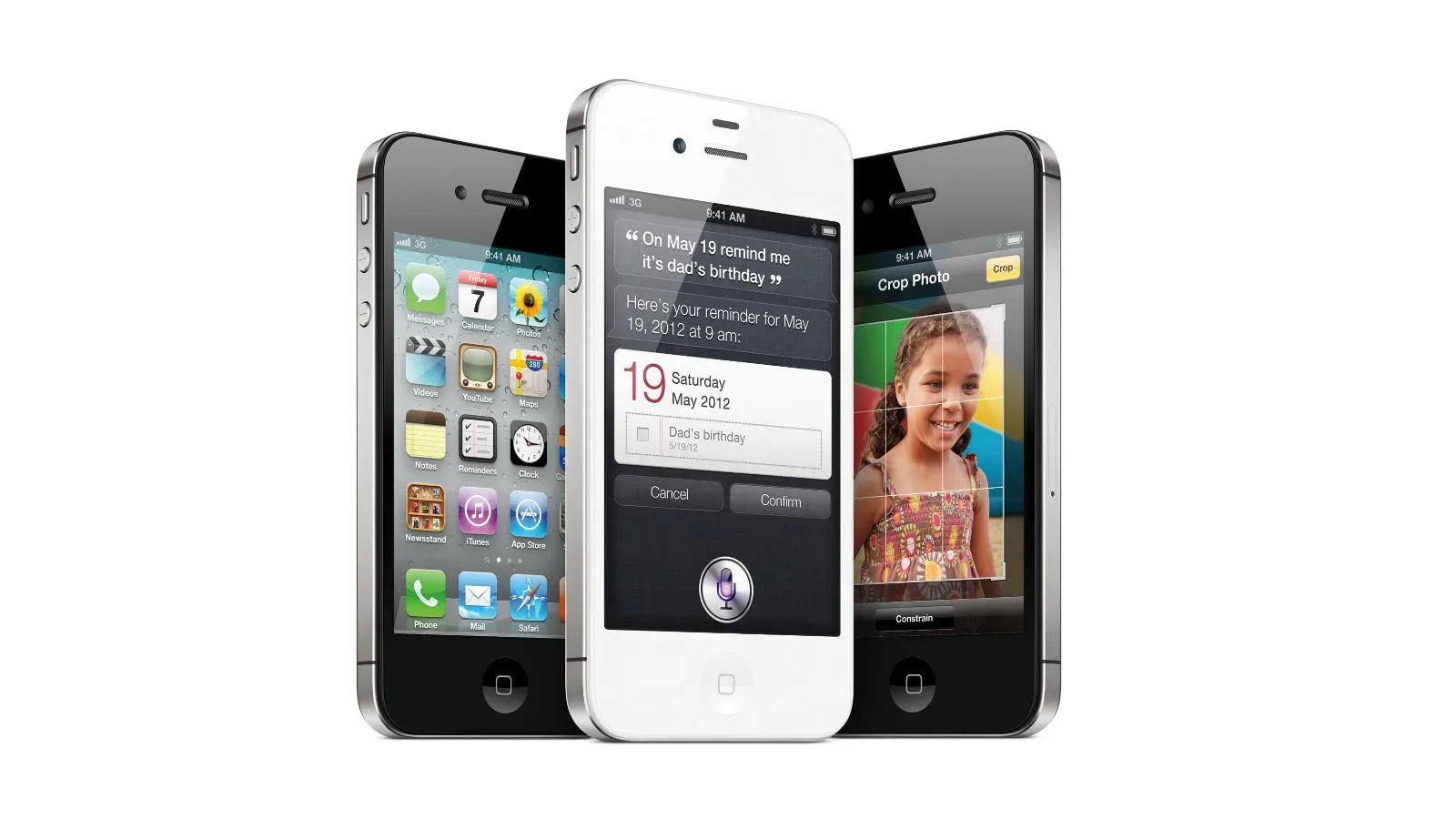
Fifteen years after it reached stores on October 14, 2011, the iPhone 4S remains an unusually clear snapshot of a phone launch built around software as much as hardware. Its exterior retained the iPhone 4’s glass-and-stainless-steel construction, but the 4S added a new built-in voice assistant, faster internals, a substantially revised rear camera and iOS 5.
The headline feature was Siri. It was not merely a microphone shortcut or a command list bolted onto the phone: Apple presented it as an assistant designed to understand requests expressed in natural language and to use context to infer what the person was trying to do. Asking whether an umbrella was needed, for example, could be understood as a request for a weather forecast. That distinction—between issuing a rigid command and phrasing a question conversationally—was central to the iPhone 4S pitch.
It was also a major product transition. Siri had previously been a separate iPhone app, released in February 2010. Apple acquired the company behind it in April of that year, then folded its technology into iOS for the 4S. After the 4S reveal, the original standalone app was removed from the App Store, and its existing users were told the service would stop functioning on October 15.
Siri arrived as a beta feature, and only on the iPhone 4S
The first integrated Siri release was labeled beta. At launch, it supported English localized for the United States, United Kingdom and Australia, plus French and German. It could place calls, send messages, make reminders, schedule appointments and answer questions.
Beta means the feature was released to the public while still being developed and refined. That designation matters when looking back at the launch: Siri was a prominent reason to choose the new phone, but it was also explicitly presented as an evolving service rather than a finished, universally capable system.
Access was tied to the handset. Siri was exclusive to the iPhone 4S, so owners of earlier iPhones could not simply install iOS 5 and receive the new assistant. The arrangement made the assistant both a software story and a hardware-upgrade incentive. The 4S was visually close to its predecessor, but the feature divide was stark: the newest iOS alone did not provide the defining new interaction method on older devices.
That approach helps explain why the 4S has an enduring place in the history of the iPhone. A voice assistant that can interpret intent changes the way a device is described. Instead of focusing only on taps through menus, demonstrations can center on an outcome: send a message, set a reminder, arrange an appointment or find out the weather. Whether every request could be understood perfectly was a separate question; the important launch proposition was that a phone could take a request stated in everyday language and connect it to an action.
The upgrade was more than a voice feature
Under the familiar enclosure, the iPhone 4S moved to Apple’s dual-core A5 chip. Apple said the processor could deliver up to twice the CPU performance and up to seven times the graphics performance of the iPhone 4.
CPU performance concerns the general processing work a phone performs, while graphics performance relates to rendering images, animation and other visually intensive tasks. The figures were Apple’s stated comparisons, not a guarantee that every app or activity would improve by the same amount. Still, the split between CPU and graphics claims shows that the 4S was positioned as a broad internal upgrade rather than a single-feature refresh.
The rear camera rose from five megapixels to eight megapixels, gained an f/2.4 aperture and added 1080p video recording. A megapixel figure describes image resolution, while the aperture is represented by an f-number. Here, the source-supported detail is the specified f/2.4 aperture; it is one component of a camera system, alongside the sensor and software, rather than a complete account of picture quality by itself. The most direct practical changes were the move to a higher-resolution still camera and the availability of 1080p video capture.
Connectivity received attention as well. The revised antenna system could switch between antennas for transmitting and receiving. Maximum supported HSDPA download speed doubled to 14.4 Mbps. HSDPA, or High-Speed Downlink Packet Access, is a mobile data technology; the stated 14.4 Mbps figure describes the device’s maximum supported download rate, not a promise that every carrier connection would achieve that speed in real-world use.
The resulting package made sense as a “same design, changed capabilities” device. It preserved a recognizable physical identity while upgrading processing, graphics, imaging, mobile-data support and voice interaction. Those are distinct parts of smartphone use, and the 4S concentrated its changes in precisely those areas.
iOS 5 supplied the ecosystem around the handset
The iPhone 4S shipped with iOS 5, which had become available two days earlier alongside iCloud. The software release brought iMessage, Notification Center, Reminders, wireless software updates and on-device setup.
These were consequential additions even apart from Siri. iMessage provided a new messaging service within Apple’s software environment. Notification Center created a dedicated place for notifications. Reminders added task-oriented prompts, fitting naturally with Siri’s ability to create reminders from spoken requests.
Wireless software updates and on-device setup are less flashy features, but they point to a practical shift in how a phone could be maintained and started. They reduced reliance on a separate computer for those processes. Combined with iCloud, iOS 5 framed the device as more self-sufficient and more closely connected to Apple’s services.
This is why it is difficult to isolate the 4S as only “the Siri phone.” Siri was the defining new interface, but it arrived amid software changes that altered messages, alerts, reminders, setup and updates. A request made to Siri could create a reminder, for instance, while Notification Center and Reminders gave that result an obvious place in the operating system. The hardware and software announcements were working toward a single idea: making common phone tasks faster to begin and easier to manage.
Launch lineup, contract pricing and early demand
The phone initially went on sale in the United States, Australia, Canada, France, Germany, Japan and the United Kingdom, ten days after its announcement. It was offered in black and white and in 16GB, 32GB and a newly added 64GB storage configuration.
In the United States, the 16GB model started at $199, the 32GB version at $299 and the 64GB option at $399, each with a qualifying two-year carrier contract. Those figures should be read as contract prices, not as the unrestricted cost of the phone. Carrier agreements were part of the purchase conditions attached to the advertised starting prices.
The new 64GB tier is a notable detail because it expanded the storage ceiling available in the iPhone 4S lineup. It also created a straightforward three-step price ladder: buyers could choose 16GB, 32GB or 64GB at $100 increments under the qualifying contract arrangement.
Early sales were substantial. Apple said it sold more than four million iPhone 4S units during the first three days of availability, more than twice the iPhone 4’s opening sales over the same period. The comparison captures the immediate scale of the launch without establishing why each buyer chose the device. The 4S brought Siri, the A5 chip, the upgraded camera, faster supported HSDPA downloads, iOS 5 and expanded storage; the three-day total shows a strong opening response to that combined package.
Why the iPhone 4S still matters in a technology timeline
The iPhone 4S anniversary is chiefly a reminder that new consumer technology can be defined by an interaction model, not just an industrial redesign. Its physical appearance continued the iPhone 4 formula, while its signature change asked users to speak to a phone in a more natural way. At the same time, its camera, processor, graphics capability, antenna behavior and supported download speed all received meaningful attention.
There is also a useful distinction between the device’s historical importance and its present-day practical role. The supplied record establishes the iPhone 4S as a 2011 product with a beta-era Siri and launch-era carrier pricing; it does not establish present-day service, repair or software status. Anyone assessing an older Apple device today should separate its original specification from current support considerations. Apple’s product lifecycle can eventually alter service options, as seen when the company designated the 2017 12-inch MacBook, sixth-generation iPad and BeatsX as obsolete in a separate service-status update.
For the iPhone 4S itself, the enduring story is compact: a phone introduced on October 14, 2011, kept an established design and made a voice assistant the centerpiece of an internal overhaul. Siri’s first built-in iPhone appearance was limited by language, market and device eligibility, and it was openly in beta. Yet it represented a different way to frame mobile computing—one based on stating the goal rather than navigating every step manually. Fifteen years later, that remains the clearest reason the 4S is remembered.