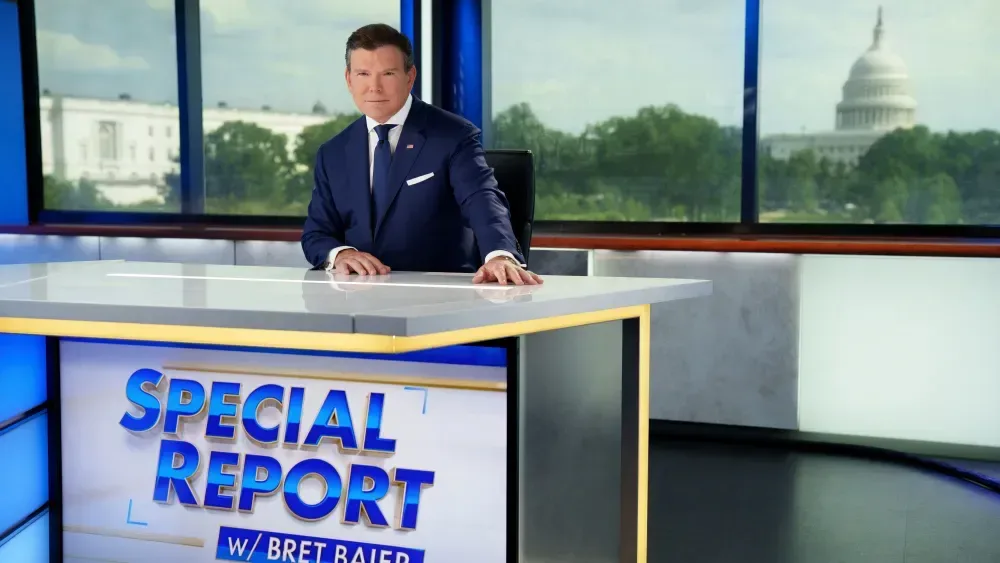
Fox News is putting a sharper public emphasis on its reporting operation ahead of the 2026 midterm elections, with anchor Bret Baier outlining a strategy centered on major interviews, travel to competitive races and an Election Night presentation built around explaining vote data.
The approach matters because election coverage remains one of television news’ biggest live events, even as cable subscriptions decline and audiences increasingly encounter news through social platforms, individual creators and specialized commentators. Fox News remains a major cable-news draw, but it is operating in the same fragmented media environment affecting its competitors.
Baier said he is now pursuing reporting opportunities that would not necessarily have been attempted when he joined the channel in 1998. Recent work included an on-camera interview with Iranian President Masoud Pezeshkian. Baier was also scheduled to speak with entrepreneur Jeff Bezos, and plans to travel before the midterms in hopes of interviewing Senate candidates from both parties.
Interviews are part of the election strategy
The stated focus is not simply on campaign events or studio debate. It is on securing direct conversations with people who can influence the political and public-policy agenda, then pairing those interviews with candidate coverage across the country.
That is a familiar television-news playbook, but it carries added weight in an election cycle. Interviews can give viewers a candidate’s argument in their own words, while also giving journalists an opportunity to test claims, ask about policy and establish differences between campaigns. Their value depends on the quality of the questioning and the context supplied around the exchange; an interview is a reporting format, not a substitute for independent verification.
Fox News has also highlighted news personnel in more visible schedule positions. Peter Doocy and Jacqui Heinrich have received solo weekend hours, while Trace Gallagher leads a weekday news hour. Foreign correspondent Trey Yingst has become prominent both on the linear channel and on social media, and Washington correspondent Bill Melugin is among the reporters cited as part of the network’s field-based reporting bench.
The network has also hosted politicians outside the audience many viewers may assume it reaches. Michigan Democratic Senate candidate Abdul El-Sayed appeared in studio with Martha MacCallum. That does not by itself establish the ideological breadth of a channel’s overall coverage, but it is a concrete example of Fox News seeking access to a Democratic candidate during an election year.
Breaking-news flexibility remains a key programming tool
The channel can replace its 10 p.m. comedy programming with breaking-news coverage when a major story warrants it. That flexibility is significant because it shows the boundary between scheduled personality programming and hard-news coverage is not fixed.
Related coverage includes Fox News Expands News Coverage Strategy Ahead of 2026 Midterms.
For television operations, breaking-news capacity means more than changing the program guide. It requires reporters, producers, control-room staff, guests, video and editorial teams that can rapidly shift from a planned format to live information gathering. Executives describe the organization as able to “swarm” a story quickly, with reporters already located where events are unfolding rather than relying only on sending a New York-based anchor to a developing national story.
In practical terms, that model has two advantages during a campaign season. First, a network can react to an unexpected event in a Senate or House contest without waiting for a scheduled political show. Second, field reporters can deliver local texture that is difficult to reproduce from a studio: the immediate response of voters, the regional stakes of an issue, and the way a national campaign message lands in a particular place.
What a Decision Desk does on Election Night
Baier has described Election Night as the network’s “Super Bowl,” but the underlying job is less about spectacle than arithmetic and explanation. A Decision Desk is the team responsible for assessing vote returns and other election data to determine when a race can be called. Its work is distinct from punditry. Analysts may discuss political implications, but a race call is an evidence-based editorial judgment about whether outstanding votes can plausibly change the result.
That distinction becomes especially important in close or politically charged contests. Fox News faced a major backlash from Donald Trump and his supporters after its early 2020 Election Night call of Arizona for Joe Biden. The network also publicly demonstrated uncertainty and internal scrutiny in 2012, when Megyn Kelly questioned the network’s decision team on camera about projections pointing toward Barack Obama’s reelection.
The lesson for viewers is straightforward: a call does not replace official certification, and an early return is not a final result. Election coverage works best when broadcasters clearly distinguish between votes already counted, estimates about remaining ballots and the legal or administrative steps still to come.
Baier’s stated standard is to explain the numbers as they develop. For an audience, useful numerical explanation includes the share of expected votes reported, the type of ballots remaining, geographic differences among counties or districts, and whether a candidate’s margin is growing or shrinking relative to what remains. Without that context, a percentage bar can create a misleading sense of certainty.
A stable operation in an unsettled media business
Fox News is entering the midterms while several competitors are navigating corporate changes. MS NOW is preparing for its first midterm cycle as part of Versant without NBC News newsgathering. CBS News and CNN are also facing scrutiny over their performance under Skydance, the Ellison family vehicle created from the Paramount and Warner Bros. Discovery combination. Skydance has said it aims to find $6 billion in corporate cuts, primarily through technology, integration and procurement, marketing, and real-estate rationalization; its leadership has said layoffs could result.
Those developments are relevant to campaign coverage because elections demand resources. Political reporting is labor-intensive, particularly when outlets need reporters in multiple states, producers to coordinate live coverage, teams to process polling and returns, and editors to provide timely context. Corporate consolidation does not automatically mean weaker coverage, but budget cuts and organizational change can affect staffing, institutional knowledge and workflow at the moment a newsroom is preparing for a high-pressure event.
Fox News executives say they are not trying to capture a rival channel’s audience so much as serve the one they have built. That is a business position as much as an editorial one. Cable news channels have long cultivated recognizable identities, and it is difficult to persuade viewers to abandon routines formed around particular anchors, shows and political expectations.
The audience challenge goes beyond any one network
Fox News is still the most-watched cable news outlet and often attracts a larger live audience than one or more broadcast networks on a given night. Yet its subscriber base is declining along with those of MS NOW and CNN, a reminder that strong relative ratings and broad structural pressure can exist at the same time.
In the third quarter, Fox News’ total-day viewership fell 16%, while its audience among adults ages 25 to 54 dropped 24%. The 25-to-54 demographic is closely watched because advertisers have traditionally assigned it particular value in news programming. CNN and MS NOW registered small overall-audience gains during the same period. Fox News, meanwhile, is winning its largest percentage of the cable-news audience this year.
These figures tell two different stories. One is about the shrinking size of the conventional cable universe: fewer subscriptions mean fewer potential linear-TV viewers. The other is about share: Fox News can claim a larger portion of cable-news viewing even if its own raw audience declines. Neither measurement alone fully describes the health of a modern news operation.
Digital behavior makes the picture still more complicated. Research cited in the discussion found adults under 30 follow news less closely than other age groups and are more likely to get it through social media. For a television network, that means a polished live broadcast remains important but is no longer the sole product. Clips, reporter posts, short-form explainers and direct exchanges with followers can help a story reach viewers who may never tune in to a cable channel at a set hour.
Fox News says it is adapting by employing journalists accustomed to a less formal social-media environment, particularly recruits from local news. The goal, as described by management, is to use a more formal presentation on television while allowing reporters and anchors to communicate differently on digital platforms.
That balance has consequences. Social posts can offer speed and personality, but they also place a premium on accuracy, clarity and correction practices. A fast clip stripped of surrounding context can travel farther than the segment it came from. During an election, the distinction between a live update, a projection, an unofficial return and a certified outcome must be unmistakable wherever the information appears.
For readers interested in how major television events are expanding beyond traditional distribution, the shift toward streaming around marquee broadcasts is also visible in Disney+’s planned Super Bowl LXI stream in 2027. News coverage faces a different set of editorial demands, but the broader distribution question is similar: audiences increasingly expect high-interest live programming to be available in more than one place.
What viewers should watch in November
Key Senate and House races could change hands, and Fox News expects election coverage to generate a larger audience. The most valuable test of its news-first messaging will be how consistently it pairs live drama with usable explanation.
That means viewers can reasonably look for several things: interviews with candidates from both parties; on-the-ground reporting from consequential states and districts; transparent distinctions between analysis and vote calls; and clear reporting when a race remains too close to project. The political story does not end once a winner is declared, either. Results can expose divisions within parties, including tensions among Democrats if candidates on the party’s left challenge its direction on policy or procedure.
Baier also frames the election season as a chance to hear directly from audiences about issues they care about. For a network, that feedback may inform coverage priorities. For voters, the more important standard is whether coverage gives them enough verified information to understand what is at stake before ballots are cast and what the results actually show once counting begins.