When an electric-vehicle battery comes out of a car, it has not necessarily reached a dead end. A shorter driving range may make it unsuitable for its original job, but the same pack can still hold meaningful capacity for a less demanding one. Its eventual destination depends on inspection results: some packs can be repaired, some can be repurposed for stationary energy storage, and others are dismantled so their materials can re-enter manufacturing.
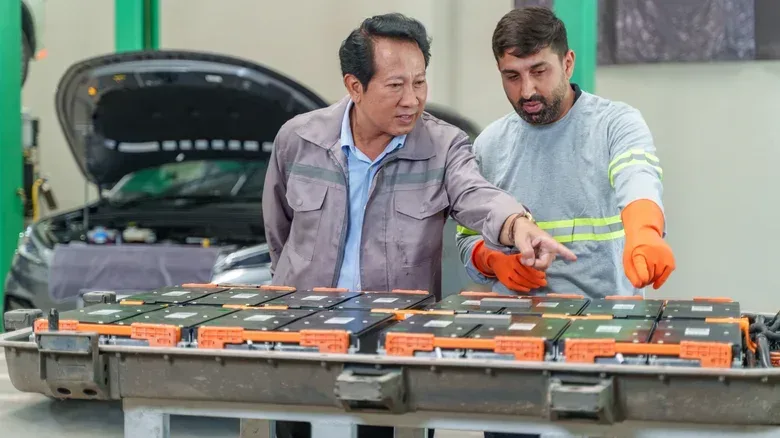
The important point is that removal alone does not determine an EV battery’s value or safety. A pack might be removed because an owner wants the vehicle’s original range back, because it has developed a fault, or because a collision has damaged the vehicle. Those scenarios call for different decisions. Technicians who assess EV batteries examine and test the pack before determining whether repair, reuse, repurposing or recycling makes sense.
The battery pack is more than one battery
It helps to distinguish between a cell, a module and a pack. Individual cells store energy. Those cells are typically arranged into modules, and multiple modules make up the larger battery pack installed in the vehicle. That layered construction can matter after a problem is identified.
In some designs, a technician may be able to replace a faulty module or another component rather than discard the entire pack. If the repaired battery can be made safe and reliable, it may be usable again in a compatible vehicle. This is the most direct way for a battery to remain in transport service: instead of beginning a completely different career, it returns to a role close to the one it had before.
That outcome is not guaranteed. Battery packs vary in how readily they can be repaired, and severe crash damage can make repair impractical. A vehicle declared a total loss after a serious accident is a particularly clear example of why the answer cannot be reduced to “replace one bad part.” Physical damage and the condition of the pack shape what technicians can responsibly do next.
Why reduced range does not automatically mean useless
An EV owner may decide a battery no longer meets their daily driving needs because the vehicle’s range has declined. But driving places a particular demand on a battery: it must provide enough energy in a portable package to move a car over useful distances. A stationary application does not face that exact requirement.
Undamaged retired EV batteries can potentially retain around 70% to 80% of their original capacity. That remaining capacity may be insufficient for the owner who needs the car’s original range, while still being useful when the battery stays in one location. This is commonly called a second life: the pack is moved from a vehicle to a new purpose rather than being immediately processed for its raw materials.
One leading second-life use is stationary energy storage. In plain terms, the battery stops powering wheels and starts storing electricity for later use. It could provide backup power for a building or help balance supply and demand on the electricity grid. California, for example, is using Nissan Leaf and Honda batteries to store solar energy.
That use illustrates why battery health is contextual. The question is not simply whether a pack is as capable as it was when new. It is whether its remaining performance is suited to the job being proposed. A battery that no longer satisfies a commuter’s range expectations can still have a practical role storing energy that will not need to travel anywhere.
Repurposing is an engineering process, not a quick swap
Putting a retired EV battery into a stationary system is more involved than relocating the pack. After inspection, suitable components must be integrated with controls and safety equipment designed for the battery’s new environment. The stationary system needs to manage how energy is stored and supplied while accounting for the pack’s condition and the safety requirements of its new role.
This is why a usable battery is not automatically a financially viable second-life project. Repurposing is costly. If the cost of preparing, integrating and protecting the battery outweighs the expected return, recycling may be the better option even if the pack retains some capacity. In other words, remaining energy capacity is only one part of the decision; the complexity and economics of safely using that capacity matter as well.
For people thinking about household technology, it is also worth separating stationary battery storage from the smart devices that may sit alongside it. A connected display or control product can be part of a modern home setup, as seen in Apple’s HomeView smart hub, but a reused EV battery is fundamentally an energy-storage component. Its purpose is to hold and deliver electricity, not to act as the interface that controls a home.
When repair and reuse are off the table
Some packs cannot be repaired or repurposed safely or economically. That does not mean they have no remaining value. In those cases, the pack is prepared for safe processing and dismantled. Materials including steel, aluminum and copper can be removed and recovered.
The cells then go through further processing. One described route involves shredding and separation, producing a material mixture known as black mass. Despite the name, black mass is not a finished product or a single recovered metal. It is a mixture containing electrode materials from the cells. Those electrode materials require additional processing before valuable ingredients can be extracted.
The exact next steps depend on the battery’s chemistry, meaning the particular material makeup of the battery. Different batteries are not identical, so recycling does not yield the same material amounts from every pack. Heat-based treatment or chemical solutions may be used to recover additional materials. The recovered materials can then return to manufacturing.
The trade-offs behind recycling
Recycling is valuable because it can reduce demand for newly mined resources, lowering environmental impact relative to relying solely on extraction. But it is not cost-free or lossless. Battery recycling requires energy, costs money and involves material losses during processing. The practical goal is therefore not a magical loop where every material returns perfectly and effortlessly, but a system that recovers useful materials where repair or second-life use no longer makes sense.
There is also a sensible order to the possible outcomes. A battery that can be repaired for a compatible vehicle keeps delivering the function it was originally designed to provide. A pack that remains capable but is no longer ideal for driving may be a candidate for stationary storage. A pack that is unsuitable for either route can be dismantled for material recovery. Each path tries to make use of what remains, but none is appropriate for every battery.
What this means for EV owners
Owners should not assume that battery replacement means a single predetermined fate for the old pack. The realistic answer depends on the condition of that specific unit, including whether it is merely degraded, has a fault, or has been affected by an accident. Specialist assessment is central because it establishes whether a safe repair or reuse route exists.
It also means that a battery’s end of service in a vehicle is better understood as a transition point. It may resume use in a compatible car, begin a stationary job helping store electricity, or enter a recovery process that separates materials for future manufacturing. The common thread is that an EV pack can retain utility after its automotive chapter ends—though the amount of work, cost and safety preparation needed determines which next chapter is actually viable.