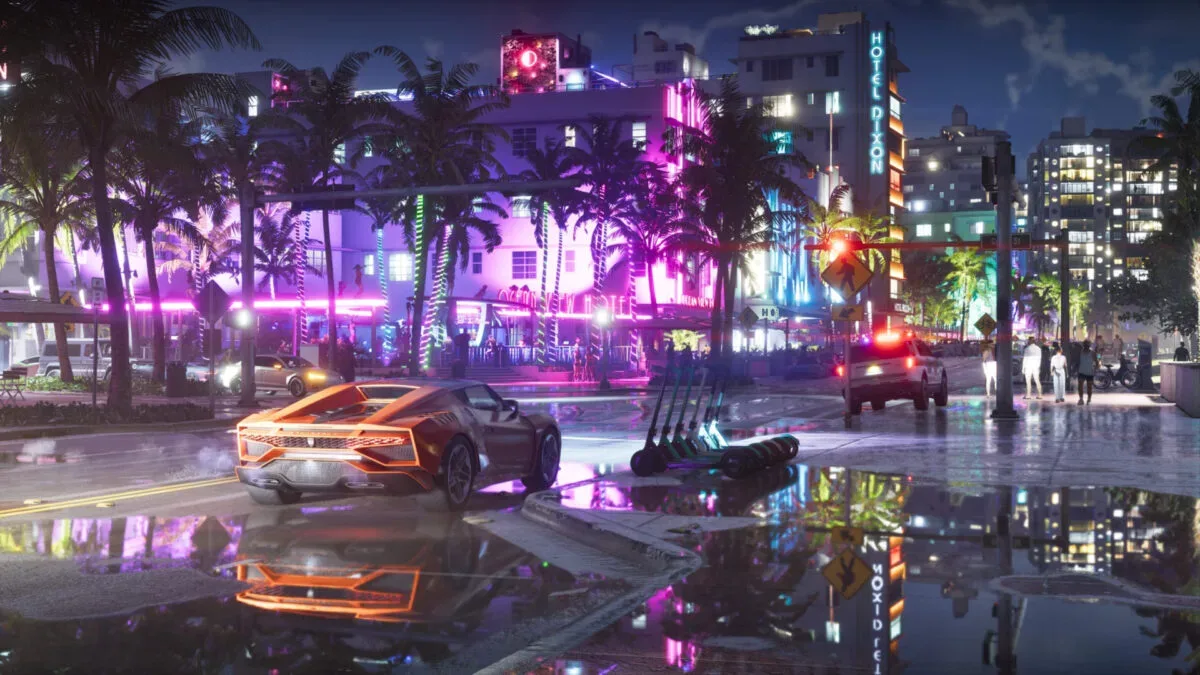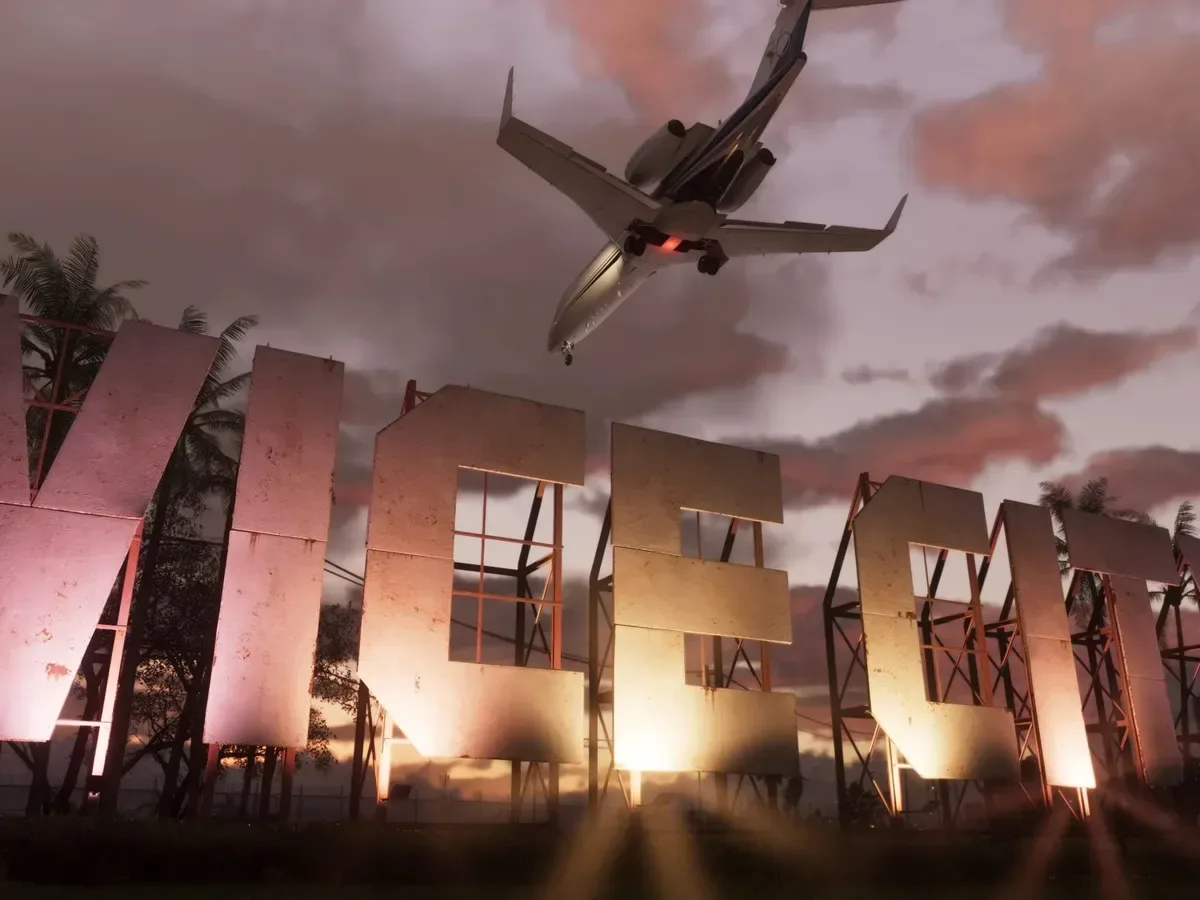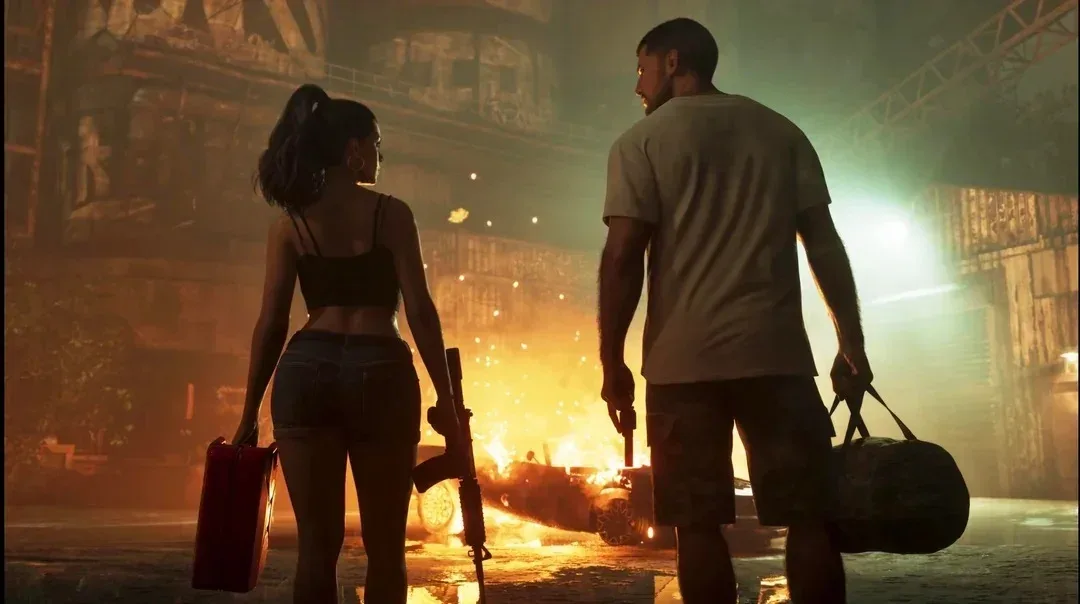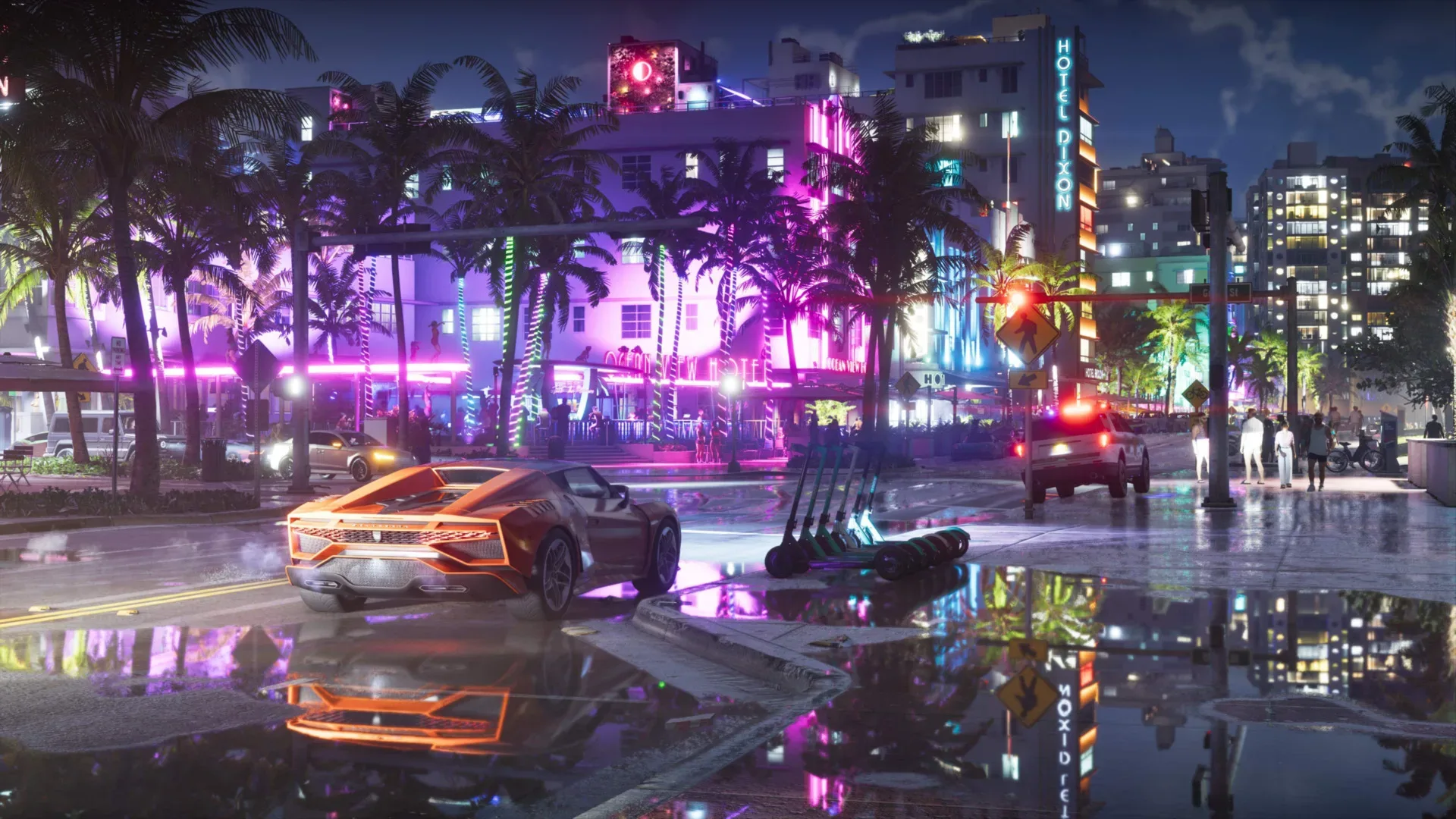
Grand Theft Auto 6 has delivered the kind of screenshot that makes people zoom in until their browser starts negotiating overtime. A newly shared image shows a rain-soaked Vice City street at night, where traffic, pedestrians, puddles and neon signage converge into an unusually convincing slice of humid urban atmosphere.
The image has attracted understandable disbelief. Wet asphalt catches reflections from cars and buildings; the Ocean View Hotel’s neon glow spreads across the street; and the whole scene appears sharply composed enough to invite the immediate question: can the actual game really look like this on console hardware?
The most sensible answer is neither a flat yes nor an accusation of smoke-and-mirrors trickery. It is entirely plausible that the screenshot comes from GTA 6 running in-engine, while also being captured under highly favorable conditions: at a very high resolution, with a carefully selected camera angle and potentially through internal development tools that are not representative of ordinary moment-to-moment play.
That distinction matters. A beautiful promotional image can be real without being a promise that every second of the released game will reproduce its exact clarity, lighting and density.
The scene that started the magnifying-glass marathon
The screenshot depicts a nighttime location in Vice City amid rainfall. Several cars occupy the road, pedestrians populate the sidewalks, and rainwater on the pavement provides the visual centerpiece. Reflections in puddles reproduce pieces of vehicles, nearby lights and the surrounding environment, while the Ocean View Hotel’s sign adds the intense color contrast that makes wet nighttime scenes so attractive in modern games.
Rain is an especially effective showcase for graphical technology because it gives lighting more surfaces to interact with. A dry road might read as a mostly flat strip of dark material. Add puddles, damp patches and bright signs, and the scene gains mirrored highlights, scattered colors and visual depth. That is why a rainy street can look dramatically more expensive than a daytime screenshot of the same block—even when some of the underlying geometry is unchanged.
It is also why still images need a little caution. A screenshot freezes a single ideal instant: the rain is in the right place, the traffic is arranged attractively, the camera is positioned to catch the best reflections, and the viewer is not moving quickly enough to notice temporal artifacts. A game in motion must constantly make compromises that a single static image does not reveal as easily.
The imperfections are more revealing than the neon
Interestingly, the image does not look immaculate once inspected at close range. Its minor shortcomings may be the strongest reason to take it seriously as an in-engine capture rather than a conventional pre-rendered render.
In more distant reflections, viewers can see what appears to be dithering. Dithering is a pattern of noise or dots used to approximate detail that cannot be rendered cleanly at a given quality level. In reflections, it can help disguise limited information, reduce banding or manage the cost of rendering a complex scene. The result may look imperfect under magnification, but it is a familiar trade-off in console graphics.
There also appear to be pedestrians in the far distance without clearly drawn shadows beneath them. That can be another performance-saving decision. Shadows are computationally expensive, especially in a rainy nighttime environment already asking the system to handle artificial lights, traffic, crowds, wet materials and reflective surfaces. Games often reduce, simplify or remove certain effects for distant objects because those details have less impact during normal gameplay.
Zoom far enough into the background, and some people also appear less geometrically detailed than the figures nearest the camera. This is consistent with level of detail, commonly shortened to LOD. Developers use multiple versions of a character or object model: a fuller, more complex version for close viewing and simplified versions for greater distances. The technique is not a sign that a game looks bad. It is one of the basic ways a large open world can fill its streets without bringing performance to a halt.
These visible limitations do not prove which machine created the image. They do, however, fit the profile of a real-time scene operating within practical rendering constraints. A purely polished target render would have little reason to leave such blemishes in frame.
What a debug capture can change
One plausible explanation is that the image was created using an internal debug or photo-capture tool. Developers use debug tools to inspect systems, position cameras, stage characters, adjust a scene and capture material during production. A tool can allow a team to make an image more readable and more dramatic than an unscripted drive through the city.
That does not automatically mean the graphics are fake. It can mean the capture is benefiting from conditions that players may not have during ordinary play. For example, a development setup could prioritize image quality over responsiveness while taking a still, or enable a higher-resolution output for a capture. It could also permit a camera placement that would be impossible during gameplay.
Resolution is central here. A very high-resolution still has more detail to work with before it is compressed, resized and shared. It can make fine rain streaks, wet road texture and distant signage read more clearly than they might on a television during fast movement. A crisp source image also makes lighting appear cleaner, even when the scene contains the same kinds of technical compromises visible in the screenshot.
That is why the most reasonable interpretation is not that the final game will “rarely look good,” nor that every gameplay frame will be indistinguishable from this particular image. The smarter expectation is that GTA 6 may be capable of producing this kind of visual mood, particularly in deliberate nighttime compositions, while actual play will vary with movement, weather, location, crowd density and the performance targets of each platform.
Why wet streets are a particularly hard test
Rainy streets turn a straightforward city scene into a pile-up of rendering problems. Water changes the appearance of the road, lights must illuminate both direct surfaces and reflective ones, and moving vehicles introduce additional changing shapes and colors. The game must decide how accurately each reflection is represented and where it can reduce quality without becoming distracting.
A reflection can be generated in several ways, each with different costs and limitations. The important takeaway for players is simple: reflections are often selectively detailed. The closer, more prominent portion of a street may look persuasive, while more distant reflections may become noisy, simplified or unstable. The apparent dithering in the GTA 6 image is a reminder that even an impressive shot is managing a budget.
Likewise, a busy nighttime scene is not judged solely by pixel-perfect reflections. The sensation of a living city comes from the combined effect of headlights, signs, rain, pedestrians, traffic and color. If GTA 6 maintains the screenshot’s atmosphere while players move through Vice City, the game does not need every puddle to pass a forensic examination at extreme zoom.
What Rockstar’s earlier marketing suggests—and what it cannot guarantee
Rockstar’s past game marketing has generally used in-game or in-engine material. Earlier screenshots for Grand Theft Auto V drew similar suspicion before the final Xbox 360 and PlayStation 3 release demonstrated that the promotional images were broadly representative of the game’s visual direction. Other Rockstar releases, including Red Dead, Bully and Max Payne 3, likewise support the idea that the studio’s promotional captures tend to originate from its own game technology rather than being unrelated cinematic renders.
That history provides useful context, not a technical specification. GTA 6 is a new project, and an image from a controlled capture is still not the same thing as footage of a retail build running through an unscripted sequence. Screenshot discourse gets unhelpful when it treats those two possibilities as mutually exclusive. A capture may be authentic and still be optimized for presentation.
That approach is common sense, not diminished excitement. The visible LOD shifts, distant shadow omissions and reflection noise are exactly the types of signs viewers should look for when evaluating whether a gorgeous promotional still exists within real-time constraints.
What this means for PS5, PS5 Pro and Xbox players
The screenshot alone does not establish the exact hardware or settings used to capture it. It has been suggested that a PlayStation 5 Pro development kit could be involved, but there is no definitive confirmation from the image itself. As a result, viewers should avoid treating the screenshot as proof of a particular PS5 Pro mode, frame rate, rendering resolution or feature set.
What can be said is more limited: Rockstar has shared an image that shows GTA 6 pursuing an extremely high-end nighttime look on current console platforms. The game is set to arrive on PlayStation 5, PlayStation 5 Pro and Xbox Series X, and this scene gives a strong indication of the visual ambition behind its depiction of Vice City after dark.
The Xbox Series S question remains especially open. Nothing in the screenshot identifies a Series S performance profile, and it would be speculation to infer one. Large multiplatform games often require different compromises across hardware tiers, but the specifics here have not been detailed.
The radio reveal quietly adds a useful detail
The screenshot appeared alongside news about GTA 6’s music and radio offerings. Rockstar confirmed that multiple well-known musicians, including Bad Bunny, will host stations in the game. It also confirmed that players will be able to listen to those stations on foot through their in-game phone rather than only while inside a vehicle.
That may seem separate from a rain-soaked street image, but it reinforces the broader goal suggested by the scene: Vice City is being presented as an environment players can inhabit rather than merely race through. Radio extending beyond the car is a small design detail, while the screenshot’s puddles, signs and crowds are visual details; together, they point toward a city where atmosphere is expected to carry across more than just driving sequences.
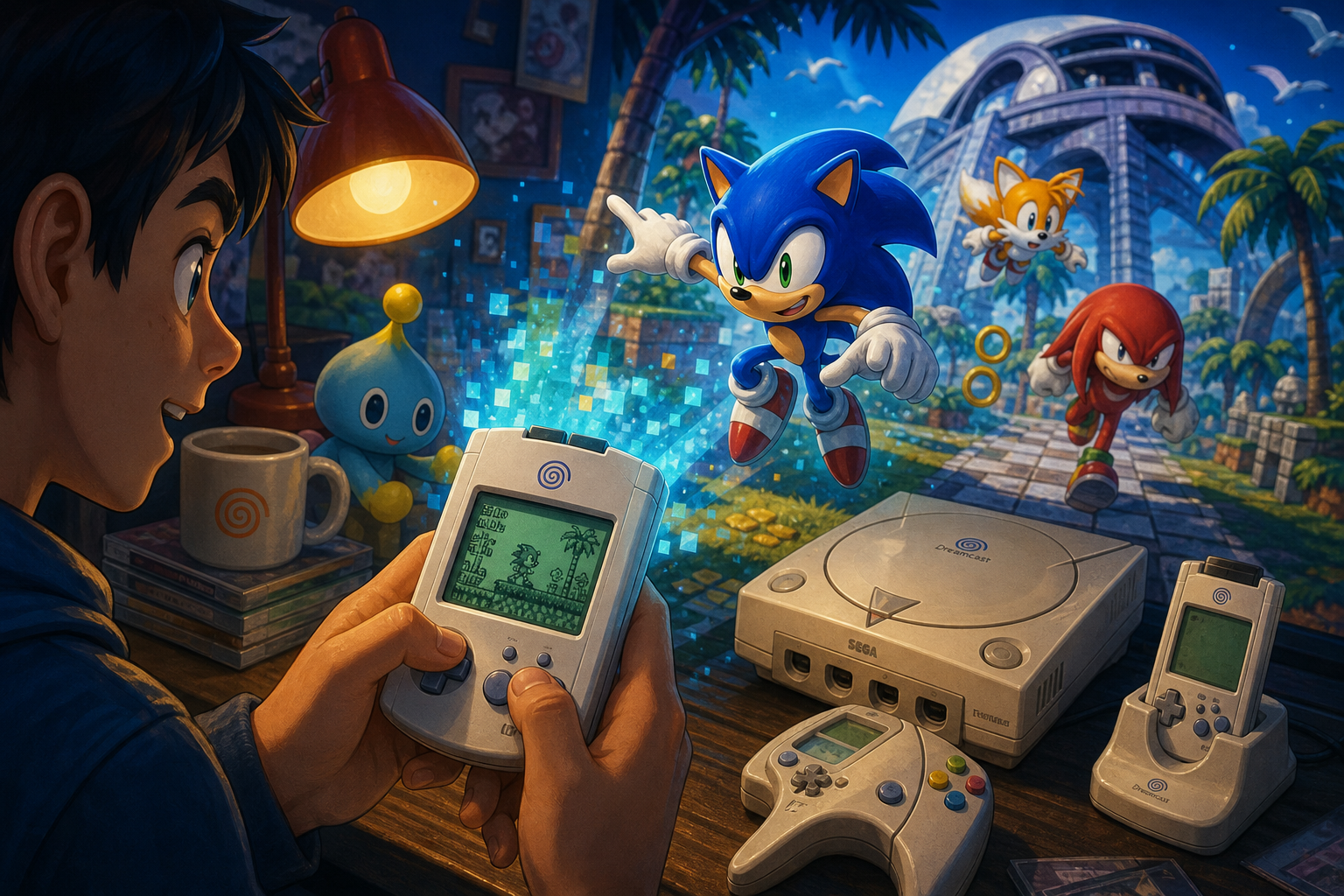
For more perspective on how games can turn a seemingly small piece of hardware into part of their identity, see our look back at the Dreamcast VMU.
Do not let one screenshot become a checklist
The useful way to read the GTA 6 image is as an encouraging technical snapshot, not as a contractual promise about every platform, every weather condition or every frame of gameplay. Its composition is clearly favorable: night lighting, rain and neon give the scene its punch. Its flaws are just as valuable, because they suggest a game balancing visual ambition against the realities of real-time rendering.
That combination is ultimately more exciting than a sterile image with no visible limitations. The screenshot looks remarkable because it presents a believable rain-soaked Vice City with actual texture and atmosphere. The noisy distant reflections, missing far-off shadows and simplified background figures suggest that the image may have been captured from a genuine interactive world—not from a place where every puddle is legally required to reflect perfection.