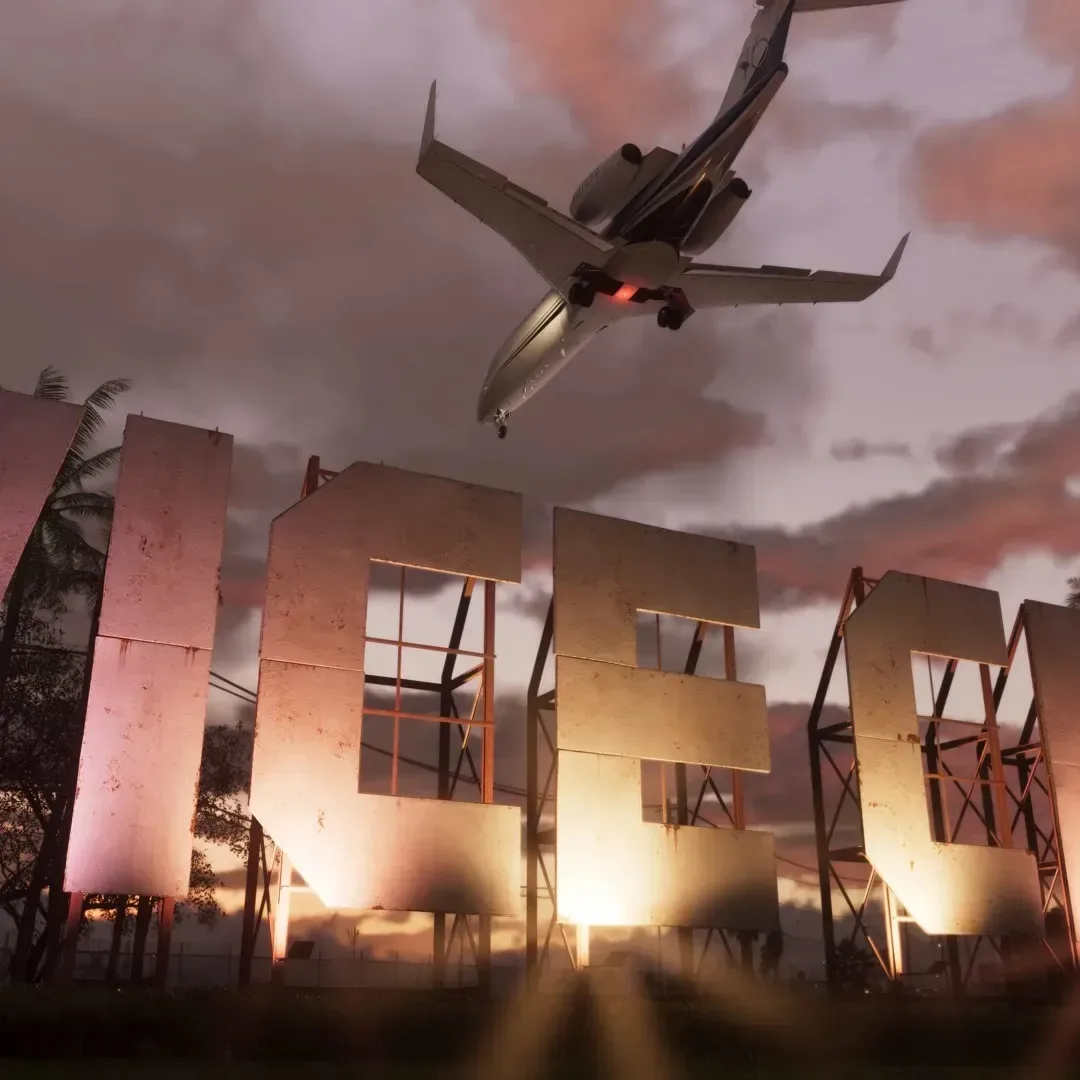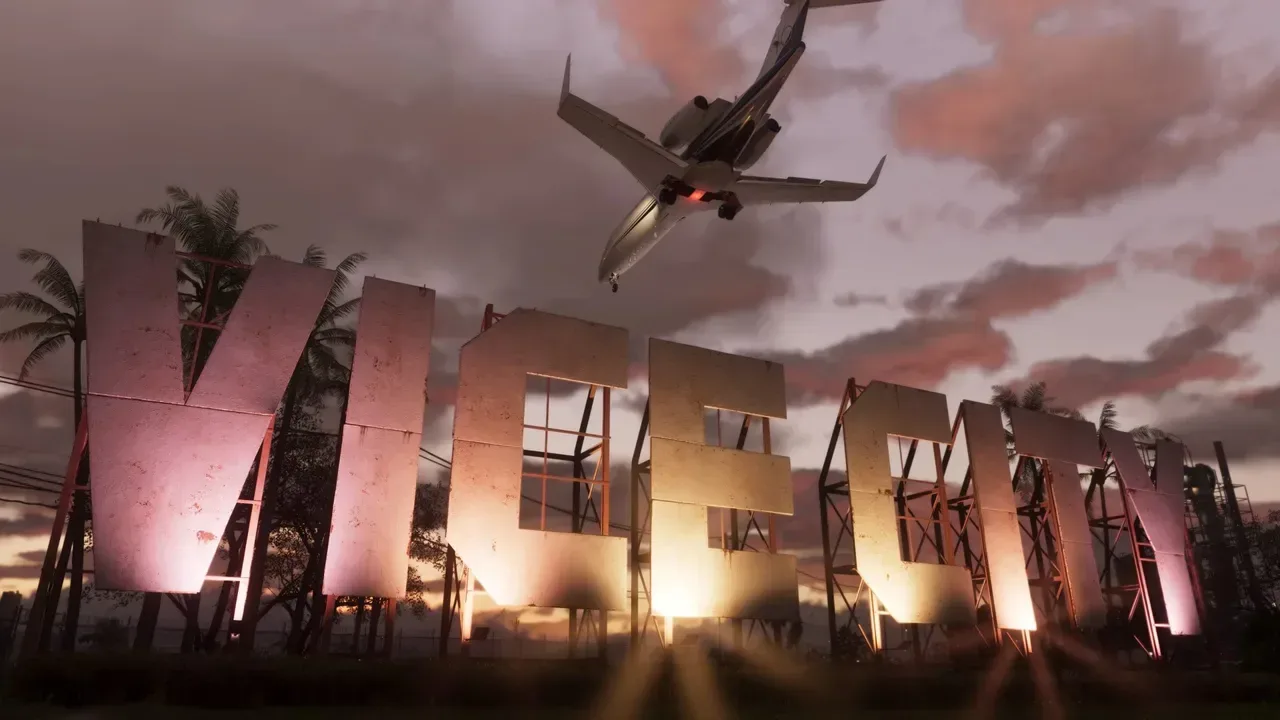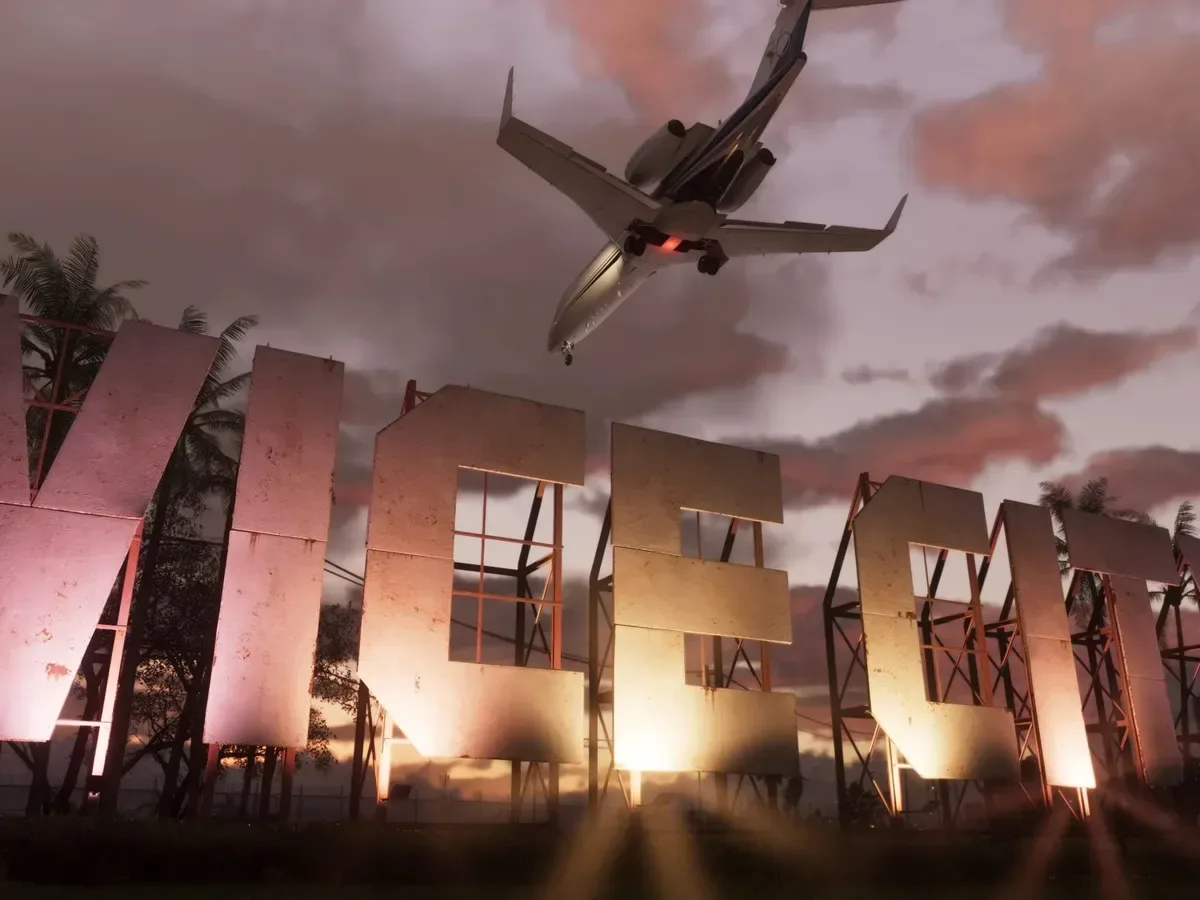
Grand Theft Auto 6 has taken one of its biggest promotional steps beyond trailers and social feeds: a large “Welcome to Vice City” sign has been installed on the roof of Miami’s Kaseya Center. The rooftop display, lifted into place by helicopter after several days of visible construction, turns a real Miami landmark into a conspicuous piece of advertising for Rockstar Games’ next open-world crime game.
The financial scale is just as conspicuous. Miami-Dade is expected to receive $975,000 from Rockstar under the marketing agreement, an amount just shy of $1 million. The sign is already complete, creating a literal skyline-level introduction to Vice City for people travelling above or around the arena.
That physical presence matters because Vice City is Rockstar’s fictional counterpart to Miami. Rather than merely using the city as visual inspiration inside the game, the campaign is now placing the fictional destination back into the real place that informs it. It is an unusually direct overlap between a game world and a real-world cityscape: Miami residents and visitors can see a welcome message for a fictional city while standing in, or flying over, the city that inspired it.
A landmark becomes a GTA 6 billboard
The Kaseya Center is home to the Miami Heat, which gives the placement a meaning beyond the physical size of the sign. An arena is already a location associated with crowds, regular events and television coverage. A roof installation also differs from advertising that must be sought out online: it can enter the background of live shots, aerial footage and travel views without asking an audience to open an app, watch a trailer, or follow a game account.
In marketing terms, this is out-of-home advertising: promotion encountered in a public environment instead of within a game, website, broadcast break, or social-media feed. The available details do not establish how long the display will remain in place or whether it is tied to additional media buys. But its location makes the central idea clear. Rockstar is using a real venue to make the imagined Vice City feel as though it has spilled out into Miami.
The wording is concise, too. “Welcome to Vice City” is not a list of features, a release-date card, or a plot explanation. It functions as an invitation and a location marker. For people familiar with the series, the phrase immediately identifies the fictional setting. For people who are less engaged with game news, the words and their highly visible placement can still prompt the basic question a major campaign needs to generate: what is Vice City, and why is it on an arena roof?
The money and the local debate
The agreement was not presented as a frictionless civic celebration. Miami officials debated whether the city should participate in marketing a game built around crime and one that lets players attack police officers and civilians. That concern goes directly to the tension in the campaign. A city is not simply lending a neutral wall or rooftop to a product; it is becoming visibly associated with a franchise whose subject matter can be deliberately provocative.
Ultimately, the city ruled in favor of moving forward with the campaign. The expected $975,000 payment gives Miami-Dade a clear financial component to weigh against those objections. It also explains why the installation should be understood as more than a spontaneous stunt. This is part of a formal marketing arrangement, one that required conversations with the city and a decision about whether the association was acceptable.
The decision does not erase the criticism behind the debate. Instead, it establishes the position Miami-Dade has taken: the campaign can proceed despite the contrast between tourism-friendly city branding and a game series centered on criminal activity. That contrast is likely part of why the sign has drawn so much attention. GTA 6 is adapting Miami into a satirical fictional world, while Miami itself is now helping announce that world’s arrival.
More Miami promotion was discussed, but not confirmed
The rooftop sign is real and installed. What happens next remains much less certain. Discussions in August reportedly included ideas for events, an airport takeover and other promotional activity. None of those broader concepts should be treated as confirmed plans. They were pitches considered in conversations with the city, not a verified schedule of campaign activations.
That distinction is important when a major launch approaches. Marketing speculation can quickly turn a proposed idea into an assumed event, especially once a public installation has made the campaign impossible to miss. At present, the supported facts are narrower: Rockstar has a marketing agreement with Miami-Dade, the Kaseya Center sign is in place, and additional concepts have been discussed. Whether any event programming, airport branding, or other takeover appears is still unresolved.
For players, that means the sign is evidence of a major local push, not proof that every rumored piece of the proposed Miami campaign will happen. It is reasonable to watch for further activity, but it is not reasonable to present unconfirmed concepts as a promised rollout.
The Miami Heat connection could widen the audience
Kaseya Center’s role as the Heat’s home arena presents an obvious possibility. Miami’s first regular-season Heat home game is scheduled for October 21, and the rooftop sign could be visible in coverage connected to that game. Aerial shots are often useful for establishing an event’s location, and a large message positioned on the building could make any such view especially memorable.
Still, neither a special GTA 6 segment nor a new trailer tied to the game has been confirmed for the broadcast. The possibility is notable because it would put the campaign in front of viewers who may not closely follow game-specific channels. But possibility is not announcement. The available information supports only that the arena hosts the team, that its first regular-season home game is October 21, and that the sign is now physically present on the roof.
If the installation does appear in a broadcast shot, it would illustrate one advantage of the placement: a single piece of physical advertising can work across several settings. It can be seen from the air, noticed by people around the arena, photographed by passersby, and potentially captured by television cameras. That is an inference from the location and visibility of the sign, not confirmation of a defined broadcast plan.
Why the timing is so deliberate
Grand Theft Auto 6 launches November 19 on PlayStation 5 and Xbox Series X|S. With the sign installed in late September and the October 21 Heat home opener falling less than a month before release, the campaign is entering the period when public visibility can become especially valuable. The closer a release gets, the more a short message, a familiar logo, or a striking installation can serve as a reminder to people who already know the game is coming and an introduction to those who do not.
The rooftop display does not reveal a new feature, character, mission, or platform beyond the announced release information. Its significance is instead about scale and intent. Rockstar is spending close to $1 million for a high-profile Miami installation and pursuing a campaign that connects Vice City to the city that inspired it. This is marketing designed to be seen outside the usual spaces where game advertising lives.
There is also a practical lesson in separating what the sign communicates from what it does not. It communicates that GTA 6’s promotional effort is active in Miami, that the game’s Vice City setting is central to that effort, and that local government has approved a paid agreement. It does not confirm a trailer drop, airport promotion, game event, Heat partnership, or further physical installation. Those may remain possibilities, but the completed sign is the only visible element that can currently be treated as settled.
What players should watch for next
- Further official campaign material: The Miami installation raises the profile of the game’s rollout, but it does not itself announce new footage or game information.
- Whether Miami plans expand: Event ideas and airport-related branding were among concepts discussed with the city, but their status remains unconfirmed.
- October 21 arena exposure: The Heat’s first regular-season home game could offer a prominent setting for the sign to be seen, though no special GTA 6 broadcast element has been announced.
- Platform planning: The currently stated November 19 release is for PS5 and Xbox Series X|S.
For now, the Kaseya Center sign is a remarkably tangible signal of the final stretch before GTA 6 arrives. Vice City has always been fictional; the marketing is making sure it is visible over Miami anyway. For more game-release coverage across platforms, see our report on recent standout PC releases and rankings.