Grand Theft Auto VI has brought Vice City into Miami’s skyline, at least in lights. Kaseya Center, the Biscayne Bay arena that hosts the Miami Heat, is now carrying a rooftop display reading “Welcome to Vice City” alongside “VI”, the Roman numeral for six.
The installation is a conspicuous real-world extension of Rockstar’s marketing for its next open-world game. GTA 6 is set in a fictionalized Florida, and its version of Vice City has been designed around recognizable regional touchstones rather than being presented as a literal recreation. Using a major Miami building as the canvas makes that relationship unusually direct: the game’s Florida-inspired setting is being promoted from inside the place that helped inspire it.
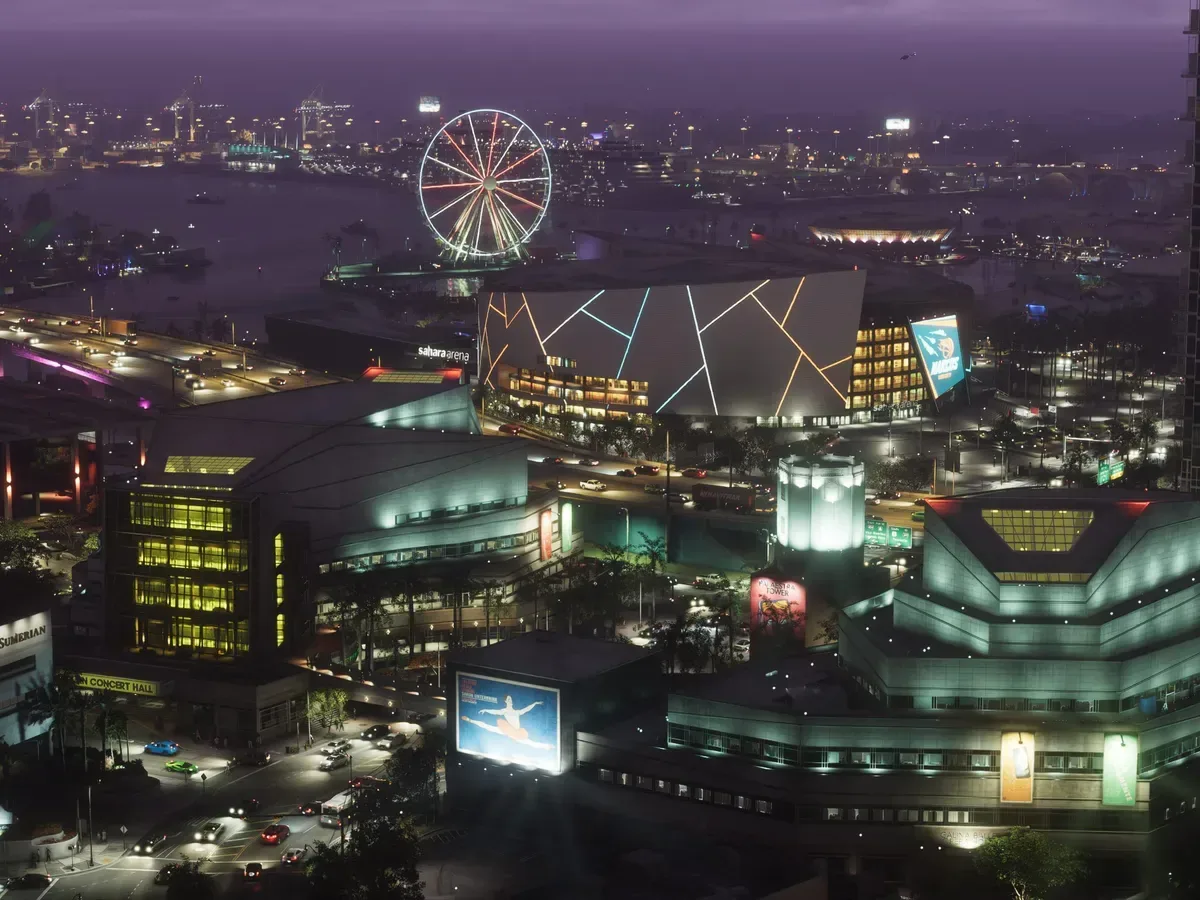
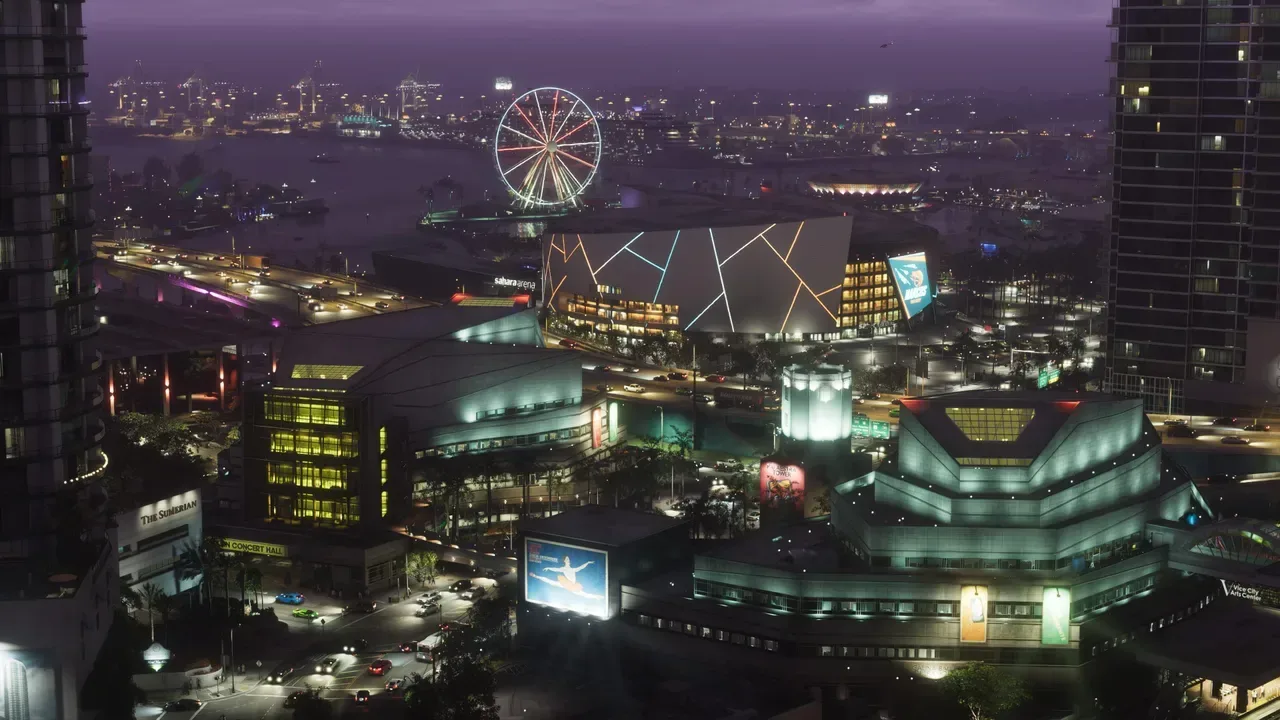
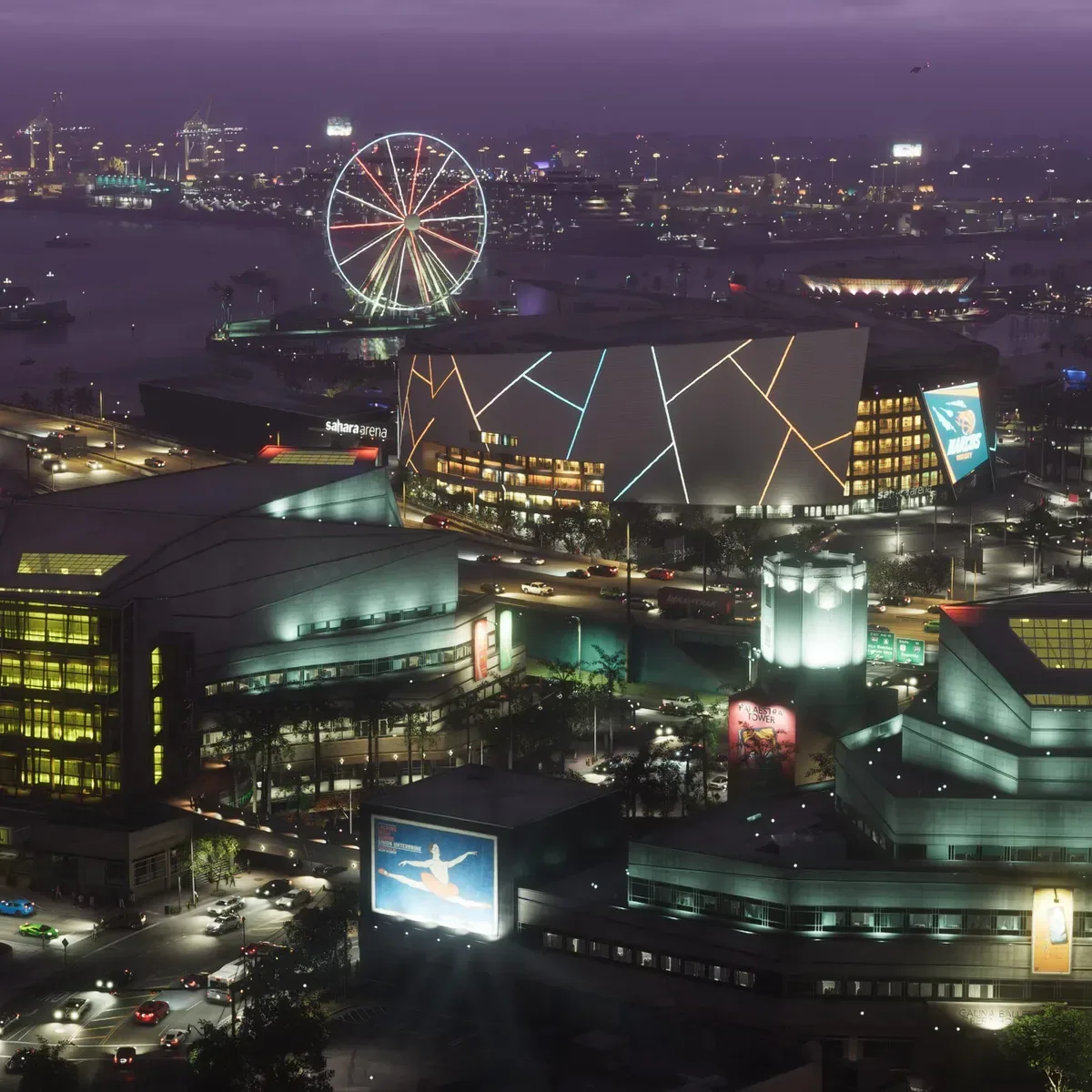
It also turns an arena roof into a point of comparison for players studying the game’s setting. Recent GTA 6 screenshots feature the same real-world building’s counterpart, called the Sahara Arena in the game. It occupies the corresponding part of the city and is accompanied by the same ferris wheel landmark. That alignment is the important detail behind the stunt. The sign is not merely a logo placed on a well-known venue; it draws attention to the game’s approach of translating Miami geography and visual cues into a fictional world.
From Kaseya Center to Sahara Arena
Rockstar’s Grand Theft Auto games traditionally build fictional settings that echo recognizable American cities and regions. In this case, the real Kaseya Center becomes Sahara Arena in GTA 6. The name changes, but the placement and surrounding visual language remain close enough to establish the intended connection.
That is a useful distinction for anyone reading the imagery as a map rather than a one-to-one reconstruction. GTA 6’s city is Vice City, not Miami, and Sahara Arena is not Kaseya Center under a different sign. The available details instead point to a fictionalized counterpart: an invented venue positioned in the same area and flanked by the same ferris wheel. Players can reasonably expect familiar reference points, but the game’s names and its world remain Rockstar’s own.
In practical terms, the display turns that design philosophy into a simple visual gag with considerable scale. Look at the arena in Miami, then look at the arena shown in GTA 6 material: the comparison is immediate. It is a marketing device built around environmental recognition rather than a new gameplay reveal.
Open-world is the term for a game structure that allows players to move through a broad connected setting rather than progress only through a fixed sequence of separate levels. Landmarks matter in that format because they help a city feel legible. They provide orientation, add character to districts, and make an invented space feel grounded. GTA 6’s use of an arena-like landmark and ferris wheel suggests that recognizable silhouettes are part of how Vice City will establish that sense of place.
A Miami plan that was larger than one building
The Kaseya Center activation followed months of discussions between Rockstar and Miami-Dade County officials over a wider Miami marketing takeover. Before the arena installation emerged, possibilities under consideration reportedly included transforming the airport, staging drone shows, and taking over beaches.
Related coverage includes GTA 6 Turns Miami's Kaseya Center Into a Real-World Vice City Welcome Sign.
Those possibilities underline the scale of the proposal, even if they were not the option that became visible in this campaign. An airport, beach, or drone show would have spread the promotion across highly public civic spaces. The arena is more contained, but it remains a major local landmark with an especially clear connection to the game’s city-building.
Fans had noticed work being installed in late September, before the display was fully illuminated. The final sign is reported to have cost Rockstar close to $1 million. That figure should be treated as a reported cost rather than a confirmed detailed budget: no breakdown is provided for installation, lighting, approvals, operations, or any related campaign spending.
Even so, the reported scale explains why the display has attracted attention. This is not simply a digital ad or an image shared online. It places GTA 6 branding in the physical city most closely associated with its fictional setting, creating something residents can see and visitors can photograph. For a game whose promotional appeal includes environmental detail and recognizable landmarks, the location does much of the message-setting work.
Approval came after a close public vote
The Miami-Dade County negotiations were approved in a 4–3 vote by local commissioners. The narrow margin shows that the proposal was not viewed solely as a routine advertising arrangement.
Miami Beach Commissioner David Suarez opposed the plan. Suarez presented footage from GTA 6’s extended look and argued that the game does not reflect local values. The objection places the marketing stunt within a broader and familiar tension around Grand Theft Auto: the series is a mainstream entertainment property, but its satirical and adult-oriented identity can make public association contentious.
Supporters made the opposite case. Commissioner Monica Matteo-Salinas backed the game and described the effort as a win for gamers and gaming enthusiasts. Her support recognizes the cultural visibility of a release on GTA 6’s scale and the appeal of connecting a global game launch with Miami.
“This is a win for gamers and gaming nerds such as myself.”
The disagreement matters because a physical activation is more than an ordinary game advertisement. It involves public-facing property, local government negotiations, and a city whose appearance is central to the campaign. The close vote makes clear that the Kaseya Center display arrived through a debated approval process, not a universally embraced civic celebration.
What the installation does—and does not—tell players
The new display confirms a highly visible piece of marketing, and it reinforces the geographic relationship between Miami and GTA 6’s Vice City. It does not, however, establish new information about missions, activities, map size, playable characters, or how the Sahara Arena functions in the game.
The screenshots and the real-world sign support a narrower observation: Rockstar is emphasizing architectural and location-based parallels as part of GTA 6’s identity. The Sahara Arena’s presence in the corresponding area, together with the nearby ferris wheel, gives players a concrete example of the game’s fictionalized approach to Florida.
That restraint is worth keeping in mind as fans compare screenshots with real sites. A visual analogue can indicate inspiration without confirming every surrounding street, business, or waterfront feature will appear exactly as it does in Miami. The available evidence identifies one arena counterpart and its adjacent ferris wheel; it should not be stretched into a claim that the game duplicates the city in full.
Still, location spotting will likely remain a major part of the lead-up to launch. Rockstar has put a real Miami venue at the center of the campaign and connected it explicitly to Vice City. It invites the audience to look closely at the environment shown in official images—and, later, to see how closely the fictional landscape echoes the real one.
Release date and platforms
GTA 6 is scheduled to release on November 19 for PlayStation 5 and Xbox Series consoles. The Kaseya Center lighting arrives as a location-focused reminder of the game’s setting ahead of that release.
For players, the immediate takeaway is straightforward: Miami now has a temporary, highly visible Vice City welcome sign, while GTA 6’s version of the nearby arena will carry the Sahara Arena name. For Rockstar, the activation demonstrates how a fictional city can be marketed through the very real city that informs it—without abandoning the altered names and satirical distance that define the series’ world.
As other publishers and studios reshape how their teams and franchises are organized, the industry’s largest releases continue to compete for attention in increasingly public ways; that wider business context can be seen in Massive Entertainment’s new role as Ubisoft’s home for The Division, Ghost Recon and Splinter Cell. GTA 6’s Miami display is a different kind of move: not an internal restructuring, but a costly physical statement that its fictional Florida is ready to occupy the real skyline.